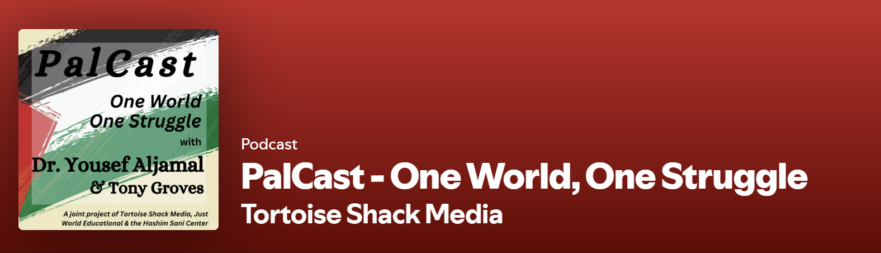
On a January evening, an episode of PalCast comes together like this: Dr. Yousef Aljamal logs on from Istanbul, Türkiye, where it’s already dark. Tony Groves joins from Dublin, nursing the day’s second cup of coffee. Helena Cobban dials in from Washington, DC. And for this particular conversation, Norma Hashim is there too, connecting from Istanbul on a rare visit, having flown in from Kuala Lumpur. Within the hour they’ll be talking about the ICJ case, Malaysian solidarity with Palestine, and their mutual friend, Dr. Refaat Alareer, before signing off so Yousef can, as he puts it, “talk to you next week.”
This is what an ordinary week looks like for PalCast, the podcast sponsored by Just World Educational, the Hashim Sani Centre for Palestine Studies, and Tortoise Shack Media. Most weeks, the fourth voice in the room isn’t in Ireland, Türkiye, or the United States at all — it’s in Gaza, or in the diaspora that Israel’s decades of restrictions have scattered across the world. A podcast built this way, spanning continents to make room for people whose stories might otherwise go unheard, doesn’t happen by accident. It happens because a handful of people in a handful of countries decided, in the darkest days of a genocide, that it mattered enough to keep doing every single week.
How it began
PalCast started in late October and early November of 2023, in the earliest, most disorienting weeks of Israel’s still ongoing genocide on Gaza. “We had no idea about the depth of the destruction that Israel would be able to inflict on Palestinian lives and society in Gaza,” Helena recalls. “(We still don’t. The genocide still continues.)”
Helena, president of Just World Educational, had worked closely with Yousef for more than a decade by that point, which made him “Just World Ed’s natural choice to lead the project.” Yousef, in turn, brought in Tony, an Irish podcaster he knew could handle the production side. Helena was one of the show’s main hosts in those first months and still joins occasionally; Yousef and Tony have carried it forward ever since, week after week, interviewing Palestinians about their lives, their losses, and their hopes.
What began as an improvised response to catastrophe has become something closer to an institution: a continuing, dated record of what the Gaza genocide has done to a society, told largely by the people living through it.
The people behind the podcast
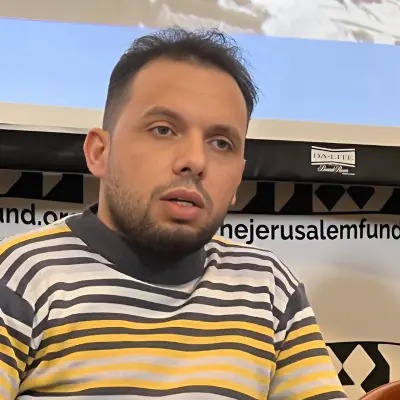
Dr. Yousef Aljamal is the show’s driving force. A Palestinian refugee based in Sakarya, Türkiye, he is also the one who finds most of PalCast’s guests, which a task that depends entirely on the relationships and trust he’s built over years inside Gaza and across the Palestinian diaspora.
It’s Yousef who reaches a teacher still working in a school with no windows, or a journalist filing dispatches between airstrikes, and persuades them to spend an hour talking into a laptop microphone about what’s actually happening to them. Without that access, PalCast would simply have less to work with; with it, the show reaches people whose experiences would otherwise struggle to break through the noise of the news cycle.
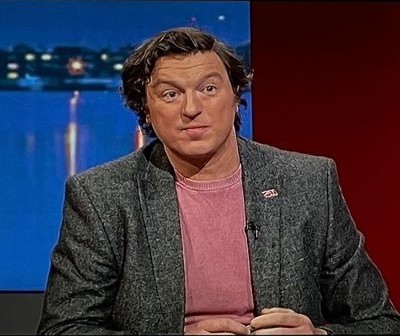
Tony Groves, of Tortoise Shack Media in Dublin, is PalCast’s producer and Yousef’s regular co-host — and the person quietly making sure a podcast recorded across three or four time zones, often with a guest on a patchy Gaza internet connection, actually gets made and gets heard.
That work rarely shows up on air, but its absence would be obvious immediately. What does show up on air is the rapport between Tony and Yousef, built over roughly two years of weekly recording.
Introducing one Gaza-based guest, a journalist and engineering student who’d also started a small novelty sock business, Yousef couldn’t resist a dig: “This reminds me of Tony’s Christmas socks.” When the same guest explained why he’d chosen engineering over the journalism he was already good at — “engineering is the power of act… as a journalist you will only record it” — Tony jumped in with the deadpan local truth: “in Gaza, you can only be an engineer or a doctor… anything else, you’re in trouble.” It’s a small moment, but it says something real about how the show works: two men who trust each other enough to joke, in the middle of talking about a genocide, without ever losing sight of why they’re there.
Tony described what the show means to him directly: “PalCast has been an anchor for me in all the turbulence. The relentless horror and sense of hopelessness never really goes away, but for an hour, as Yousef and I chat to a friend we are about to make in Gaza, I get a sense of fulfilment.” At the end of one episode, unprompted, he put it even more simply: “It is an absolute privilege to work with these two. I don’t understand how I even got involved.”
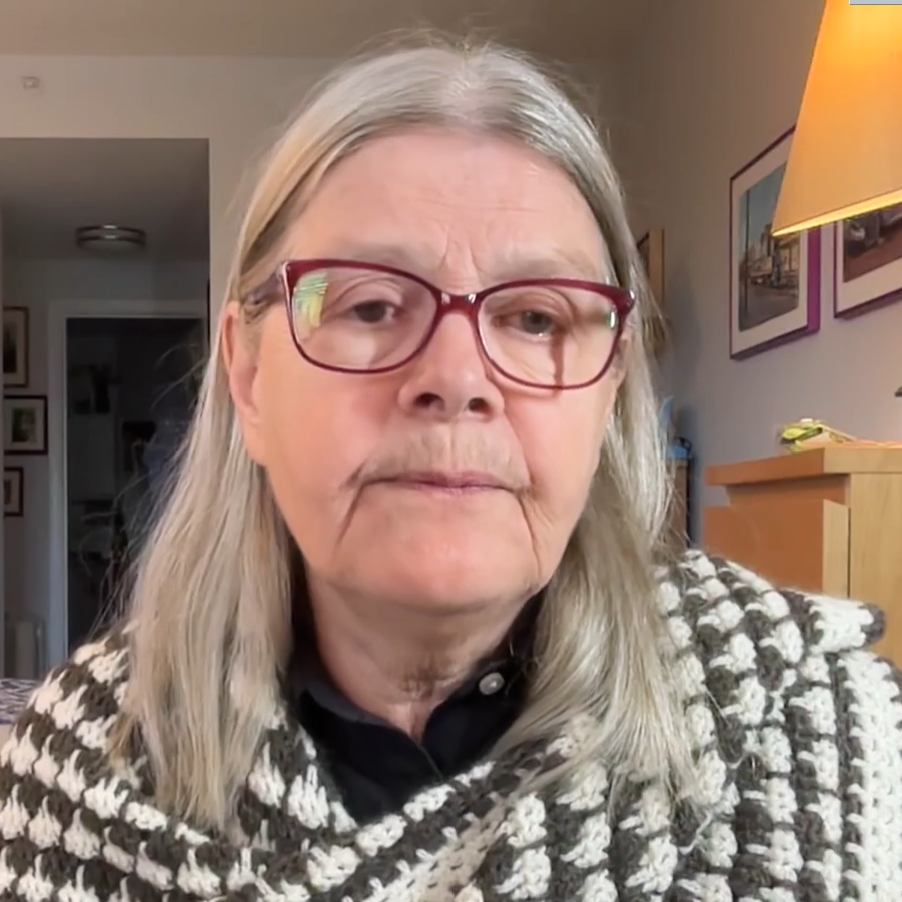
Helena Cobban, president of Just World Educational in the United States, helped launch PalCast and now hosts occasionally. Beyond the microphone, JWE has increasingly supported the show’s reach by posting full-length video episodes and shorter clips to its YouTube channel — work Helena credits to Yousef and Tony’s encouragement. She is candid that the show’s future direction is mostly Yousef’s to chart, not hers to dictate, which says a lot about how the collaboration actually functions: less a hierarchy than a division of trust.
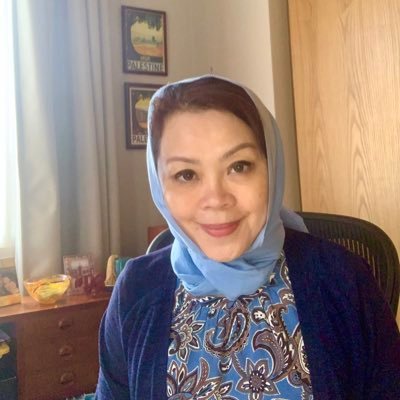
Norma Hashim, funder and founder of the Hashim Sani Centre for Palestine Studies at the University of Malaya in Kuala Lumpur, is the podcast’s co-sponsor and was the podcast’s guest herself once. Her connection to the project runs deeper than a sponsorship line.
She had known Refaat Alareer, the Gaza writer, teacher, and mentor to Yousef who was killed by an Israeli strike in December 2023, for years before the genocide began; she met him in Malaysia in 2013 at the launch of a book of Palestinian prisoners’ writing, and he stayed on to do his PhD there.
On the appearance she has made on PalCast, joining from Istanbul alongside Yousef, Tony, and Helena, Norma drew a line from Malaysia’s own colonial history to the reaction in Gaza after October 7: “we as Malaysians we know what it’s like to be colonised… it’s a wake up call not just for Palestinians… but also for people throughout the global South.” It’s exactly the kind of connection PalCast exists to make audible.
The voices of PalCast
The range of people who’ve sat across from Yousef and Tony is wide, and that range is the point. Political analyst Muhammad Shehada and third-generation refugee, artist, and academic Dr. Shahd Abusalama have unpacked the politics and history surrounding Gaza. Ambassador Chas W. Freeman Jr., a retired American diplomat, and Balakrishnan Rajagopal, the UN Special Rapporteur on the Right to Adequate Housing, have placed the crisis inside the machinery of international law and diplomacy.
Journalists Zena Tahhan and Leila Warah have discussed displacement and erasure in the occupied territories; Saul Takahashi, formerly of the UN’s human-rights office in Palestine, has brought an insider’s view of that institution’s limits.
But it’s the guests speaking from inside Gaza itself who give the show its centre of gravity. Arwa Alzraiy, a Durham University PhD candidate who returned to Gaza to collect research data just before the war began and has been there ever since, described teaching displaced students in a school with no chairs, no blackboards, and windows shattered to nothing — “we just painted the wall black.”
She spoke of walking students home and being told, matter-of-factly, which streets were about to be evacuated, and of timing the walk so the children wouldn’t be roped into hauling water from the municipal supply. Curriculum materials, she explained, have to be reviewed and approved by Israeli authorities before they can be taught; religion and social studies have been dropped altogether. And yet, she said, of her decision to stay: “I found peace in the fact that I am here as a Palestinian living through this with the other Palestinians that are my friends, my neighbours, my family.”
Hussam Tannera, a teacher and father living around 700 metres from Gaza’s shifting “yellow line,” described a landscape stripped of the trees Israeli forces cleared and residents later cut for firewood, until the strip of Gaza still under Palestinian control took on a permanent yellow-brown haze — “Gaza is now yellow.”
Even so, mid-genocide, he applied for an Ireland-Palestine scholarship, determined to keep believing “everything’s going to be okay.” An eight-year-old named Banias Ayesh, interviewed with her mother on the eve of Christmas, talked about missing her old school, living in a house that isn’t hers, and still dreaming of visiting New York one day. None of these are stories about victims with nothing left; they are stories about people insisting, often in small and specific ways, on staying whole.
A record of Palestinian experience
Yousef has described what all of this adds up to in stark terms: “PalCast has been a powerful platform for Palestinians to tell their own story during the genocide in Gaza when narrative has itself become a weapon of war… It meant preserving a history that would otherwise have been erased. PalCast has been an act of witness.” He sees no end point for that work “as long as the genocide continues in Gaza.”
Tony frames the same instinct differently, but toward a similar end: he wants PalCast to become “an audio library of stories that ultimately tracks the story of the Gaza genocide to the reemergence of Gaza and Palestinian liberty.” The show’s tribute episode for Refaat Alareer, recorded a year after his death, gathering voices from Ali Abunimah to Yousef himself to a Cambridge PhD student he’d once helped buy course books she couldn’t afford, is perhaps the clearest example of what that library is for: not just documenting loss, but keeping specific people, in their specific fullness, from disappearing into a casualty count.
A genuinely international collaboration
Strip away the individual episodes and what’s left is a structure that is, frankly, unusual: an Irish production house, a Turkish-based Palestinian academic, a Malaysian research centre, an American nonprofit, and a rotating cast of guests scattered from the Gaza Strip to London to wherever the diaspora has landed, all coordinating, week after week, around a shared conviction that the story needs telling.
Helena calls it the show’s “globe-girdling” character, and it’s hard to find a better word for it. Each institution brings something the others don’t have: JWE’s platform and distribution, Tortoise Shack’s production expertise and its own activist audience in Ireland, the Hashim Sani Centre’s academic grounding and its reach into Southeast Asian solidarity networks, and Yousef’s irreplaceable access to Gaza and the diaspora. None of it would hold together without the trust between the people running it.
Looking ahead
Neither Helena nor Tony treats the current phase as PalCast’s final form. Helena is hopeful that the international campaign to end the genocide and Israel’s control over Gaza and the West Bank “can bear real fruit within the next two years,” at which point, she suggests, PalCast “can be transformed into a forum for brainstorming how Gaza can best be rebuilt.”
Tony’s audio-library metaphor points toward the same horizon — a record that runs from catastrophe through to “the reemergence of Gaza and Palestinian liberty.” But both are clear that this is a future to work toward, not a present to assume. For now, as Helena puts it, the task is to keep doing what Yousef already does: “foreground the lived experiences of as many as possible of Gaza’s amazing, resilient people.”
One world, one struggle
PalCast’s slogan is easy to read past, four words that could sit on any activist banner. But listen to a few episodes back to back, to Yousef in Türkiye and Tony in Ireland drawing out a guest in Gaza while Helena weighs in from the opposite side of the planet, and the phrase stops being a slogan and starts being a description.
The struggle it names isn’t abstract solidarity; it’s a teacher in Deir al-Balah, a producer in Dublin, an academic in Kuala Lumpur, and a nonprofit in Washington, all showing up to the same conversation, week after week, because someone has to keep the record. As Norma put it, simply: “PalCast has been a constant voice of Gaza and Palestinians throughout this genocide.” It still is.