
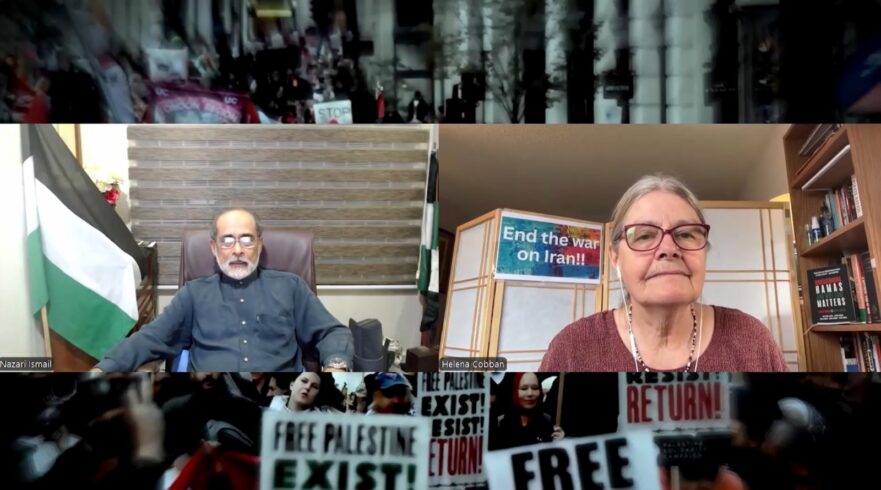
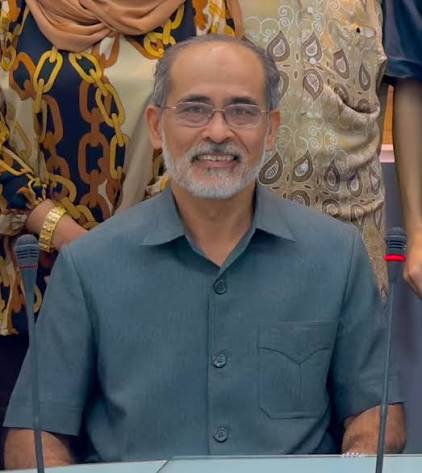
The Hashim Sani Centre for Palestine Studies has published a new video interview on its YouTube channel featuring JWE President Helena Cobban in conversation with Professor Nazari Ismail, Director of the Hashim Sani Centre for Palestine Studies at Universiti Malaya. Recorded as events in Michigan’s Democratic primary were unfolding, the wide-ranging discussion covered shifting political currents in the United States, the state of the US-Iran war, Israel’s escalating pressure on Lebanon, and the deteriorating situation in Gaza under the so-called ceasefire. Prof. Nazari opened by asking Cobban to make sense of a fast-moving news cycle, and she offered a detailed, first-hand analysis grounded in decades of reporting on the region.
Much of the conversation focused on an unprecedented shift inside the Democratic Party in the United States. Cobban pointed to Zohran Mamdani’s New York City victory and physician Abdul El-Sayed’s strong showing in Michigan’s Senate primary against an AIPAC-backed opponent as evidence of a new generation of candidates willing to champion Palestinian rights. She noted that Michigan, home to a large Arab-American population, had been “the center of the movement” inside the party that refused to back Biden and then Harris over their support for the war on Gaza. Cobban described this energy, often associated with the Democratic Socialists of America, as something she had never seen in her decades in the country, while also observing a parallel, if smaller, fracture inside the Republican Party, exemplified by commentator Tucker Carlson’s public break with unconditional support for Israeli actions.
Turning to the US-Iran war, Cobban argued bluntly that Trump and Netanyahu’s strategy had failed. The February 28th attack, she explained, had been premised on the hope that a “decapitation” strike would trigger the collapse of Iran’s system of governance, a plan she said drew on years of Israeli preparation that ultimately went nowhere. She traced Iran’s resilience back to the Iran-Iraq war of the 1980s, when the Islamic Revolutionary Guard Corps began building deeply buried military infrastructure across the country’s mountainous terrain. According to Cobban, Iran has since combined this resilience with a deliberate strategy of deterrence and “compellance,” using precision strikes to warn Gulf states against aiding US attacks. She cited reports that Saudi Crown Prince Mohammed bin Salman had told Trump to “just shut up” and threatened to pull Saudi investment from US treasuries if the war escalated further.
On Lebanon, Cobban was equally direct, describing the internationally brokered talks in Rome between Lebanese and Israeli representatives as “a pantomime” carried out under Saudi and American financial pressure despite lacking any real mandate from Lebanon’s parliament or cabinet. She linked Israel’s campaign of destruction in Lebanon to the same “dahiya doctrine” of mass demolition first developed against Beirut’s southern suburbs in 2006 and later applied throughout Gaza, using the term “omnicide” to describe what she called the deliberate destruction of everything in its path. Even so, she suggested Israel’s position in Lebanon was ultimately unsustainable given weakening American backing.
Discussing Gaza itself, Cobban described a ceasefire that has functioned as a “strangle hold” over the territory’s more than two million remaining residents, with Israel restricting humanitarian access even as Palestinian casualties continue to mount. She detailed Hamas’s renewed offer, led by newly elected political bureau chief Khalil al-Hayya, to hand its heavy weapons to Gaza’s National Council for Administration rather than to Israel, contingent on an Israeli withdrawal to the agreed “yellow line.” Cobban was sharply critical of the UN Security Council’s decision to hand control over Gaza to the US-led Board of Peace, calling it a moment that effectively signed “the death notice for the United Nations as a whole,” and pointed to the upcoming UN General Assembly session and US midterm elections as key moments that could shift the balance.
Despite the grim realities she described, Cobban closed the interview on a note of cautious optimism, invoking Antonio Gramsci’s observation that the world exists in “a time of monsters” between an old order dying and a new one struggling to be born. She pointed to growing American public fatigue with the cost of the war, a wave of Israeli emigration, and the possibility that the UN’s next secretary-general could be backed by Beijing rather than Washington as signs of a shifting global balance. You can now watch the full interview on YouTube. Watch, share, and help spread this timely conversation on Palestine, Iran, and the future of US policy in the region.