
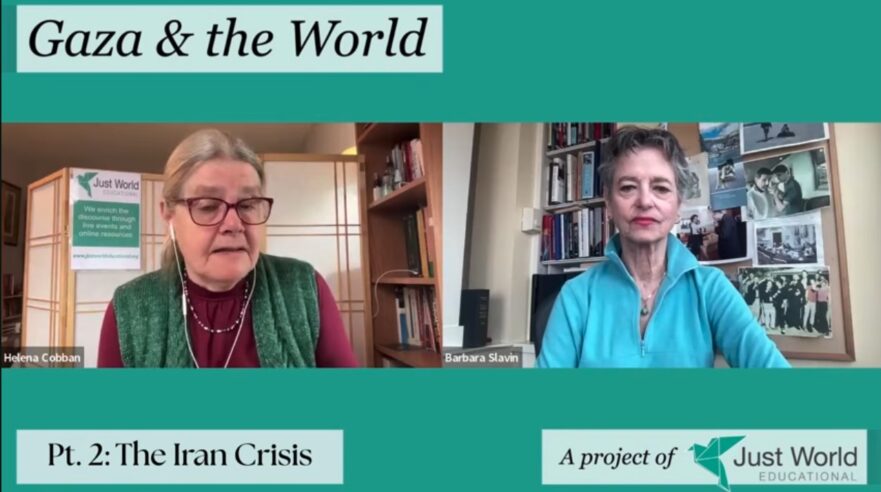
Pres. Trump “has essentially decided on a cosmic roll of the dice and gone up against Iran,” the long-time Iran expert Barbara Slavin told Just World Ed president Helena Cobban earlier today. But Iran, she predicted, “will survive this, long after Donald Trump is gone, and certainly after [Secretary of War] Pete Hegseth has gone back to Fox News.”
Slavin was speaking during the seventh conversation that Cobban has conducted in Just World Ed’s current “Iran Crisis” series, which is part of our continuing project on “Gaza and the World.”
You can watch the video of Cobban’s full 52-minute convo with Slavin here. Find the audio on Apple Podcasts or Spotify; and a full transcript is here.
Slavin, who is a Distinguished Fellow at Washington DC’s Stimson Center, laid out a stark picture of an overreaching United States, an increasingly out-of-control Israel and a battered but still durable Islamic Republic whose fate will reshape regional and global politics.
She argued that while Israeli PM Netanyahu had long pushed for the United States to undertake a massive, deeply debilitating strike on Iran, responsibility for the current war rests squarely with President Donald Trump. Netanyahu, she said, finally found in Trump “the first American president crazy enough to fall in with” his long‑standing demands for military action against Tehran. Trump, eager for a legacy and “high on his own supply,” was persuaded that now was the moment he could preside over the collapse of the Islamic Republic, a “thorn in our side for 47 years.” The war, she added, marks a decisive break with Trump’s campaign promise of “no more stupid wars” and his earlier positioning as a president of peace focused on the economy.
Slavin described diverging endgames in Washington and Jerusalem. Trump, she said, is still searching for a “Venezuela solution” – a Delcy Rodríguez or Emperor Hirohito scenario in which elements of the existing regime capitulate and align with U.S. demands on nuclear and regional policy. Netanyahu, by contrast, wants a “Libya solution”: a weak, chaotic, fragmented Iran that can never again pose a serious threat to Israel. Tehran’s decades of anti‑Israel rhetoric and its backing for militant Palestinian factions, she acknowledged, have helped fuel such ambitions, even as she firmly opposes the war “with every fiber” of her being.
Despite intense bombardment and huge civilian and official casualties, Slavin said she sees no imminent regime collapse in Tehran. Iran’s rulers remain deeply unpopular – she described Iranian society as perhaps the most secular in the Middle East after “47 years of Shia Islam being stuffed down their throats” – but judged that the state apparatus has held together. Key institutions, from the interim three‑man leadership council to the Assembly of Experts and a new Revolutionary Guard commander, are functioning after the assassination of the Supreme Leader. For now, she argued, there are no signs of “men with guns turning against other men with guns” or of a credible, organized internal opposition with a leader inside the country.
She warned instead of a different danger: the “Gazafication” of Iran. She and Cobban jointly drew a line from the “Dahiya Doctrine” that Israel had earlier pursued in Beirut, to Gaza, and now to Iran. Slavin said the current campaign risks turning large swathes of the country into zones of devastation, even if the state itself survives. But she noted that Iran is far larger, more populous, and more historically resilient than Lebanon or Gaza, which makes the project both more dangerous and more likely to fail strategically while inflicting enormous human suffering.
On the military balance, Slavin endorsed the idea that a key inflection point will come within days as U.S. and Israeli missile‑defence stockpiles are depleted. She agreed that serious anti‑missile interceptors could start to run out in about 10 days, forcing difficult choices in Washington and Tel Aviv as Iran continues to demonstrate the ability to coordinate strikes across the Gulf and beyond.
She said she believes Tehran’s targeting of Arab Gulf states, including high‑profile infrastructure projects, is part of a deliberate strategy to “shorten the war by increasing the pain” for regional partners of the U.S. and Israel. She noted that decision‑making in Iran was partially decentralized after the early Israeli decapitation strikes, which has allowed pre‑planned operations to continue even after those strikes.
In terms of U.S. policy, Slavin predicted that U.S. domestic politics – not battlefield dynamics – will eventually force Trump to “declare victory, no matter what has happened.” She pointed to a rapid rise in gasoline prices, broader inflation fears, and already‑unpopular midterm prospects for Republicans as factors likely to erode support for a prolonged conflict. The financial and human costs of what she called an “illegal, immoral war” will become harder to justify as billions of dollars are “burned up” while Americans face soaring medical insurance premiums and shrinking social support at home. Notably, she observed, influential figures in the MAGA ecosystem – from Tucker Carlson and Megyn Kelly to Marjorie Taylor Greene and libertarian policy outfits – have broken with Trump over the war, opening space for cross‑party cooperation among opponents that did not exist during the 2003 Iraq invasion.
Internationally, Slavin painted a bleak picture oforU.S. soft power and legitimacy. Trump, she argued, has “shredded” the UN Charter framework and reduced Washington’s adherence to international law to a dead letter. She cited the U.S. military’s March 4 sinking of an Iranian naval vessel returning from friendly maneuvers in India – with no attempt to rescue survivors and open boasting from Defense Secretary Pete Hegseth about that being “the first time we’ve sunk an enemy warship since World War II”, and described it as a stark war crime that has made the United States “unrecognizable.”
With USAID meantime also having been gutted and global health commitments abandoned, she said, China increasingly appears as “the adult in the room and the upholder of international law,” including through its efforts to explore a diplomatic resolution to the current conflict.
She noted that the war is also battering U.S. allies and partners. Arab Gulf monarchies, especially the small city‑state sheikhdoms of the former British “Trucial States,” have seen airports and civilian infrastructure hit by Iranian missiles in retaliation for their security and economic ties with Washington and Israel. Ambitious projects such as Saudi Arabia’s Vision 2030 and the UAE’s bid to become a global AI and data‑services hub now face serious setbacks, she noted. And meantime those Arab Gulf governments are also redirecting resources from commitments to help reconstruct Lebanon, Syria and Gaza to repairing their own damage. She noted that Gaza, already reduced to what Cobban called an “ever‑shrinking, genocidal concentration camp,” is likely to see even less international support, with no credible prospect that Muslim‑majority states will contribute troops to the so‑called stabilization force.
Within Israel, Slavin identified both entrenched militarism and growing strategic risk. Polls show overwhelming Jewish Israeli support for the war on Iran, even as the traditional peace camp has withered and maximalist visions of what Cobban called a “Very Much Greater Israel,” stretching from the Nile to the Euphrates, gain traction among key segments of the population. Israeli actions in Gaza and Lebanon – including the order for all residents south of the Litani River to move north and the renewed choking off of aid to Gaza – are compounding regional instability and deepening international anger.
Slavin judged that Hezbollah’s decision to join the fight has proved disastrous for Lebanon and is deeply unpopular among Lebanese Shia, while in Yemen the Houthis are carefully calibrating their own actions and have not yet resumed full‑scale attacks on shipping in the Red Sea.
Slavin concluded on a somber note, reflecting on decades spent studying and living in the Middle East and the “extremely painful” experience of watching the region become “further immiserated and dragged down into violence and chaos.” At some point, she said, the trajectory “has to stop getting worse and start getting better” – but for now, she admitted, she cannot see when that turning point will come.