
“I call it a war of whim because its not even a rational choice.”
“The impact is serious and widespread because the rise of energy prices and everything produced with energy, including fertilizer, most importantly, hits the entire world.”
“I want the U.S. to go home. Just go home.”
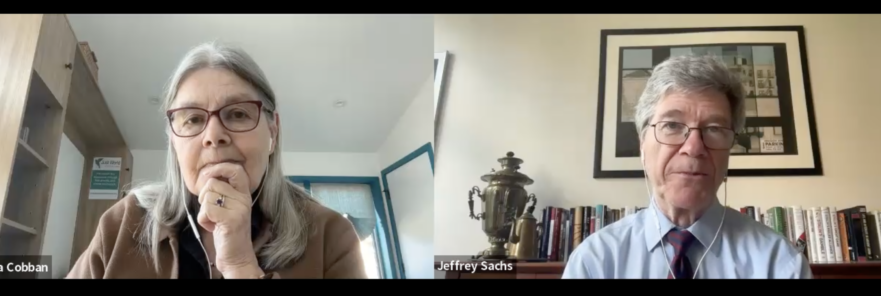
These were three of the key insights that the international economics guru and long-time UN advisor Prof. Jeffrey Sachs shared in the conversation that Just World Ed president Helena Cobban conducted with him on June 5
This conversation was #24 in Just World Ed’s ongoing project on the Iran Crisis. The full video can be viewed here. Find the audio on Apple Podcasts or Spotify. Or download the transcript here.
At the outset, Sachs noted that the immediate economic consequences are already serious and are affecting people and communities worldwide. “But we don’t know yet,” he said, “whether this will be a devastating impact– which is possible, if this continues and especially if the war escalates– or whether it will be a moderate, serious impact, which it already is. So there’s still a lot of uncertainty because it depends on the actions, especially, of the United States.”
He assessed the way global markets are responding to the crisis, describing oil prices as a kind of prediction market, that reflects the expectations of governments, companies, and producers about whether supply lines will reopen or worsen. He said that companies and states are making intertemporal decisions about whether to use reserves now or hold them back, and that the current price structure suggests some expectation that flows may resume before a deeper collapse.
Cobban said that the logic of the market resembles a wager on political outcomes, which she deemed “crazy.” Sachs responded that the truly irrational element is not the pricing mechanism itself, but the existence of the blockade and war.
Both Sachs and Cobban were sharply critical of the role played by Pres. Trump. Sachs framed the crisis as a product of reckless decision-making in Washington and Tel Aviv, describing Pres. Trump and Israeli PM Netanyahu as “completely psychopathic leaders” moving the region into disaster. He said the U.S. had chosen confrontation for no rational purpose and had become the central obstacle to peace. He also argued that the war is benefiting a narrow set of interests, including oil companies and military contractors, while imposing costs on ordinary people in the United States and across the world.
Cobban asked about the effects on the Global South, and Sachs said poor countries already face rising food prices, worsening fertilizer shortages, and greater food insecurity, and that these woes could worsen in the months ahead. He noted that climate conditions could amplify those pressures, particularly if the world moves into a severe El Niño phase. He argued that the economic burden of the U.S.-Iraeli war on Iran has fallen most heavily on people who already have to spend most of their income on food and basic survival.
The conversation also turned to the effectiveness (or otherwise) of the role played by the UN and its constituent agencies. Sachs argued forcefully that the UN is being undermined by the United States, which he accused of rejecting international law, ignoring Security Council decisions, failing to pay its dues, and increasingly attacking the organization itself. He noted that the UN is not designed as a world government with enforcement powers, but rather as a framework for cooperation among sovereign states, which makes it vulnerable when major powers refuse to participate in good faith. He defended the UN’s importance while arguing that the deeper crisis lies in U.S. conduct, not at the level of the UN’s leadership.
He praised specific UN-related bodies, including the International Court of Justice and UNRWA, but noted that both are constrained by political pressure and delay. Referring to the failure of the ICJ to follow up on the landmark January 2024 interim ruling in which the ICJ had ruled that Israel’s actions in Gaza could plausibly constitute genocide, he commented that “Justice delayed is justice denied.” He said that said Israel, with American backing, has worked to destroy UNRWA. And he described the Security Council’s Resolution 2803 which endorsed the so-called Trump “Board of Peace” for Gaza as a charade, saying it has no real funding and no credible role. In his view, it represents an attempt to create the appearance of normalcy while the underlying genocide continues.
The final part of the conversation shifted to U.S. domestic politics. Sachs noted that the American public is broadly opposed to the war and sympathetic to a Palestinian state, but he argued that U.S. democracy has been hollowed out by a security state and captured by narrow interests. He pointed to the military-industrial complex, Silicon Valley firms such as Palantir, the Zionist lobby, and religious figures who, he said, promote war. Sachs said the challenge for Americans is to “regain our government” and rein in the executive branch. He urged a political shift in the upcoming election, not out of party loyalty, but as a check on what he called Trump’s personal gain, family grift, and war-making.
The conversation ended with Sachs arguing that the immediate priority is to end the blockade and stop what he called “stupid things.” He said the United States should withdraw completely from the war effort, lift the sanctions, and let Iran reopen the Strait of Hormuz, rather than pursue further escalation. Cobban echoed that sentiment, framing the path forward as a call for the U.S. to go home and for sanctions to be lifted.