
“China is the only major power that still has a functional, candid channel to Tehran, to Gulf Arabs, and Washington, at the same time.”
“We cannot have a sustainable resolution of the entire the Iran file while Gaza and southern Lebanon are still in war.”
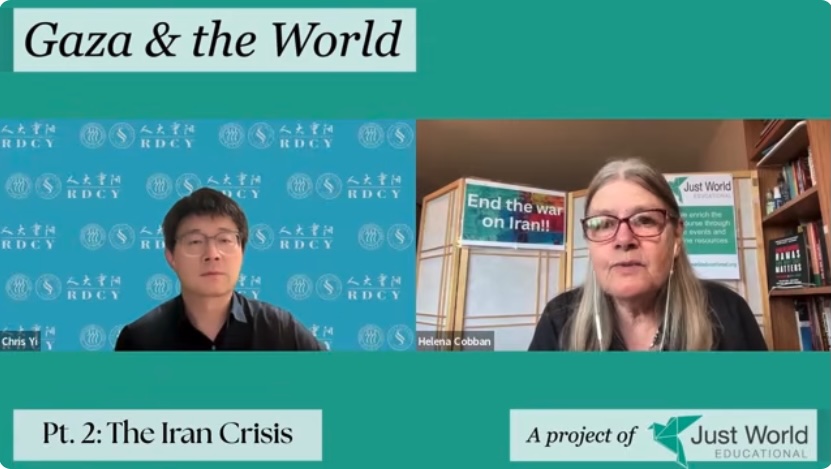
These were just two of the notable judgments expressed by Chinese scholar Dr. Yingnan (“Chris”) Yi in during an in-depth, 80-minute dialogue that JWE president Helena Cobban conducted with him May 20. Dr. Yi is an expert in international economics who’s a Research Fellow with the Chongyang Institute for Financial Studies at Renmin University in China.
You can see their whole dialogue on Youtube here. Listen to the audio on Apple Podcasts or Spotify, or download the transcript here.
This dialogue was #22 in JWE’s ongoing podcast series on “The Iran Crisis”. It differed a little from the previous conversations Ms. Cobban has conducted in the series in that both Dr. Yi and Ms. Cobban had the opportunity to pose questions to each other, which led to a very rich exchange.
In the dialogue the two scholars examined the US-Iran conflict, China’s diplomatic role, the state of U.S.-China relations, and the broader shifts reshaping global politics today. Across the conversation, both speakers returned to one central theme: military confrontation is proving less decisive than diplomacy, economics, and regional connectivity.
Cobban and Yi opened with a detailed assessment of recent high-level diplomacy, including the latest U.S.-China summit, which Yi said helped the two sides move “beyond talking past each other” and toward a relationship that stresses “constructive strategic stability.” He pointed in particular to a joint working group on AI safety and military applications, which he described as a meaningful risk-reduction step. But he also noted that the summit’s economic deliverables were thinner than the moment required and that key Taiwan issues remained unresolved in practical terms.
The discussion then turned to China’s role in efforts to end the U.S.-Israeli war Iran. Yi argued (as noted above) that China’s value lies in its ability to maintain channels with Tehran, Gulf Arab states, Pakistan, and Washington at the same time. He described China as bringing three distinct assets to this diplomacy: it role and reputation as a “honest broker and bridge;” its insistence that any durable settlement be nested in a UN framework; and its potential role as areconstruction partner that can help with infrastructure, energy, and trade connectivity once fighting stops.
Cobban praised China’s quiet diplomatic work and noted that Beijing’s behind-the-scenes contacts with Pakistan, Saudi Arabia, the UAE, and other regional actors have given it an important convening role. She emphasized that a settlement cannot be sustainable if Gaza and southern Lebanon are ignored, arguing that those conflicts are intertwined with the wider regional crisis. Yi agreed, saying a stable resolution is impossible while Gaza and southern Lebanon remain at war and that any serious diplomatic package must address Israel, Palestine, Lebanon, and Iran together.
The two also discussed the limited room for maneuver in Washington. Cobban said that many American analysts now recognize there is no realistic military victory for the United States and that the conflict’s trajectory now depends more on Iran’s decisions than on President Trump’s rhetoric. She judged that Trump’s recent visit to China has not much altered his political standing at home, noting that some of his recent actions have spurred new outrage in domestic politics. She also argued that his unpredictability, tariffs, and war policies have made it very hard for other countries to balance relations between Beijing and Washington.
A major portion of the dialogue focused on economics and the evolving world order. Cobban argued that economic relationships are becoming more important than military ones and pointed to the fourteenth century (pre-European) trading system in the Indian Ocean as a historical model of open commerce and shared prosperity. Yi agreed that the region should not be dominated by any one supreme power and said he hoped for a more balanced Asian order in which China does not seek to dominate its neighbors. Both speakers framed regional integration as a path to stability, with trade, infrastructure, and energy links replacing zero-sum geopolitical competition.
The conversation also explored whether the United States is strategically contracting from Asia. Cobban said she sees elements inside the Trump administration that want a continental retrenchment, but also another faction determined to confront China. She argued that the cost of overseas bases and wars may eventually force a rethinking of American posture, though not quickly. Yi expressed skepticism that U.S.-China rivalry is inherently existential, saying many in China still view the United States favorably because of the wartime alliance and because direct conflict across the Pacific would be irrational.
Near the end of the exchange, Yi shifted to Shenzhen and China’s longer-term strategy. He described Shenzhen as both a high-tech showcase and a destination city, citing special policy support, transportation experiments, and innovation at Huawei and elsewhere. He then raised the question of 2035 as a possible turning point in the world order, asking how China can seize strategic opportunities and how the United States will react to the rise of the Global South.
Cobban replied that China could help by making its diplomacy more publicly visible and by promoting the UN Charter, nonviolent conflict resolution, and broader scholarly and civic dialogue.
Overall, the dialogue presented a largely pragmatic and cautiously hopeful vision. It suggested that the path out of today’s overlapping crises will depend less on battlefield outcomes than on the ability of major powers to support ceasefires, reduce miscalculation, and build durable regional arrangements rooted in economics, diplomacy, and international law.