
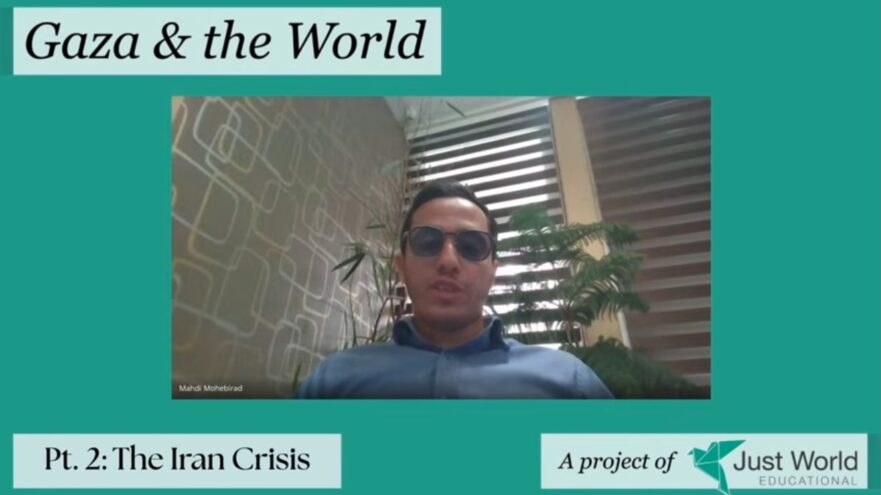
“International law is fundamentally a tool. And we must calibrate our expectations to the actual capacity of this tool.”
This was one of the key judgments expressed by Mahdi Mohebirad, a legal scholar who is the Director of a Tehran-based NGO called the Organization for Defending Victims of Violence, in a conversation he had May 12 with Just World Ed president Helena Cobban.
This conversation was #21 in Just World Ed’s ongoing project on the Iran Crisis. You can see the whole video of it here. Catch the audio on Apple Podcasts and Spotify. Or download the transcript here.
In this wide-ranging conversation Mohebirad argued that years of unilateral sanctions and recent military attacks have created a severe human rights crisis for ordinary Iranians, while also exposing deeper flaws in the international legal system. He stressed that the effects of war and sanctions are not limited to government institutions but are felt by civilians through disruptions to electricity, internet access, supply chains, medicine imports, education, and psychological security.
He described the current situation in Tehran as stable enough for this conversation to be held, but stressed that the broader picture remains dire. He said the ongoing aggression against Iran has produced an “existential threat” for the population and argued that sanctions amount to a form of sustained pressure that undermines the right of civilians to be protected. He noted that the deprivation caused by sanctions and blockade is especially severe for vulnerable groups such as children, women, patients, students, and scholars, and insisted that such measures affect not only the state but the entire society.
Mohebirad also challenged the idea, often voiced in the West, that unilateral coercive measures target governments without harming civilians. He said the reality is the opposite: the humanitarian consequences are widespread and include shortages of essential goods and medicine, as well as damage to the right to education and development. In his view, sanctions and military aggression are linked mechanisms that violate basic rights and should not be treated as separate issues.
A major portion of the discussion centered on how Iran has responded diplomatically and legally to these pressures. Mohebirad said Tehran has used a combination of legal arguments, international forums, and regional coalitions to highlight alleged violations. He pointed to Iran’s participation in International Court of Justice advisory proceedings related to Israel’s policies in the occupied territories, as well as statements and submissions made to the UN General Assembly and Human Rights Council. He also noted efforts to engage regional and emerging blocs such as the Organization of Islamic Cooperation and BRICS, while emphasizing that non-governmental organizations play a critical role in documenting harms on the ground.
When the conversation turned to the effectiveness of international institutions, Mohebirad offered a blunt assessment. He said international law is “a tool,” but one whose power is limited by enforcement failures, political vetoes, and the dominance of major powers. Citing the ICJ and the UN Security Council, he argued that legal rulings can be symbolically important and useful for delegitimization, but often lack practical enforcement when powerful states resist compliance. He described “naming and shaming” as one of the few real consequences of international legal action.
He also criticized the international criminal justice system, saying it remains structurally biased and politically skewed. He argued that the International Criminal Court has largely focused on African defendants while remaining constrained by the non-membership of major powers such as the United States, Israel, Russia, and China. He said this gives the court a colonial appearance and limits its credibility as a truly universal institution. At the same time, he said recent global attention to the ICC, the ICJ, and other institutions has awakened broader public awareness about international law and justice.
In the final part of the exchange, Mohebirad said the global South should push for meaningful reforms to the UN system rather than cosmetic changes. He expressed skepticism that simply adding new permanent members to the Security Council would solve the deeper problem. Instead, he argued for stronger legal mechanisms that would make ICJ decisions more enforceable and for a broader transformation of the international order. Despite the limitations of the current system, he said the recent crisis has sparked a global awakening and reinforced the need for civil society, NGOs, and international solidarity to keep pressing for accountability.