
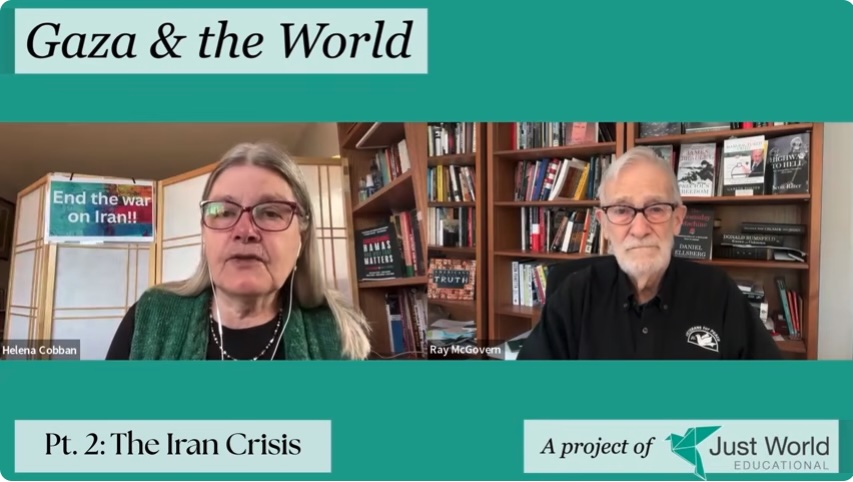
The former CIA official, now longtime antiwar activist and thinker, Ray McGovern noted Friday that Russia’s president Vladimir Putin has warned Pres. Trump in the strongest possible terms against launching any new military attack on Iran– “especially a ground attack”, as he judged the results of Iranian Foreign Minister Abbas Araghchi’s recent visit to Moscow to have been largely successful.
McGovern, who was for a long time one of the CIA’s most senior analysts of Russian/Soviet affairs, shared these assessments with Just World Ed president Helena Cobban in Episode 18 of JWE’s ongoing project on “The Iran Crisis.”
You can see the video of their whole 45-minute conversation here. The audio is on Apple Podcasts and Spotify. Or you can download the transcript here.
This wide-ranging conversation explored many very timely issues, including:
- the still-unresolved Iran crisis;
- political dysfunction and the possibility of more severe political breakdown in the United States;
- Russia’s role;
- the implications of the recent piratical action the Israeli navy took against an aid flotilla bound for Gaza; and
- the broader implications of such developments for war, diplomacy, and democracy.
Throughout the discussion, McGovern argued that Washington and Tel Aviv are moving in ways that risk a much wider and more dangerous conflict, while Iran and Russia are signaling both resistance and diplomatic openness.
McGovern underscored that (like many other people) he no longer trusts Washington’s logic; he described Pres. Trump as “mercurial” and warned that U.S. behavior has become increasingly unpredictable. He said Iran appears confident in its ability to withstand pressure from the United States and Israel, and judged that Iran’s leaders have been acting with unusual restraint and with solidarity toward others in the region. He framed this as evidence that the “Axis of Resistance” is not rhetorical but real, describing Iran as serious about supporting all those resisting occupation.
A major theme of the convo was the possibility of renewed U.S.-Israeli military action. McGovern said (and Cobban concurred) that he believed the Iranians could “withstand the worst” that Washington and Israel could throw at them, and he dismissed the likelihood of a U.S. ground invasion as both militarily unrealistic and politically reckless. He noted that shortly after FM Araghchi’s April 27 visit to Moscow, Putin had called Pres. Trump to tell him– amidst a delivery of several diplomatic niceties– that he deemed any U.S. ground operation in Iran to be “particularly unacceptable and dangerous.”
McGovern said the language in the Russian readout of that call indicated that that had been an unusually blunt warning, underscoring how seriously Moscow views the stakes.
He described FM Araghchi’s recent travel to Moscow as strategically notable and productive, noting that have that direct contact with Putin gave Tehran a powerful channel. He said Russia remains committed to facilitating diplomatic contacts and may be positioned to help with issues around Iran’s nuclear program, as it did during the JCPOA era. But he said that Russian attitudes toward the United States are not totally unified, citing criticism from former President Dmitry Medvedev, that in his view reflects frustration among Russians who believe Washington cannot be trusted.
The two briefly discussed the recent congressional hearings featuring Defense Secretary Pete Hegseth, which McGovern said revealed a broader pattern of contempt for oversight. He argued that the Trump team has normalized open disrespect toward the legislative branch. He linked this to concerns about democratic erosion, including potential interference with the midterms.
Cobban and McGovern also discussed longer-term developments in the U.S. Congress, where both said they see more resistance to U.S.-Israeli policy than before– though still not enough to count on institutional checks alone. McGovern said Congress is too often controlled by political pressure and money, and he stressed that public pressure to end the war matters more than legislative procedure and is now needed more than ever. He pointed to polling showing rising U.S. public skepticism toward Israel and suggested this could reshape politics if it continues into the next election cycle. However, he also raised alarm about the possibility that the Trump administration might try to undermine the holding of free and fair elections, warning that its authoritarian tendencies are no longer hypothetical.
Another major topic was the Gaza flotilla movement. McGovern, who was a crew member on the historic 2011 “U.S. boat to Gaza”, said these civilian aid missions still matter because they draw attention to Israeli actions and provide moral support to people in Gaza. He condemned the actions the Israeli navy undertook April 30 to capture and disable scores of small boats participating in yet another Gaza-aid flotilla, calling it piracy. He said that interception of boats near Crete showed Israel is becoming more aggressive rather than less. He recalled how the Obama administration and the Greek government had worked together to block the 2011 aid mission, arguing that such episodes show the extent of political pressure Israel can exert on Washington and its allies.
The interview closed on a broader historical note. McGovern and Cobban briefly discussed a new book on the writings of Smedley Butler, a U.S. Marine general who later condemned war as a racket, with McGovern arguing that the trump administration is currently misusing military power both abroad and at home. He warned that the same forces that enable war overseas can be turned inward against workers, activists, and elections.
The overall message of the conversation was stark: the Iran crisis is not isolated, but part of a wider struggle over war, imperial power, political accountability, and the future of democratic institutions.