“The idea that the Nuremberg Principles or the [UN] Charter, as generally perceived, were intended to nullify the discretion of the geopolitical actors is a delusion that goes back to 1945.”
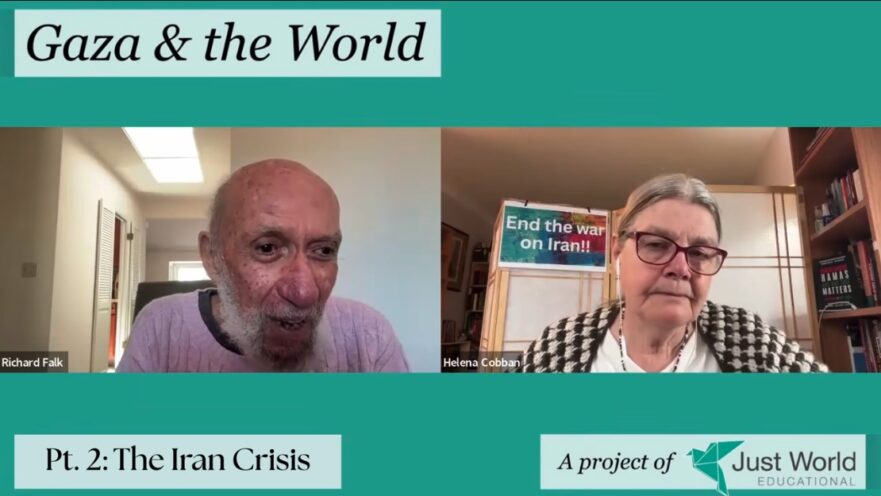
This was one of the notable judgments that veteran international law expert (and much-valued JWE board member) Prof. Richard Falk shared in an April 29 conversation with JWE’s Helena Cobban that formed Episode 17 of JWE’s ongoing project on the Iran Crisis.
You can see the whole video of their conversation here. Catch the audio on Apple Podcasts and Spotify. Or download the transcript here.
In the conversation, Falk shared numerous memories of the meeting he had with Ayatollah Ruhollah Khomeini in France, at the end of January 1979. Khomeini would fly back to Tehran the very next day, to the delight of the millions of anti-monarchist Iranians whose protests had, just two weeks earlier, forced the Shah to leave the country. Falk also shared many fascinating impressions from the visit to Iran that he, former US Attorney-General Ramsey Clark, and Philip Luce had undertaken, before they reached Khomeini’s compound in France, in a “visit”side-trip” that had been planned– in Tehran– at very short notice.
He described witnessing the Shah’s abdication, speaking with doctors who treated victims of police violence, and marching in peaceful demonstrations. Falk shared Khomeini’s opening concern: the shadow of the 1953 CIA-backed coup and whether the U.S. would intervene again. He also described Khomeini’s stated hope for normalization with the West and his notably non-sectarian framing of Islamic governance, including a revealing contrast in how he spoke about Iran’s Jewish and Baha’i minorities.
The conversation then turned to the collapse of the post-1945 international legal order. Falk argued that geopolitical actors, particularly the major powers, were never truly constrained by the UN Charter or the Nuremberg principles, echoing a warning a Mexican delegate gave at the founding of the UN: that the system “regulated the mice but let the tigers run free.”
He pushed back against total cynicism, however, noting that even though the strictures of international law lacked teeth, they gave considerable moral power to popular anti-colonial and anti-authoritarian movements. He pointed to the moral legitimacy Palestinians won through efforts like the Gaza People’s Tribunal, which he himself had helped lead, and South Africa’s landmark case against Israel at the ICC Tribunal. He noted this:
“The Palestinians have won the legitimacy war. And most winners of the legitimacy wars in the anti-colonial context have gone on to control the political outcome, though suffering great devastation and human casualties in the process. Vietnam is one of the principal examples…”
The conversation also addressed the topic of nuclear (non-)proliferation. Falk deemed Iran’s nuclear program largely a pretext for sustained hostility from the U.S. and Israel. He noted that Iran has repeatedly declared nuclear weapons immoral and that reliable intelligence did not support the claim that Iran sought them. He also recalled that Article 6 of the NPT, which committed nuclear states to actively pursue disarmament, was treated by Western powers as what they privately called a “useful fiction.”
Both speakers addressed the profound double standard around Israel’s undisclosed nuclear arsenal and the ongoing NPT review conference, where Iran’s ambassador was nominated as a vice president, provoking U.S. objections.
The full conversation covered decades of history that remain urgently relevant today. Watch to hear Professor Falk’s firsthand account of one of the most consequential moments of the 20th century, alongside his sober assessment of where international law and nuclear diplomacy stand now.