
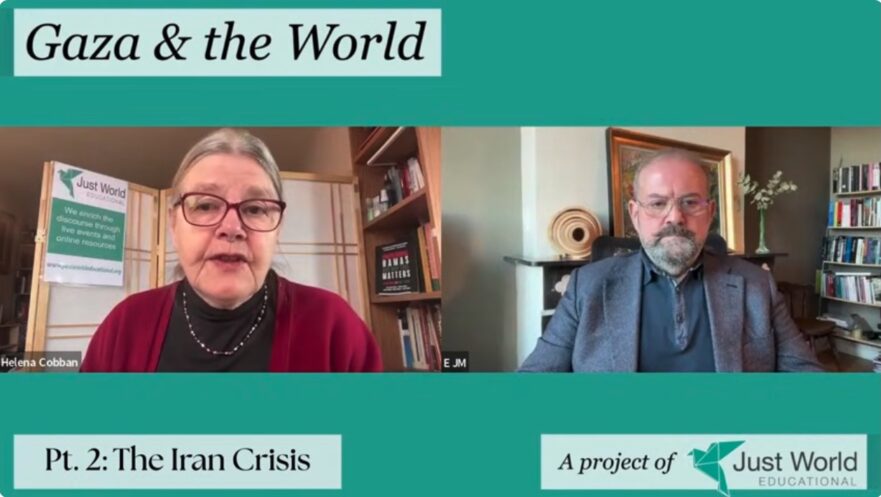
In a wide‑ranging conversation that kicked off Just World Ed’s new series on the Iran conflict, veteran strategic analyst Elijah Magnier warned today that any U.S. attack on Iran would be far from a “promenade,” and could trigger a regional and global crisis with incalculable costs.
Speaking with JWE president Helena Cobban in this new portion of JWE’s continuing “Gaza and the World” project, Magnier argued that Iran’s demonstrated ballistic‑missile capabilities mean it can inflict “real damage” on U.S. bases across the Middle East and, above all, on Israel.
Magnier’s whole 38-minutes conversation can be viewed on YouTube here, and the audio is now also on Apple Podcasts or Spotify. Cobban will be conducting additional conversations in this series over the coming days, according to the schedule that is posted, and regularly updated, here.
Be sure to share these great resources with your friends and networks and post your Likes and Comments on all the platforms!
In today’s conversation Magnier looked back at the record of the “Twelve-Day War” that the U.S. and Israel waged against Iran last June. He noted that during that war Iran’s precision missiles successfully struck key targets in Israel, with U.S.–Israeli air and missile defenses failing to intercept most of them. That experience, he noted, shattered any illusion that Washington could launch limited strikes and walk away unscathed.
In his view, Iran’s strategic objective in any war would not be classical victory, but survival: “Iran doesn’t need to win. Iran needs to hold its ground, and Iran needs to retaliate and inflict damage,” he said.
Cobban framed Tehran’s stance as a classic deterrent posture, recalling Iranian leaders’ assertions that they had shown restraint back in June but would not do so again if attacked. She highlighted the vulnerability of U.S. carrier groups and warships deployed near Iran, and pointed to Israeli and U.S. pressure to impose strict limits on Iran’s missile program that go far beyond the nuclear file.
Magnier described current U.S. policy as “deterrence by narrative,” in which officials and media repeatedly talk up the imminence of war in an effort to intimidate Tehran. He argued that such psychological pressure has little effect on a country that has lived under threat, war, and sanctions since 1979, and he warned that any attempt to devastate Iran’s infrastructure and economy could push the country into a “cornered cat” posture that risks major escalation, potentially even to nuclear use by the United States.
The discussion also examined the positions of key other parties. Magnier said European governments face a profound legality problem: with no clear Iranian violation of international law, it would be “illegal, unlawful, and without grounds” to sell a war on Iran to their own publics. Gulf Arab states, he argued, are caught in a lose‑lose dilemma, fearing both a strong and a shattered Iran: a destroyed Iran could empower Israeli expansionism, unleash chaos along Iran’s many borders, and expose Gulf states hosting U.S. bases to direct Iranian retaliation.
Both speakers stressed the global stakes of any conflict in the Gulf, especially around the Strait of Hormuz. Magnier recalled a recent Iranian military drill that briefly disrupted traffic there, during which oil tankers piled up as they waited to pass. With an estimated 19–20 percent of the world’s energy transiting that chokepoint, he warned that a serious clash could drive oil prices far above current levels and shake currencies and economies worldwide.
Cobban also drew attention to the broader erosion of international legal and diplomatic constraints, citing U.S. actions from the attack on Iran in June to the kidnapping of Venezuela’s president in early January. Magnier contended that U.S. veto power and military dominance have rendered the United Nations largely impotent. He warned that the world is entering at least three years in which “the powerful can do whatever he wants” without meaningful legal restraint.
The conversation concluded with an assessment of China’s role. Cobban argued that Chinese technology and diplomacy have bolstered Iran’s resilience, including Beijing’s mediation of a key early-2023 Saudi–Iranian rapprochement and its work on alternatives to the U.S.-dominated financial system. Magnier, however, cautioned against overestimating China’s readiness to confront Washington on Iran’s behalf; he noted that Beijing has previously backed UN sanctions on Iran and remains heavily invested in trade with both the United States and Israel.
Looking ahead, Magnier assessed the current chances of a U.S.–Iran war as roughly “50–50,” emphasizing that significant diplomatic contacts remain under way and that Tehran is preparing detailed proposals for talks even as it maintains military readiness. Cobban closed by situating the dialogue within Just World Educational’s broader multi‑speaker exploration of the Iran crisis and its global implications.