
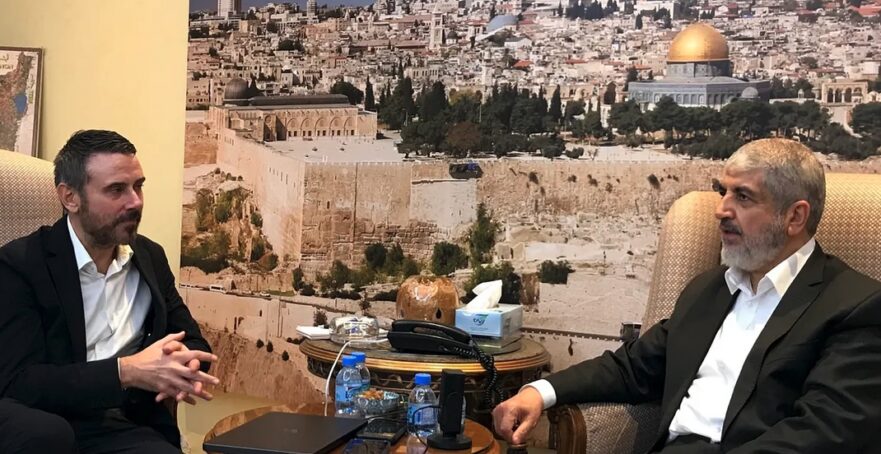
On December 9 and 11, Khaled Meshaal, the veteran Hamas leader who is now once again the head of “Hamas Abroad”, gave interviews in Arabic to Al-Jazeera and then DropSite News. Al-Jazeera produced a short English-language summary of their interview which they shared here. DropSite took a few days to translate and present their interview, which they did on December 15, here. Scroll down there for their full translated text. Their interview was conducted by Jeremy Scahill, and Jawa Ahmed also received a byline.
I haven’t had the chance yet to watch the whole of the Al-Jazeera interview. But from the summary they provided it seemed to me that Mr. Meshaal in his DropSite interview he presented a different, slightly more forthcoming stance toward the Gaza negotiations than he had to the Al-Jazeera audience two days earlier.
On the key question of the U.S.-Israeli demand for Hamas’s complete disarmament, Al-Jazeera summarized his views thus:
Disarmament will be a key issue. Israel has demanded it, while Hamas officials have expressed ambivalence, but which Meshaal said would be akin to “removing the soul” of the group. Hamas officials have previously said they would be prepared to relinquish their arms to a Palestinian state.
In the DropSite interview, Meshaal told Scahill:
We do not want to clash with anyone or confront anyone, but we will not accept being forcibly disarmed. We told them, if you want results, let us look for a realistic approach that includes guarantees. We outlined several such guarantees. The first guarantee is that these weapons—Hamas and the resistance forces would preserve and not use, display or parade them. [The weapons] would be set aside by their own decision and with full seriousness, especially given that Hamas has a record of commitment and high credibility…
We do not want to clash with anyone or confront anyone, but we will not accept being forcibly disarmed. We told them, if you want results, let us look for a realistic approach that includes guarantees.
On other key points in the negotiations, he said:
- “We accept [the International Stabilization Force] on the borders as separation forces between the Palestinian side and the Israeli side, not as forces deployed inside Gaza, as was intended for them and as Netanyahu wants—for them to clash with Palestinians and disarm them.”
- “We proposed a hudna [truce], and this is evidence of Hamas’s seriousness and the seriousness of the Palestinian resistance. A truce of five years, seven years, ten years—whatever is agreed upon. And a hudna means commitment. All the periods of calm, as we call them, during the wars of the past twenty years—all those limited hudnas—Hamas adhered to them, and it was Israel that violated them.”
- “We said that the three mediators [Qatar, Turkey, and Egypt], along with other Arab and Islamic countries that have good relations with Hamas, Islamic Jihad, and the resistance forces, can guarantee the Palestinian side to both the Israeli and the American sides.
In the DropSite interview, Mr. Meshaal made a notable attempt to reach out to Pres. Trump by appealing to what he referred to as, “the pragmatic American mindset, and President Trump’s genuine concern to achieve stability and prevent Gaza from remaining a continual bleeding wound that worries the world and deeply strikes the human conscience…”
He also revisited many of steps Hamas has taken over past decades to engage politically with initiatives undertaken by the United States and other Western nations. One key example he mentioned was the decision the movement took to participate in the legislative elections being held in 2006 under the terms of the Oslo Agreement, a deal that Hamas had energetically opposed when it was first struck, back in 1994. (Hamas, as we know, won the 2006 elections decisively; and almost immediately thereafter, the United States and Israel launched a tireless campaign to try to overthrow the results of those elections, to enact brutal punishment on the movement, and to launch a punishingly tight siege on the entire population of Gaza… )
In the book Understanding Hamas And Why That Matters that my colleague Rami G. Khouri and I published last year, we and the five experts on Hamas who contributed to the book provide a lot of valuable background on the movement’s long history of political engagement, along with substantial excerpts from all the major documents relevant to that history. I still heartily recommend the book to all those seeking to understand the movement! But most likely, any new edition of our book should also include long excerpts from Scahill’s interview, too.
** Plus, a little bonus: I was recently able to retrieve the transcripts of two of the interviews that I conducted with Khaled Meshaal, in Damascus, back in January 2008 and June 2009. Access the first of those here, and the second one here.