
I’ve been thinking and writing a lot recently (e.g., here) about the need to make the whole of the Persian/Arabian Gulf (the “Khalij”) a Zone of Peace, often casting this as a generalized, international responsibility. But on further thought, it is clear that those of us who are U.S. citizen have unique responsibilities in this matter.
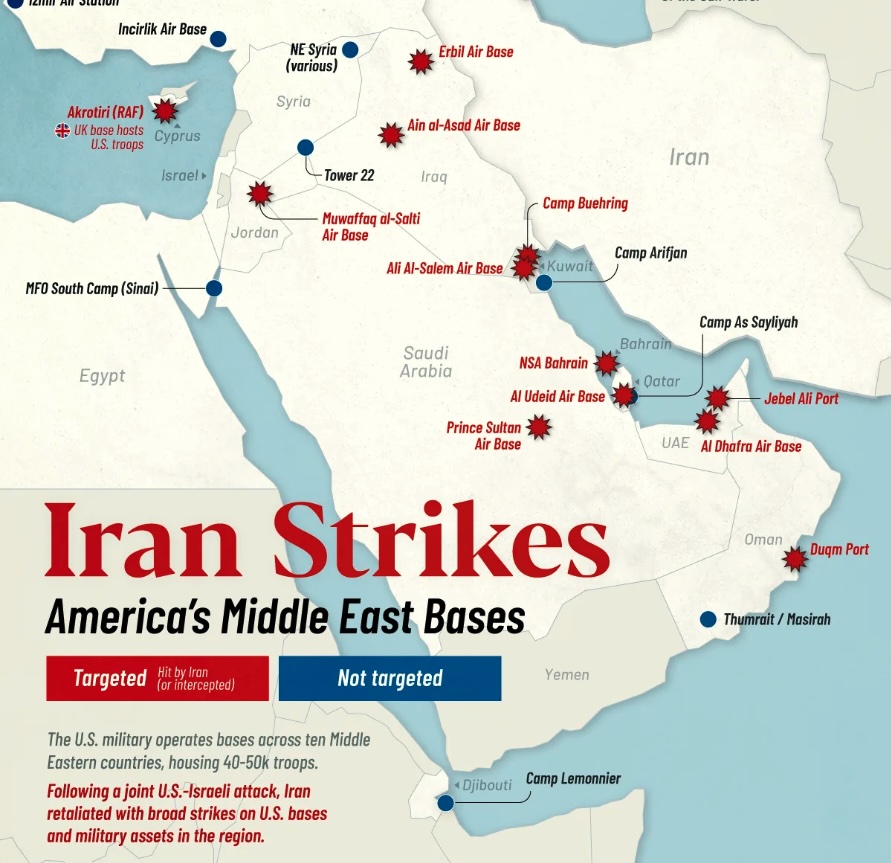
It is our tax dollars and political leaders that have for decades sustained the presence along the southern coast of the Khalij of U.S. military bases whose activities have been a major nexus of conflict for that region’s peoples. It is therefore we, all the U.S. citizens who are opposed to U.S. wars abroad, who must take the lead in demanding the closing of these bases and the establishment among the states that border the Khalij of a Zone of Peace for their region.
We note that those bases (a) have contributed irreplaceable support to the current campaign of destruction that the Israeli-U.S. alliance has been waging against the people and society of Iran, and (b) have contributed nothing effective to the defense of the host countries in which they sit, against the (understandable) retaliatory attacks launched by the Iranian forces.
Quite the opposite. U.S. diplomats have long “sold” these bases to the host countries of the southern coast of the Gulf as helping to defend them against outside aggression, or even as “deterring” any such aggression from happening. But what we have seen since February 28 is that the presence of these bases has itself made the countries in which they sit an operationally important target for Iran. (And last September, the fact that Qatar hosts the largest U.S. base in the Gulf did not “deter” Israel from undertaking a deadly strike against a civilian villa in the capital, Doha.)
We U.S. citizens have a lot of work to do to meet our responsibility to shut down those super-provocative bases as speedily as possible. For decades now, it has become “normalized” to a very depressing degree that the U.S. military somehow should have a role to play in the security system of the distant Khalij. But this is decidedly NOT normal.
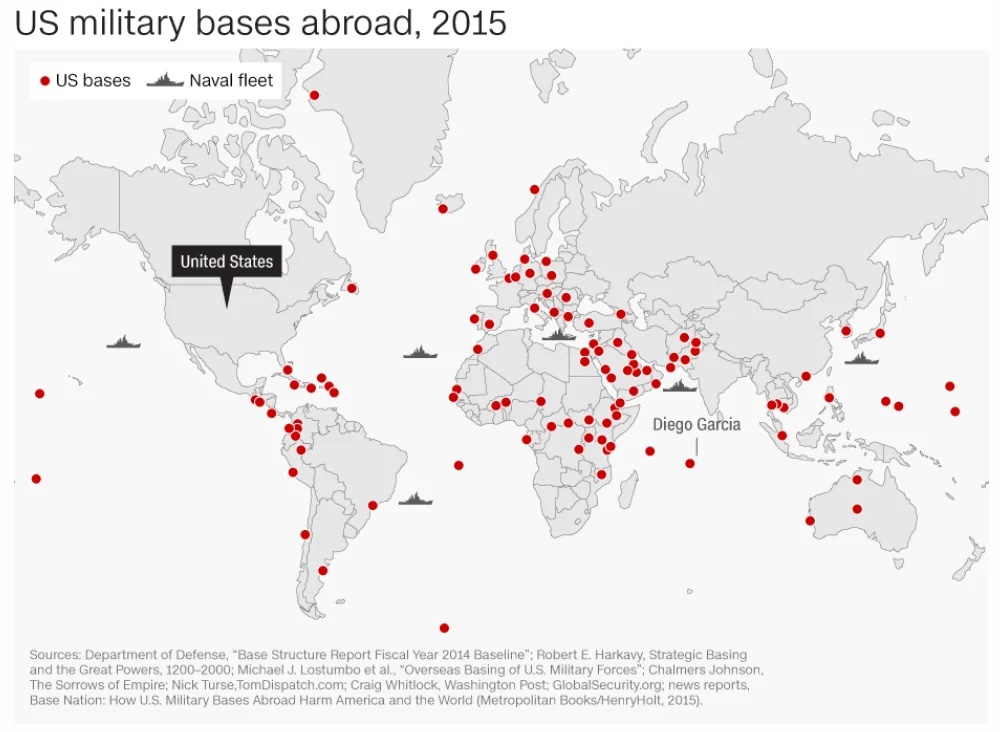
Ever since 1507 CE, White, Western empires– what I like to call the “White Supremacy International”, on the model of the “Communist International” or the “Second International”– have had a violent, interfering role in the Khalij. In that year, a Portuguese commander torched the whole of the until-then prosperous Persian city of Hormuz. Violent Portuguese conquistadors then roamed up and down the Gulf for more than a century.
Then in 1635 the mercenary battalions and sepoys of London’s “East India Company” were able to push out the Portuguese. The Gulf then became a playground for the EIC, and after it the British government, for the next 300-plus years.
During those centuries the British military kept bases along both coasts of the Gulf. But by 1967, the U.K. government concluded that maintaining its whole web of bases in the seas “East of Suez” was too expensive, and started a planned withdrawal. The U.S. military– which had long had ties with the eponymous “Al Saud” kings of Saudi Arabia, and to Iran– then replaced the British in all the smaller Arab statelets where they still had bases.
At that point, the whole Gulf became an American lake– until 1979, when the Islamists led by Ayatollah Khomeini ousted the brutal, U.S.-backed shah and declared their independence from U.S. overlordship.
Now, it is time to end that overlordship (and the very destabilizing basing structure on which it is built) from the south coast of the Gulf as well as the north coast. The populations that have their homes, communities, and governments on both sides of the Gulf have had a rich history of interaction for many millennia before the White Supremacy International sailed to their shores, and also throughout the last 500 years until today.
(Indeed, throughout history, bodies of water have more often united the peoples who live along their coastlines in webs of trade, cooperation, banking, and the exchange of cultures, rather than divided them. Just think of the Mediterranean…)
And now, already, some notable voices from the southern (Arab) coast of the Gulf have started to speak out somewhat boldly in opposition to the Israeli-U.S. attack against Iran and the horrors that the U.S. war machine has brought down on their heads.

On March 8, the renowned Debawi (from Dubai) real-estate developer Khalaf Al-Habtoor wrote a post on X in which he witheringly criticized the Israeli-U.S. assault and the retribution on UAE facilities that had followed. Habtoor speedily retracted that post. But he repeated many of the sentiments he’d expressed there in these encounters with a WaPo reporter.
At the more “official” level, the Foreign Minister of Oman, Badr Albusaidi, recently penned an eloquent essay in The Economist in which he argued that Pres. Trump had somehow been suckered by Israel into participating in the attack on Iran, and that neither Israel nor the U.S. could win what they have sought from it.
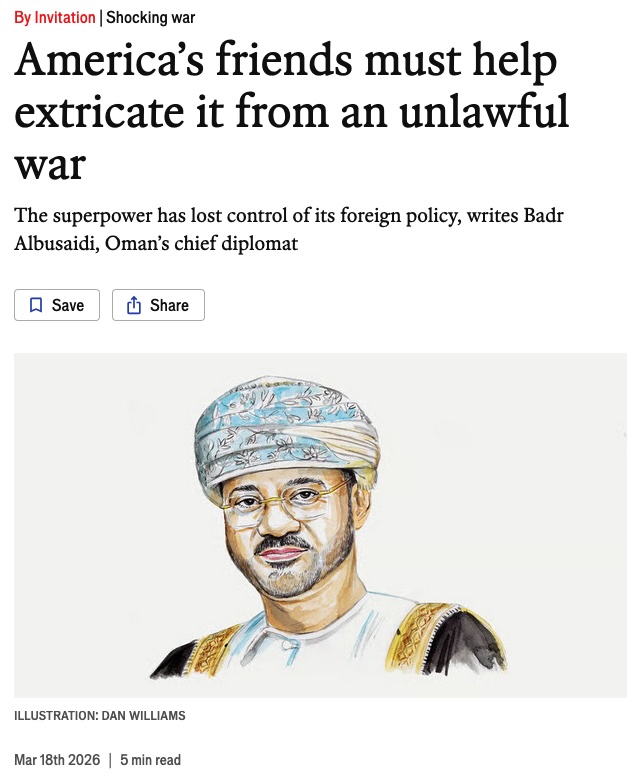
Albusaidi had been the key diplomatic figure who’d mediated in both the (failed– or more precisely, designed-to-fail) rounds of diplomacy on the nuclear question that Washington and Tehran had engaged in, last June and then earlier this year. So it is probably not surprising that the main call in his latest essay was for a new round of negotiations, primarily between Washington and Tehran.
In the formula that Albusaidi proposes, he clearly wants Washington to still be an active “player” in any future security system in the Gulf. But surely, we Americans who seek to avoid any further entanglement in the complex, violent, anti-humane (and far too often Israel-dictated) affairs of that region need to tell Albusaidi and all the other decisionmakers there: No! It is ways beyond time for the U.S. military to pull our military forces out of the Gulf region completely!
Let’s turn everyone’s diplomatic efforts, instead, to consulting on what is needed to make the whole of the Khalij region truly a (foreign-base-free) Zone of Peace.