
“Ironically, the cork in the bottle on the nuclear project was the late Ali Khamenei, the Supreme Leader, who was adamantly opposed to weapons of mass destruction on moral grounds. The next leader looks to be someone who favors building a nuclear weapon.”
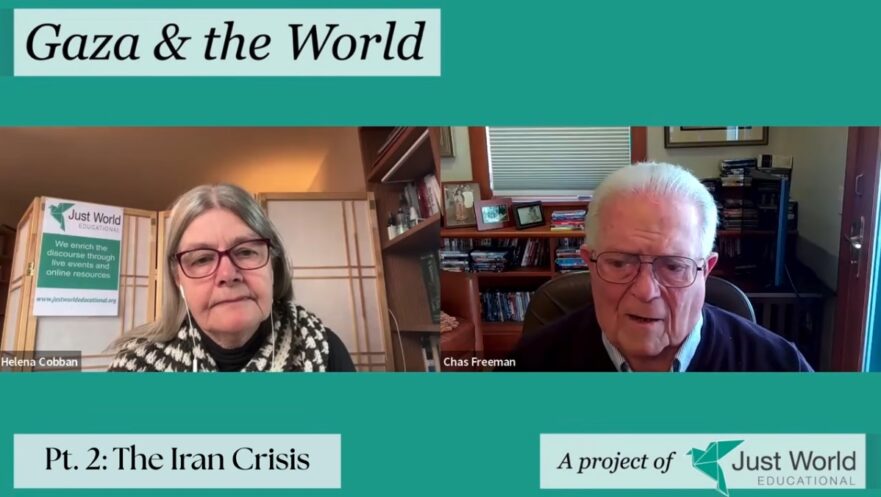
This was just one of the many significant–and significantly critical– judgments regarding the ongoing Israeli-U.S. war on Iran voiced by veteran U.S. diplomatist Amb. Chas W. Freeman, Jr. during today’s episode of Just World Educational’s ongoing “Iran Crisis” project.
You can watch the video of Freeman’s whole 57-minute convo with JWE president Helena Cobban here. Find the audio at Apple Podcasts or Spotify; and a full transcript is here.
In another prediction that will be very unwelcome in Washington, Freeman said he expected that Iran’s missile forces would survive, and would continue operating on Iran’s timetable, not Washington’s or Israel’s. (Cobban reminded her viewers at one point that, in addition to his diplomatic record, Freeman had also served in the Pentagon as a Deputy Assistant Secretary of Defense.)
Iran’s war strategy
In the conversation, Freeman noted that Iran has entered the current conflict with something Washington lacks: a coherent strategy. He outlined three core Iranian objectives: devastating Israel in response to Israel’s attempt to devastate Iran; driving U.S. forces out of Gulf bases that Tehran regards as a direct threat; and pursuing a “rope‑a‑dope” campaign to exhaust U.S. and Israeli air and missile defenses.
He likened Iran’s approach to Muhammad Ali’s famous boxing tactic, saying Tehran is using less advanced missiles and drones to deplete expensive Patriot and THAAD interceptors in the Israeli and U.S. stockpiles, where stocks are already thin. At current rates, he predicted, Israel will be the first to run out of defensive capacity, potentially prompting another wave of Israeli civilian flight and leaving the United States scrambling as it cannibalizes air defenses from places like South Korea and Japan to sustain the war.
Hormuz, blockade, and global economy
Freeman stressed that Iran has an even stronger hand at the Persian Gulf’s Hormuz chokepoint than the much‑discussed Houthis havein the Red Sea, warning that Tehran is “in a far better position” to conduct a land‑based blockade of the Strait of Hormuz. With insurers already pulling coverage and tankers diverting or idling at anchor, he dismissed President Donald Trump’s order to use a U.S. agency to insure ships and to send the Navy to escort tankers as neither legally grounded nor credibly practical.
The result, he said, is a looming energy crunch in which countries like India could see power cuts within a week, while oil‑dependent economies such as Japan and South Korea burn down limited strategic reserves. Qatar has already shut gas production, he added, and supply chains between Asia and Europe are being hit as both Hormuz and the Red Sea become contested lanes—developments that will be felt by U.S. consumers as fast‑rising fuel prices and even empty shelves under a brittle just‑in‑time logistics system.
U.S.–Israel alignment and regional politics
Freeman portrayed the war not as a two‑sided clash between the United States and Iran plus a separate Israeli front, but as what– at Cobban’s suggestion– he called more accurately an “Israeli‑U.S. war.” He said he sees “no daylight” between Trump and Prime Minister Benjamin Netanyahu, arguing that Trump “takes his orders from Netanyahu” and that Washington is effectively fighting on behalf of a foreign power whose long‑standing project is to reduce Iran “to rubble” and break it up.
He described Gulf monarchies as caught in a severe dilemma: they invited U.S. forces onto their soil as a shield, only to discover those bases have become “attractive nuisances” drawing Iranian fire. The United Arab Emirates, he noted, has already been told that interceptor resupply will go to Israel first, a decision he believes will have lasting consequences for how Gulf states view the value of their partnership with Washington.
Global South and European responses
On the diplomatic front, Freeman argued that the war has further cemented a split between the “global South” and the West, with European allies lining up behind Washington’s narrative much as Soviet satellites once did behind Moscow’s. He was especially scathing about British Prime Minister Keir Starmer’s claim that London is helping defend civilians from Iranian attacks, calling such statements “very Orwellian” in light of casualty figures in Iran and Israel.
Yet he also highlighted exceptions: Spain, which he called perhaps “the most honorable country in Europe” for its stance on Gaza and refusal to support the war effort against Iran, and Ireland and Norway, which have stayed out or remained notably quiet. Italy, he added, has emerged as a go‑between, relaying a U.S. attempt to restart talks with Iran—a move that Tehran’s foreign minister immediately rebuffed, citing Washington’s record of using negotiations as cover for surprise attacks in Iran, Venezuela, and against Hamas.
Media, censorship, and public ignorance
Freeman castigated Western media performance as “appalling,” saying coverage highlights U.S. and Israeli military prowess while ignoring Israel’s own substantial losses under a regime of Israeli censorship that Western outlets largely obey without disclosing the constraints. He contrasted this with the skepticism routinely shown toward casualty figures from Gaza or Iranian sources, which are often presented as unverified because reporters cannot enter those areas.
He warned that corporate and algorithmic control over platforms such as TikTok is shrinking the space for honest reporting, leaving U.S. citizens “exceedingly ill informed” and policymakers “drunk on [their] own claims of success.” The result, he said, is an environment in which “everything’s plausible, nothing’s true,” complicating any effort—inside or outside government—to judge the war’s real course and costs.
U.S. governance, military morale, and lawlessness
Turning homeward, Freeman linked what he called the shredding of international law abroad to the erosion of constitutional norms inside the United States. He said Trump has concentrated war‑making, tariff, and spending powers in the presidency, while pursuing “mafia‑style shakedown” trade policies that mix state power with personal and family financial interests.
He voiced deep concern about U.S. military morale, citing endless deployments, decrepit hardware, politicization, and the absence of any persuasive case that the war serves American rather than Israeli interests. In such circumstances, he asked, it is unclear how Washington will sustain public or military support if casualties mount, or who will volunteer to serve in a force increasingly associated with what he called crusading rhetoric and disregard for international law.