
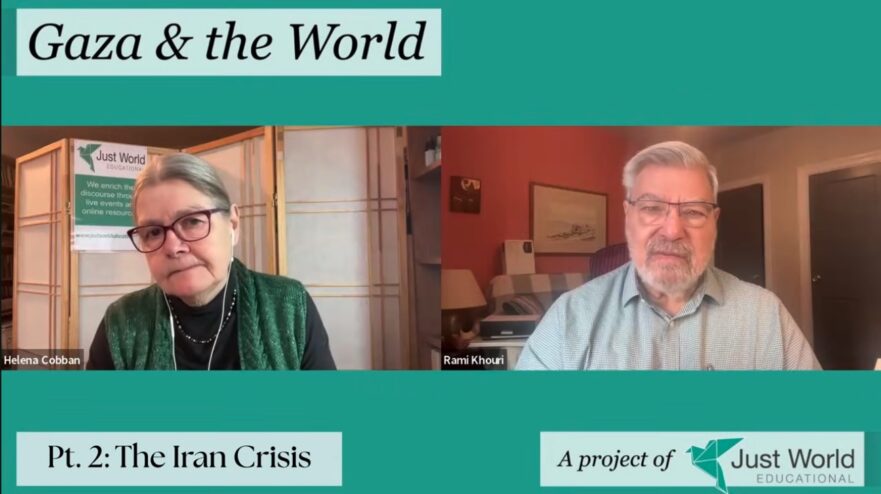
“The Iranians have been resisting Western hegemonic assaults for almost three quarters of a century, and they’re still doing it, and they’re the only country in the region that has credibly resisted the non-stop onslaught of U.S. sanctions and attacks, and Israeli attacks.” With this assessment of Iranian resilience, veteran Arab journalist and analyst Rami G. Khouri set the tone for a wide-ranging online discussion of the new U.S.–Israeli war on Iran, that Just World Ed president Helena Cobban hosted on March 3.
This convo was Episode 5 in Just World Ed’s continuing series of video podcasts on the rapidly unfolding crisis triggered by the large-scale assault that the United States and Israeli jointly launched on February 28. You can see the whole of their 48-minute convo on our YouTube channel, here, or listen to the audio on Apple Podcasts, Spotify, or Buzzsprout. Or download the transcript here.
Cobban and Khouri each have many decades of experience of writing about and commenting on the affairs of West Asia, and the role that Western and other world powers have played in the region, as journalists, analysis, authors, and commentators. Khouri sits on the board of Just World Ed and is also a Distinguished Fellow at AUB’s Issam Fares Center. Together, they painted a picture of the current crisis as one that is both brutally immediate and also deeply rooted in a centuries-long history of Western– and later also Israeli– intervention in West Asia.
In his introductory remarks Khouri argued that the current crisis represents a “rejuvenation and digitization” of an old colonial project. He contended that mainly white Western powers—once acting under explicitly Christian imperial banners, now joined by what he calls an Israeli–Jewish–Zionist angle—are seeking new ways to reassert control over West Asia. Iran’s role in this picture is central: since the 1940s and the 1953 overthrow of Prime Minister Mohammad Mossadegh, he said, Iran has faced a continuous onslaught of coups, sanctions, covert action, and military pressure. But it has emerged as the only regional state capable of mounting a sustained, credible resistance.
For her part, Cobban underscored that the present war was not inevitable or launched in a haphazard way, but was “a quite gratuitous and aggressive war of choice,” launched by President Donald Trump in close coordination with Israel, with no serious attempt to fit it into the constraints of U.S. or international law. She highlighted reports that some American officials themselves considered the support to Israel’s ongoing campaign in Gaza—and now the Iran war—illegal, and noted how Trump has set up his own “Board of Peace” as a rival to the UN as he escalates this conflict.
Cobban amplified the focus on Iran’s resilience with a concrete operational example. Drawing on comments by veteran war correspondent Elijah Magnier, she noted that when the U.S.–Israeli axis attacked Iran the previous June, it took Tehran almost a full day to regroup and launch missiles and drones in response. This time, she said, “it took them an hour.” Iranian forces were “much speedier,” better prepared, and had built redundancies into their systems, learning tactical and organizational lessons even under severe pressure. That rapid response, Cobban suggested, is one measure of how far the Iranian state apparatus is from collapse, despite Western hopes to the contrary.
Both speakers stressed that the war has already expanded far beyond Iran. Khouri recalled that Iranian officials had long warned that any major attack would trigger a regional conflagration, and argued that they are now making good on that promise. He described how Iranian forces or aligned groups have hit targets linked to the U.S. and Israel, as well as some Arab oil installations in Saudi Arabia, Kuwait, and Jordan. The strategic message, he said, is blunt: “If they’re going to suffer sanctions and attacks… other people have to feel the pain.” By spreading the suffering to Gulf energy, tourism, and shipping sectors, Tehran aims to force regional and global stakeholders to move to stop the U.S.–Israeli campaign.
Cobban added historical texture to this logic of shared vulnerability by zeroing in on the situation at the Strait of Hormuz, now partially closed by the Iranians. She reminded viewers that the small island of Hormuz was the target of a brutal Portuguese assault in 1507, an early episode in European colonial penetration of the Indian Ocean. “What goes around comes around,” she remarked, suggesting that five centuries later, Western and Gulf shipping interests now find themselves exposed to a different kind of coercive power emanating from the same strategic chokepoint.
A recurring theme in Khouri’s analysis was the near-total erosion of Arab sovereignty. He argued that no Arab government today can take major decisions—whether on security cooperation, trade deals, or oil contracts—without de facto approval from one or more external powers, naming the U.S., Israel, Iran, Turkey, Russia, and China. This “disappearance of Arab agency,” he said, has left regional governments unable or unwilling to formulate a coherent response to a war that directly threatens their territory and economies. Cobban, for her part, emphasized how Washington has long presented its bases in Gulf monarchies as essential to their defense, while Iran’s recent strikes and rhetoric have instead cast those same U.S. deployments as forward outposts for the protection of Israeli interests.
The two also converged on a grim assessment of Israel’s doctrine and methods. Cobban explicitly named the “Dahiyya Doctrine,” developed after Israel’s deliberate devastation of Beirut’s southern suburbs in 2006, as a template for the approach now being applied in Gaza and, in attenuated form, in Iranian cities. Under that doctrine, she explained, Israel threatens to level entire urban districts in order to punish and deter resistance movements. Gaza’s cities and infrastructure have been “substantially leveled to the ground,” Cobban noted, yet two million Palestinians remain, surviving and resisting—proof that a strategy of physical obliteration cannot eliminate people or their political will.
Khouri extended this logic to the current Iran war, warning that if the conflict drags on, Israeli planners might identify a suburb, village, or even an entire province in Iran and “totally wipe it out like they did in Gaza,” destroying the ability of any living thing to survive there as a warning to the rest of the country. Both he and Cobban argued that such tactics are part of a broader Israeli ambition—shared by allies like former Arkansas governor Mike Huckabee—to establish a vastly expanded sphere of influence “from the Nile to the Euphrates.” Khouri dismissed this “Very Much Greater Israel” vision as militarily overreaching and politically unsustainable, noting Israel’s long failure to subdue Lebanese resistance despite decades of warfare.
Cobban and Khouri also zeroed in on the erosion of international law. Cobban traced a long pattern of U.S. unilateralism, from Bill Clinton’s 1999 intervention in Kosovo, to George W. Bush’s 2003 invasion of Iraq on “completely trumped up” grounds, to Joe Biden’s support for Israel’s Gaza campaign despite internal legal objections. Trump’s current defiance of the UN system, she argued, is only the most brazen phase of a much longer effort to evade multilateral constraints. Khouri was even more blunt, saying that Washington, London, and Tel Aviv have effectively declared that “laws don’t matter”—at least not for them—and have replaced legal norms with a militarized, colonial logic of domination.
The global economic stakes of this shift were another focal point. Khouri emphasized that the crisis is about more than oil prices: damage to energy infrastructure and the disruption of container shipping could impose severe costs on Europe—already weaned off Russian gas—on many parts of the Global South, and to a lesser extent on China. He framed Iran’s strategy as a conscious attempt to demonstrate that “the colonialism that assaults us will generate counter-responses that assault you and your economies,” in the hope that fear of economic blowback would galvanize diplomatic intervention.
Cobban agreed that Europe and the Global South are among the most vulnerable, but she also highlighted a political shift inside the United States. Until around October 7, 2023, she observed, open identification with Israeli interests was generally a net political asset in U.S. domestic politics. Now, however, Israel’s actions in Gaza and Iran have become increasingly controversial across both major parties. When Senator Marco Rubio defends the Iran war by saying “we had to join in” because “the Israelis were going to do this anyway,” Cobban argued, such rhetoric may hurt more than it helps, signaling subordination of U.S. decision-making to a foreign power at a time when public skepticism is surging.
Khouri, who now lives near Boston, delivered a scathing critique of U.S. political culture, calling the current moment “cartoon diplomacy.” He described television news saturated with images of aircraft carriers, fighter jets, and missile launches—visuals meant to project strength, even as policy outcomes from Vietnam to Afghanistan, Iraq, Somalia, Lebanon and now Iran reveal what he called a consistent pattern of incompetence and, at times, criminality. In the Middle East in particular, he said, U.S. policy has been “heavily dictated by what Israel wants,” a dynamic that is now coming under unprecedented scrutiny.
Both speakers concluded that meaningful de-escalation is unlikely to come from Washington or European capitals alone. Khouri placed more hope in coalitions of non-Western and middle powers—such as China, Turkey, Russia, the expanding “Hague Group,” and perhaps BRICS states—to push back against the U.S.–British–Israeli axis and to reassert a basic principle: that all peoples, including Iranians and Palestinians, have equal rights to liberty, dignity, and security. Cobban, speaking to an audience largely based in the United States, stressed that ordinary citizens also have a role, through advocacy and electoral pressure, in forcing a reassessment of policies that have brought the region, and now the wider world, to the brink.