
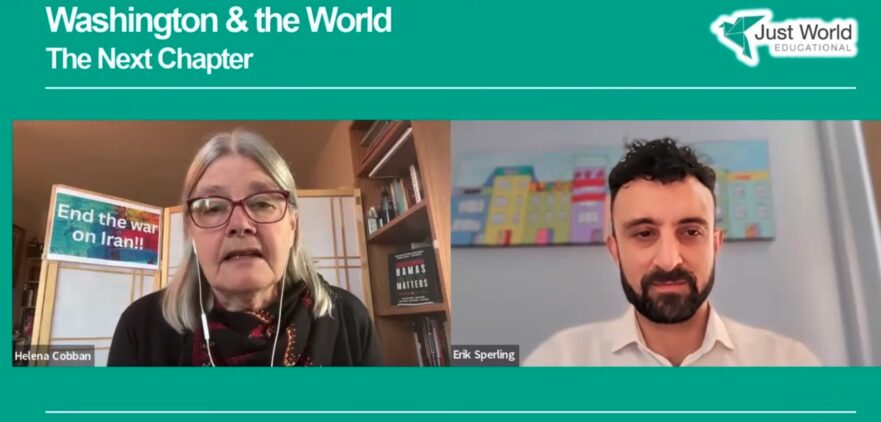
In this third episode of Just World Ed’s project “Washington and the World: The New Chapter”, JWE president Helena Cobban spoke with Erik Sperling, Executive Director of Just Foreign Policy. They explored the nuts and bolts of what members of the U.S. Congress (both houses!) need to do to bring the War on Iran to a speedy end. They also discussed the leadership fight in the Democratic caucus in the Senate, approaches to advocacy to end Israel’s genocide in Gaza, developments across West Asia as a whole, and preliminary takes from the recent trilateral summit in Shenzhen.
You can see the video of this whole, super-timely whole 30-minute conversation here. Listen to the audio on Apple Podcasts or Spotify. This week, we figured if you want to read a transcript, we’re sure you can make your own!
In the episode, Sperling explained how the War Powers Resolution worked. Any single member of Congress can force a vote, which is why, he said, the tool matters. The votes get senators on the record against the war… But he said the movement often stalls there. Many senators say “I voted against it” and leave it at that. regarding the War on Iran, some of those same senators then even attacked Trump and Vance from the right when he signed the June MOU with Iran. The next test is therefore money.
With a key December 11 funding deadline coming, Sperling said the question was whether Democrats would keep paying for the war. He talked about Sen. Chris Van Hollen‘s challenge to Chuck Schumer and the split among Democrats. Some refused to fund the war, while others looked for reasons to go along. He also flagged the blockade of Iran as a key issue in any deal.
He and Cobban also discussed:
- Why Sperling thought Section 219 of the NDAA, the U.S.-Israel military integration provision, could realistically be removed
- Why he wanted Gaza advocacy to center on an arms embargo, not only aid
- Cobban’s view of the regional balance, including Saudi Arabia and the escalation in Yemen
- Whether U.S. bases in the Gulf were worth the cost, and why the next big base fight could be over the South China Sea
- The Shenzhen summit and the fight over who would lead a House China committee.
Sperling ended with advice for anyone watching: Don’t settle for symbolic statements. Press your representatives on what the plan is to end the war, what the steps are, and how they will vote.