
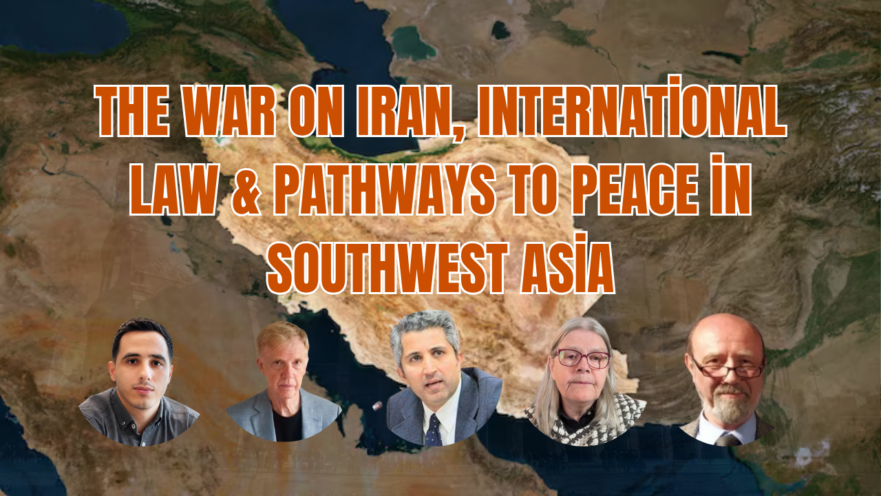
On August 11, 2026, the Organization for Defending Victims of Violence (ODVV) held an international webinar titled “International Webinar Examines the War on Iran, International Law and Pathways to Peace in Southwest Asia.” The Schiller Institute and Just World Educational were co-sponsors of the event.
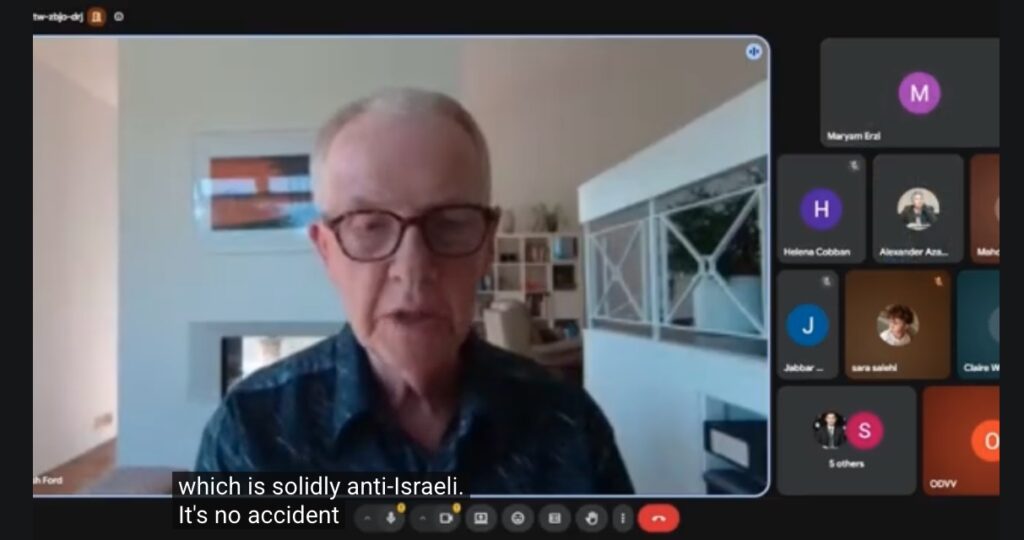
By agreement with ODVV we have now posted the full 96 minutes of the webinar on JWE’s YouTube channel, here. (Click down on that page to find separate links to the segments by the various speakers.)
This webinar brought together specialists in international law, geopolitics, international political economy, and Middle Eastern affairs from three continents. They examined the legal, humanitarian, political, and economic dimensions of the ongoing U.S.-Israeli war against Iran, as well as its consequences for the wider Southwest Asia region and possible routes toward peace. ODVV’s CEO, Mahdi Mohebirad, opened the session by stressing that behind the legal and geopolitical debates lie real human costs, and framed the discussion around whether economic cooperation, grounded in respect for international law, could help build a more stable region.
Was the War Against Iran Lawful?
Much of the webinar centered on whether the military campaign launched against Iran on February 28, 2026, complied with international law. Professor Alexander Azadgan, presenting what he described as an independent academic assessment, argued that the Trump administration’s resort to force against Iran was difficult to reconcile with the UN Charter. He noted that Article 2(4) of the Charter generally prohibits the use of force against another state, subject to two recognized exceptions: authorisation by the UN Security Council or the exercise of self-defence under Article 51. In his assessment, neither basis had been convincingly established, and he pointed to International Court of Justice jurisprudence, including the Nicaragua case, in support of the view that claims of self-defence must meet standards of necessity and proportionality. Azadgan also referenced the assassination of Iran’s head of state alongside members of his family on the first day of the war, and described a missile strike on a school in Minab, in southern Iran, that he said had killed at least 156 people, mostly children. He characterized the strike as a violation of international humanitarian law and noted that it had drawn condemnation from UNESCO and other international bodies.
Dr. Jabbar Aslani, a visiting professor of international law, offered a more institutional analysis of the same conflict. Rather than focusing solely on the legality of the initial use of force, he argued that the deeper problem is the persistent gap between existing legal rules and the political will and institutional capacity needed to enforce them. He noted that both the United States and Iran had separately invoked Article 51 self-defence claims, illustrating how contested facts can undermine agreement on how the law applies even where the rule itself is clear. Aslani proposed a five-level “preventive peace architecture,” moving from early warning and preventive diplomacy through legal verification, managed de-escalation, and post-ceasefire peace consolidation. He argued that ceasefires, including the one reached between Iran and the United States in June, need mechanisms such as joint monitoring, independent verification, and direct military-to-military communication channels if they are to hold, and he called for reforms to strengthen the role of the International Court of Justice and to improve accountability around the Security Council’s use of the veto.
Development, Alliances and Fractures
Claudio Celani, speaking on behalf of the Schiller Institute and its chairwoman, Helga Zepp-LaRouche, situated the war within a broader argument about development and diplomacy. Drawing a line from the 1648 Peace of Westphalia to the founding principles of the UN Charter, he argued that lasting peace requires negotiations that reflect the interests and development of all parties involved, not just the most powerful. He presented the Schiller Institute’s “Oasis Plan” for Southwest Asia, which proposes desalination and development corridors, including canals linking the Mediterranean, the Dead Sea and the Red Sea, powered by nuclear energy, as a way of tying regional security to shared economic development. Celani placed the war against Iran within what he called a broader pattern of conflict linked to shifting global economic power, and argued that the war had accelerated instability in energy markets and contributed to strain on European economies.
Peter Ford, a former British ambassador to Syria and Bahrain, took a more geopolitical view, arguing that the war had exposed and deepened fractures both within Europe and among Gulf states. He pointed to Spain’s public refusal to allow the United States to use its bases as an example of a government responding to public opinion, contrasting this with what he described as the British government’s public claims of non-involvement despite allowing American use of British bases. He also argued that cracks had widened within the Gulf Cooperation Council, particularly around Saudi Arabia, which he suggested was gradually distancing itself from Washington in response to strongly pro-Palestinian domestic opinion. Ford was candid that, in his view, the pressure generated so far had not been sufficient to change American or Israeli policy, and he suggested more instability, rather than less, might ultimately be needed to bring about a shift.
Helena Cobban’s Contribution
Helena Cobban, president of Just World Educational and a longtime international affairs and Middle East analyst, offered a proposal for how a sustainable peace might actually be built. Drawing on her past work on how deep-seated conflicts are terminated, including years spent examining the origins and purposes of international law, Cobban agreed with earlier speakers that the February 28 attack constituted an unprovoked war of aggression, and she noted that it followed an earlier assault on Iran by Israel and the United States in June 2025. She argued that both attacks had left core UN institutions and Charter principles severely weakened, and she described the task of salvaging what remains of that international order, particularly ahead of the UN General Assembly, as urgent.
Cobban structured her proposals for resolving the conflict around four categories of measures. The first would help make Iran whole for the damage inflicted by both wars of aggression, as well as by decades of prior US economic sanctions. The second would guard against a repeat of such aggression by any state. The third would hold the aggressor states accountable, though she cautioned, citing the harsh treatment of Germany after the First World War, that punishment needs to be proportionate rather than punitive to the point of destabilizing. The fourth, which she described as crucial, would repair the international governance system whose prior weaknesses had allowed the aggressions to happen in the first place.
At the centre of her presentation was a proposal for a “zone of peace” in the Persian Gulf, built around the littoral states themselves: the six Gulf Cooperation Council members, Iran, and Iraq. She suggested that such an arrangement might draw on the model of the Helsinki Accords and the Organization for Security and Cooperation in Europe, which helped ease Cold War tensions, as well as the postwar reconciliation that underpinned the European Union. Central to her proposal was the exclusion of external military bases from the region, which she argued, drawing on her own experience of Britain’s withdrawal from the Gulf and the subsequent American military presence that followed it, had repeatedly proven to be a source of instability rather than security.
Cobban also devoted significant attention to the continuing crisis in Gaza and the West Bank, describing Israel’s actions there as an ongoing genocide that she said remained closely linked to the wider crisis facing the UN. She pointed to UN Security Council Resolution 2803 as an example of the Council ceding its authority to act, and she argued that this failure represented an existential test for the United Nations as an institution, one made more urgent by the fact that the UN was due to elect a new secretary-general in the coming months. Later in the discussion, responding to a question about the involvement of Gulf states in the war, Cobban added a further point: that the US military’s Central Command, which she said coordinated the attacks on Iran, includes Israel as a full member, a structural link that dates only to the period following the Abraham Accords.
Implications for Peace and Regional Stability
While the speakers approached the war from different disciplinary and political vantage points, several shared concerns ran through the discussion. There was broad agreement that the war had exposed serious weaknesses in the international system meant to prevent such conflicts, from the Security Council’s political paralysis to the erosion of institutions like the International Criminal Court. There was also a shared sense that any durable peace would need to go beyond a simple cessation of hostilities to address the underlying causes of the conflict, whether through Aslani’s proposed institutional reforms, Celani’s development-based diplomacy, or Cobban’s regional security architecture.
At the same time, real differences emerged. Ford, for instance, explicitly disagreed with Cobban’s zone-of-peace concept, arguing instead that the outright breakup of the Gulf Cooperation Council would better serve Saudi Arabia’s interests. These disagreements reflected the genuine uncertainty among the speakers about which paths might realistically lead toward regional stability, even as they converged on the need to hold the aggressor states accountable and to restore the credibility of international law.
Related Discussion: “Palestine, Iran and the Shifting Politics of the Middle East”
Readers interested in Cobban’s analysis of how these issues have continued to develop may also want to watch a more recent discussion, “Palestine, Iran and the Shifting Politics of the Middle East,” organized by the Hashim Sani Centre for Palestine Studies. In that conversation, Cobban examined political shifts within the US Democratic Party, including the emergence of younger pro-Palestinian candidates and the role of Arab American voters in recent primary elections, alongside new alliances forming between Palestinian rights advocates and anti-Zionist Jewish groups. She also discussed why she believed US and Israeli expectations for the war on Iran had failed to materialize, addressed the situation in Lebanon and its parallels with Gaza, and offered her reading of the fragile Gaza ceasefire, including Hamas’s offer to hand over its heavy weapons and the disputed role of the proposed Board of Peace. She closed that conversation by explaining why she felt more optimistic than she had in some time, citing political shifts in the United States, potential changes at the United Nations, and what she called the resilience and leadership shown by Palestinians and Iranians.
You can also watch Helena Cobban’s discussion, “Palestine, Iran and the Shifting Politics of the Middle East,” by clicking here.