
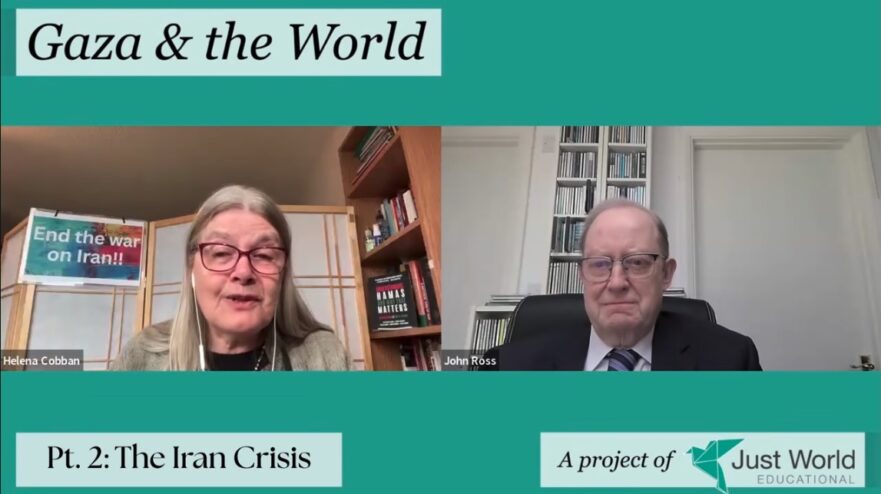
“If Iran is left after the war in control of the Straits of Hormuz, this is a tremendous strategic defeat for the United States.”
This was one of many crucial judgments expressed by John Ross, who’s a Senior Fellow with the Chongyang Institute for Financial Studies, Renmin University of China, in the conversation he had May 9 with Just World Ed president Helena Cobban. They were talking at a point midway between the May 6 visit of Iranian FM Abbas Araghchi to Beijing and the upcoming visit by U.S. President Trump, who’ll be holding an important summit there with Pres. Xi Jinping on May 13 or 14.
This conversation was #20 in Just World Ed’s ongoing ongoing project on the Iran Crisis.
You can see the whole video of their conversation here. Catch the audio on Apple Podcasts and Spotify. Or download the transcript here.
In the convo, Ross said China’s response reflects both immediate economic interests and a broader rejection of any single country claiming the right to control world trade.
He said China’s immediate interest is the reopening of the Strait of Hormuz and the lifting of the U.S.-imposed blockade. He noted that Iran had declared the strait open under the ceasefire, while Washington’s imposition of a blockade amounted to an act of war that contradicts the truce. He said that China has a direct stake in the issue because it buys roughly 80 to 85 percent of Iran’s oil, making Beijing Iran’s most important customer. But he emphasized that China is not highly dependent on Iranian crude compared with its overall energy profile and has built substantial reserves and alternative supplies.
A central theme of the discussion was Ross’s view that the U.S. is increasingly relying on military or military-related measures to dominate global trade. He pointed to a pattern that included war in Iraq, support for Israel’s military campaign in Gaza, the blockade of Cuba, pressure on Venezuela, and now the attempted restriction of energy routes affecting China. Ross argued that Washington’s preferred approach to challenging China directly at sea is no longer feasible close to Chinese shores, because China’s navy is now too strong. As a result, he said, the United States has shifted its coercive efforts farther away, including toward the Middle East and other strategic chokepoints.
He said China will not accept a world in which one power decides where shipping can move and where trade can be blocked. He argued that Beijing sees this as not only a question of Iranian oil, but also as a broader challenge to the international order. China, he stressed, regards unilateral sanctions as illegitimate unless they are authorized by the U.N. Security Council, adding that Beijing’s position is firm on this point and will not change.
The conversation also explored whether a broader coalition could challenge the blockade. Ross said China would welcome coordinated action by multiple countries, but he stressed that the main obstacle is not capability so much as political will. He suggested that a collective approach by states in Europe, the Global South, and elsewhere would be more effective than isolated gestures. However, he noted that most governments have so far avoided direct confrontation with Washington. He described Europe’s posture as politically cautious and strategically submissive, though he noted that European leaders have also been constrained by public opinion that is strongly opposed to war.
On China’s diplomacy, Ross said Beijing tends to act quietly and methodically rather than through public denunciations. He and Cobban pointed to the role China played in earlier regional diplomacy, including the 2023 rapprochement between Saudi Arabia and Iran; and he said the Chinese and Pakistani foreign ministers appear to coordinate closely on current West Asian diplomacy.
He framed this crisis as part of a wider geopolitical contest with deep economic implications. He argued that China is now outpacing the United States economically and has become a technological leader in multiple sectors, including renewable energy, electric vehicles, drones, AI, telecommunications and some pharmaceuticals. In his view, this motivates Washington to respond to its relative decline by using coercive or military tools in response. He said the real danger is not necessarily a full-scale U.S.-China war but a series of escalating confrontations around Taiwan, the South China Sea, and energy routes.
On the Iranian side, Ross said the decisive issue is not the nuclear question but missile capability. He noted that Iran’s ability to retain and use missiles gives it an effective deterrent and makes any attempt to destroy its military capacity incomplete. He said Iran can inflict unacceptable damage on Israel and that this remains central to the strategic balance.
The discussion closed with reflection on the U.N. Security Council’s role in the Gaza war and the wider regional crisis. Ross said he supports a stronger Security Council role on Gaza, Cuba, and the anti-blockade issue, though he declined to speculate on why China and Russia did not veto the latest Gaza-related resolution. He said such decisions may have depended on information and calculations not visible from the outside.
Overall, Ross portrayed the Iran crisis as a test of whether the United States can still enforce its will over global trade and energy flows, and whether China and other powers are prepared to resist that claim through diplomacy, coordination, and long-term strategic patience.