
“The key to Iran’s leverage right now … is the Strait of Hormuz.”
“If the future of international law is that it comes completely unraveled, we are going to be living in a far more terrible, more violent, more destructive world.”
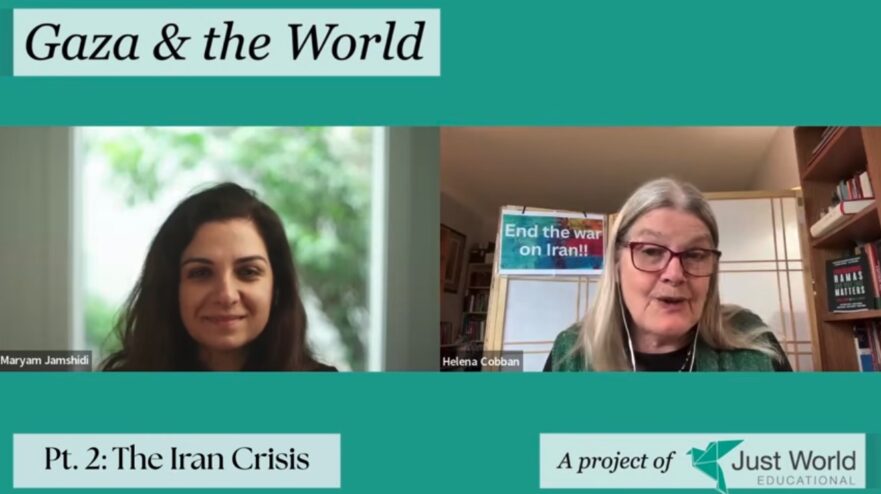
These were just two of the key insights that Maryam Jamshidi, an Associate Professor of Law at the University of Colorado, shared with JWE president Helena Cobban during a wide-ranging conversation the two of them held May 7, in the 19th episode of JWE’s ongoing “Iran Crisis” project.
You can see the video of their whole 45-minute conversation here. Find the audio on Apple Podcasts or Spotify Or you can download the transcript here.
This conversation explored many very timely issues, including:
- What international maritime law has to say about the rights Iran may enjoy over the Strait of Hormuz,
- The depth of the remaining differences between the U.S. and Iranian positions on how to end the war,
- The sad history of the UN Security Council’s engagement in the question of the U.S.-Israel war on Iran, and,
- The utility of international law in the present, lawless era.
Early in the conversation, Jamshidi noted that the fundamental disagreements between the United States and Iran are over the future survival and independence of the Islamic Republic, the security order in the region, and the legal framework governing the Strait of Hormuz. She argued that Washington’s real objective goes beyond its public insistence that Iran must not obtain a nuclear weapon. “What the United States wants, what Trump wants … is that he wants to bring an end to the Iranian revolution,” she said, adding that this would amount to “an end to Iranian independence and sovereignty.”
She said that Iran, meanwhile, is aiming to preserve and expand its sovereignty while resisting what it sees as U.S. pressure and coercion. She said Iranian officials appear to believe (and “with good reasons”) that they have achieved really meaningful successesthrough the recent conflict, and she pointed to the Strait of Hormuz as the central instrument of that leverage. According to Jamshidi, Iran’s negotiating position includes demands for an end to U.S. sanctions, a new regional security arrangement, limits on U.S. bases in the area, and possibly reparations. She said Iran may be using fee-based arrangements in the strait as a practical route toward compensation, though the details on that remain unclear.
A major portion of the discussion focused on maritime law and the legal status of the Strait of Hormuz. Jamshidi explained the difference between the “transit passage” regime adopted in the 1982 UN Convention on the Law of the Sea (UNCLOS) and the “innocent passage” approach to the governance of passage through straits that was embodied in the much older “customary law” framework. Neither Iran nor the United States is a full member of UNCLOS. Jamshidi said that Iran has never accepted the transit-passage approach and instead relies on innocent passage, which gives coastal states greater regulatory authority and can allow fees for certain services.
She noted that Iran is in a unique position because the strait lies wholly within the territorial waters of Iran and Oman– but the deepest and most navigable waters are on the Iranian side. She also said that the Turkish Straits and the 1937 Montreux Convention that governs passage through those international waterways are not a close analogy, though that widely respected Convention does show that international waterways can operate with fee structures without the degree of global disruption that some people fear might be sparked if Iran is “allowed” to charge fees for passage through Hormuz.
“The world doesn’t fall apart when an important international strait is now subject to fees,” she said, adding that coastal states can regulate passage for security-related reasons and that innocent passage requires a good-faith legal basis rather than a fabricated justification. Jamshidi emphasized that Iran’s conduct in the strait may be lawful if it remains within the innocent-passage framework.
The conversation also turned to the United Nations Security Council, which Jamshidi described as having played a deeply troubling role regarding the genocide in Gaza, Israel’s aggression in Lebanon , and certainly regarding the unprovoked, U.S.-Israeli war of choice against Iran. She said the Council has been largely ineffective on Gaza and Lebanon and has at times moved in ways that could intensify conflict with Iran. She criticized in particular the UNSC’s March 11 resolution that, she noted, condemned Iran without even acknowledging the unlawful U.S.-Israel war that had set the broader crisis in motion. She also said that a follow-on draft resolution that SC members voted on on April 7 would have effectively authorized armed action by UN member states against Iran to force the opening of the strait, which she called “very problematic” and potentially disastrous. She and Cobban noted with some relief that both China and Russia had vetoed that resolution.
Jamshidi argued that the Security Council cannot simply use Chapter 7 to override fundamental state rights or authorize war over a dispute about maritime regulation. She said a new version of the same proposal is now once again being pushed at the Council and warned that it would be a “disaster” if adopted. She said the best immediate outcome in the near future would be for the Council not to make the current situation even worse.
The discussion concluded with a broader defense of international law. Jamshidi rejected the idea that it is merely a tool of Western power, saying states in the Global South continue to invoke it because it remains one of the few available protections against domination. She said Iran, Palestine, and other actors are still trying to use international law to assert equality and self-determination. “If the future of international law is that it comes completely unraveled, we are going to be living in a far more terrible, more violent, more destructive world,” she concluded.