
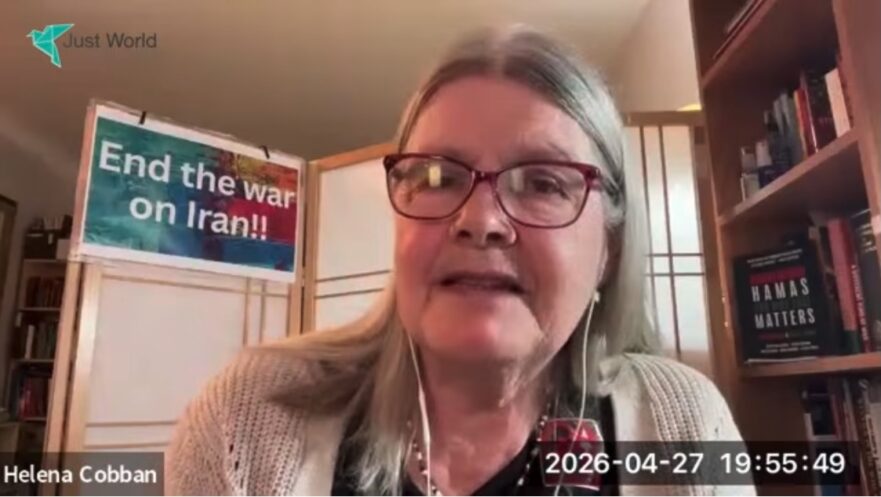
5,000 years ago, the Strait of Hormuz was a key connecting point between the seminal ancient civilizations in the Indus Valley and Mesopotamia (present-day Iraq.) That was a key insight that Just World Ed president Helena Cobban shared with attendees at a conference hosted by Northern California’s Mount Diablo Peace and Justice Center, last weekend.
Cobban was unable to be at the conference in person, and she had to pre-record her contribution more than 24 hours before the audience would see it. Given that events in the U.S. War on Iran were moving both speedily and unpredictably, she decided to focus her contribution on the “long” view of the history of Hormuz, tracing the role it had played not only in ancient times but also at key junctures in the history of Western colonial penetration of the vast, well-developed Indian Ocean trading zone.
You can see her whole presentation on Youtube, here. The audio is on Apple Podcasts and Spotify. Or you can download the complete transcript here. Here is a summary of her presentation:
Cobban opened by situating the talk within the ongoing US-Israeli military campaign against Iran, which began on February 28th. She traced Hormuz’s ancient origins as a key node connecting the Indus Valley and Mesopotamian civilizations, and from then on as a significant artery in the vast Indian Ocean trading zone that once stretched from East Africa to China.
She described that pre-European world as a thriving, self-governed commercial network with its own well-developed technologies and norms, referencing the key work of historian Janet Abu-Lughod.
She then walked listeners through the entry into that world of five European imperial powers: Portugal, Spain, England, the Netherlands, and France. She described what she called the “White Supremacist International,” a succession of empire-building ventures driven by profit, looting, and the rise of finance capitalism. She noted Portugal’s violent seizure of Hormuz in 1507 under Afonso de Albuquerque, followed by the London-based East India Company’s takeover of the port in 1622, and drew direct parallels between those colonial methods and what Israel is doing in Palestine and Lebanon today.
Turning to the present, Cobban assessed Iran’s position as one of considerable resilience. She pointed to the mountainous topography of Iran’s southern coastline, its fast naval vessels hidden in coastal caves, and its missile capabilities as factors that made capitulation unlikely.
She also noted the significant role of Pakistan as a mediator in the current conflict, in contrast to the United Nations, which she described as almost entirely sidelined, and the United States. She referenced her recent conversation with Iran expert Trita Parsi of the Quincy Institute for Responsible Statecraft, whom she described as a valuable voice for diplomatic restraint. And she applauded the attendees at the conference for their commitment to ending the War on Iran