
“The most likely scenario, and I would put it at 70%… is that there will essentially be a new non-negotiated status quo that ends the war… Trump ends the war, does not [forcefully] open the straits. I think the US side recognizes that the Iranians are going to control the straits, whether there is a deal or whether there isn’t a deal.”
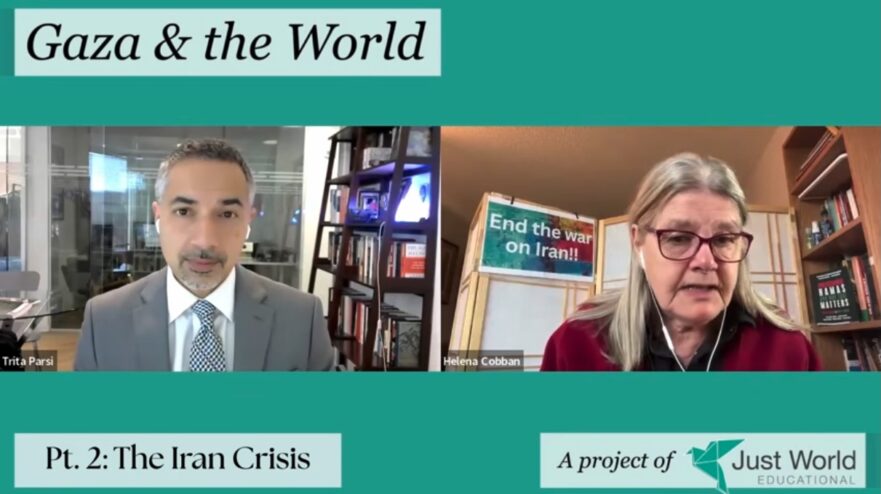
This was the assessment that Trita Parsi, a veteran scholar of Iranian and international affairs shared with viewers on April 21, around 30 hours before the expiration of the current Iran-U.S. ceasefire.
This conversation, which was conducted by JWE president Helena Cobban, was the latest episode of Just World Ed’s Iran Crisis Project. You can see the whole conversation on Youtube, here. You can listen to it on Apple Podcasts or Spotify, or read the transcript here.
In the conversation, Parsi said there was “still a chance” of talks resuming in Pakistan before the current two-week-long ceasefire expires on Wednesday, but that he was “becoming increasingly skeptical” because the Trump administration seems unable to negotiate effectively or convince the Iranians that it could implement any agreement. He stressed that recent behavior by the administration had left Tehran deeply doubtful about Trump’s intentions, honesty, and ability to conduct meaningful follow-through.
Parsi’s broader point was that the administration may want a deal in principle, but it lacks the discipline and credibility to close one. He described Trump’s messaging as erratic and said the lack of control around public statements and social media had become a serious obstacle. In his view, that dysfunction, combined with repeated reversals and broken promises, made it hard to imagine “something big” emerging before the ceasefire deadline.
A major theme of the conversation was Trump’s desire to avoid a costly war even if he had helped to start this one. Parsi said Trump likely now sees that the war “was a disaster” and that he had been “sold this war” by Israelis who presented it as an easy, fast operation. He and Cobban likened that mistaken confidence to the Iraq war’s infamous “cakewalk” sales pitch and argued that Trump is beginning to realize the conflict with Iran is not a quick or simple military project.
He said one reason Trump may hesitate from resuming full-scale military operations is that he understands he does not have “escalation dominance.” That means the United States cannot freely strike Iranian infrastructure without risking retaliation against Gulf oil facilities, American personnel, or regional shipping routes. He pointed to Trump’s threats that were never carried out, such as those against Iranian infrastructure, or threats to invade Iranian islands, and said that military advisers had repeatedly walked him back because they knew such moves could deepen the crisis rather than solve it.
The conversation also focused on the key role, from Iran’s perspective, of sanctions relief. Parsi argued that a real deal would require major sanctions relief, which Trump may not oppose in principle, but which would trigger fierce resistance from Israel. He said Israel could tolerate an ambiguous standoff, but a genuine deal with sanctions easing would be “the most disastrous outcome” for Israeli interests because it would legitimize an outcome that did not keep Iran fully isolated.
One of the more striking parts of the conversation was Parsi’s description of Lebanon as a test case. He said the Iranian demand that Lebanon be included in the ceasefire was meant to test whether Trump could actually restrain Israel, and that trump had partially (and belatedly) passed this test when he publicly stated that Israel was “prohibited” from resuming its bombing of Lebanon. The conversation returned several times to the idea that Iran wants proof that Trump can say no to Israel and sustain that position.
Parsi then laid out three scenarios for the period after the ceasefire. He assigned a roughly 25% chance to a real negotiated peace, but said the most likely outcome was a “new non-negotiated status quo” that would end the war without resolving the underlying dispute. He pegged that outcome at a 70% probability (with the remaining 5% being the probability of Washington resuming full-scale military operations against Iran.) In the “70% scenario,” he said, there would be no war, no sanctions relief, and no nuclear compromise, but also no political will on either side to return immediately to full-scale conflict. He warned, however, that this would be unstable and could still produce fresh escalatory incidents, especially if the U.S. blockade of Iran became more aggressive.
He identified two wildcards that could upset that scenario: an Israeli effort to restart war on its own, or a Trump decision to keep a blockade in place for political show. Either move, he said, could trigger retaliation by Iran, including against American ships or in the Red Sea. The 70% scenario would not be peace, he said, but it would be something short of open war, with constant risk of sliding back into a larger conflict.
The conversation ended with a discussion of the wider regional and U.S.-domestic political effects. Parsi said Gulf states now understand that the American security guarantee is not as reliable as they once believed, and that they are likely to diversify their security relationships rather than rely entirely on Washington. He also noted that Israel has been losing support rapidly across the whole U.S. political spectrum, including among Democrats and in the America First wing of MAGA, and that this shift will matter in the upcoming midterms and in 2028.
His final point was that U.S. foreign policy is heading toward a larger realignment. He said the Quincy Institute’s goal is to move American strategy away from primacy and hegemony toward restraint, and that this requires a bipartisan base. In his view, the conversation around Iran is becoming part of a much bigger debate about how the United States should use power, how much weight it should give Israel’s preferences, and whether future administrations will be willing to pursue a more disciplined and less militarized foreign policy.