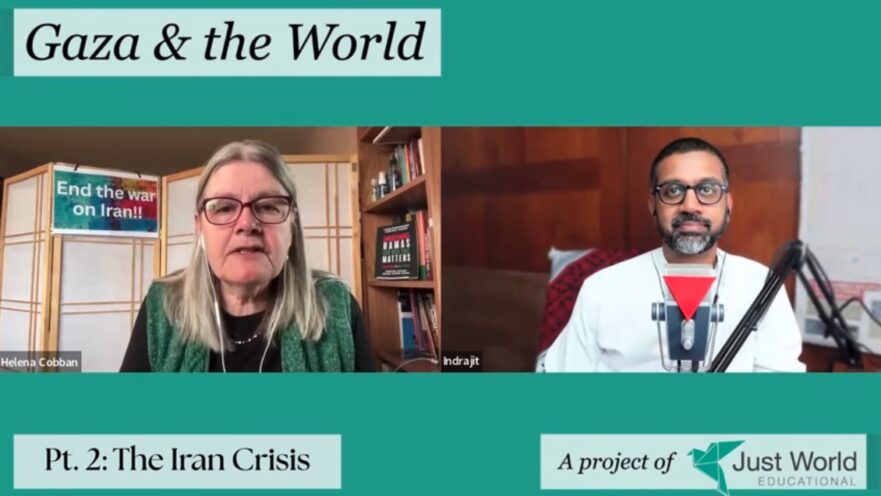
In an April 9 conversation with JWE president Helena Cobban, the Sri Lankan thinker Indi Samarajiva argued that “the subject of history is changing,” meaning that the U.S. and Trump are no longer the main drivers of events, while Iran and the broader movement of anti-empire Resistance have taken the initiative, instead.
The two conducted their globe-girdling conversation during a tumultuous week marked by the grotesque threats that Pres. Trump had voiced against Iran April 5, huge uncertainty over the fate of the two-week ceasefire he announced April 7, and the hyper-violent assaults that Israel undertook against Lebanon April 8. It formed the eleventh episode of JWE’s continuing project on the Iran Crisis.
You can see this full 51-minute conversation with Samarajiva on Youtube, here. Listen to the audio on Apple Podcasts or Spotify, or read the transcript here.
A major theme of the convo was the decline of U.S. power in the Middle East. Samarajiva argued that American bases in the region were effectively vulnerable or unusable. Cobban pushed back a little by noting that the U.S. still had logistical reach through places like Cyprus and the UK. Even so, both agreed that the old security architecture in the Gulf had been badly shaken. Samarajiva insisted that U.S. military infrastructure had been “defenestrated” by Iran’s precision strikes and that the region’s balance of forces had changed in Iran’s favor.
The discussion also broadened into a critique of what Samarajiva called “white empire,” a phrase he used to describe five centuries of colonial domination stretching from the Portuguese to the present U.S.-Israeli alliance. For her part Cobban linked the current moment to the long history of Hormuz as a strategic hinge, recalling Portuguese expansion into the Indian Ocean and the effort to control trade routes. Samarajiva connected that history to modern forms of exploitation, and also tied it to Jeffrey Epstein as a symbol of a wider predatory system. He argued that abuse of women and children, colonization, and extraction are not separate stories but part of the same imperial logic.
Another important thread of the convo concerned international law and global institutions. Samarajiva said bluntly that international law functions “as intended” by empire, and that bodies like the ICC and the UN are selective in whom they restrain. He suggested that those institutions are not neutral and that the language of legality is often used to disguise power.
Cobban brought up the recent UN vetoes by China and Russia, asking whether those moves mattered. Samarajiva answered cautiously, saying he has little faith in the institutions themselves, but that China, Russia, and Iran seem to care about them as structures worth contesting.
The convo also explored the role of Pakistan and especially China within the emerging multipolar order. Cobban emphasized China’s behind-the-scenes support for Iranian resilience, including Iran’s shift away from reliance on American-controlled and -infiltrated GPS systems. Samarajiva argued that China operates differently from Western empires: it supplies, trades with, and supports other nations without the same urge to dominate. He contrasted China’s approach with the “smash and grab” style of the West and argued that Iran’s strength lies in its indigenous military and technological base. He also described a more hopeful model of global interaction rooted in trade, reciprocity, and sovereignty rather than conquest.
The conversation returned repeatedly to Palestine, Lebanon, and Gaza as central to the wider crisis. Samarajiva portrayed the anti-imperial Resistance as reclaiming the role of “a subject of history” through force and endurance, while Cobban stressed the catastrophic humanitarian toll of U.S.-Israeli militarism in ts current phase and the failure of the international system to stop it. By the end, both speakers framed the moment as a historical turning point: the erosion of U.S.-Israeli dominance and the broader White empire that it represents, the rise of new alignments, and the possibility of a more multipolar world.