
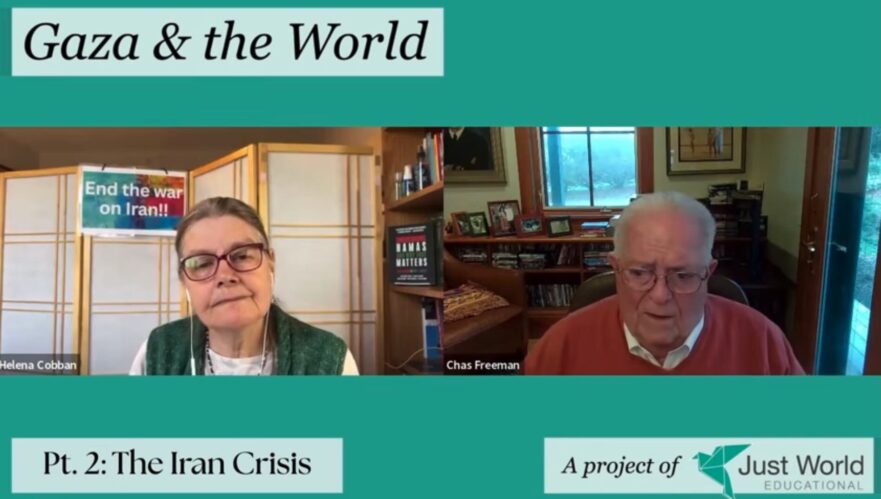
In an April 1 conversation with Helena Cobban, retired U.S. Ambassador Chas W. Freeman, Jr argued that the peace initiative that China and Pakistan proposed on March 31 for the Iran crisis could provide a much-needed diplomatic off-ramp for this increasingly damaging war. Freeman noted that Saudi Arabia, Egypt, and Turkey had all been intensively consulted on the initiative before its text was released, and said, of the Arab states that border the Persian Gulf that, “The only way they can eliminate the threat from Iran is to make peace with Iran.”
This convo formed the tenth episode of JWE’s continuing project on the Iran Crisis.
You can see the full 41-minute conversation with Amb. Freeman on Youtube, here. Listen to the audio on Apple Podcasts or Spotify, or read the transcript here. Plus, you can download the text of the Chinese-Pakistani initiative as released in Beijing and Islamabad on March 31, here.
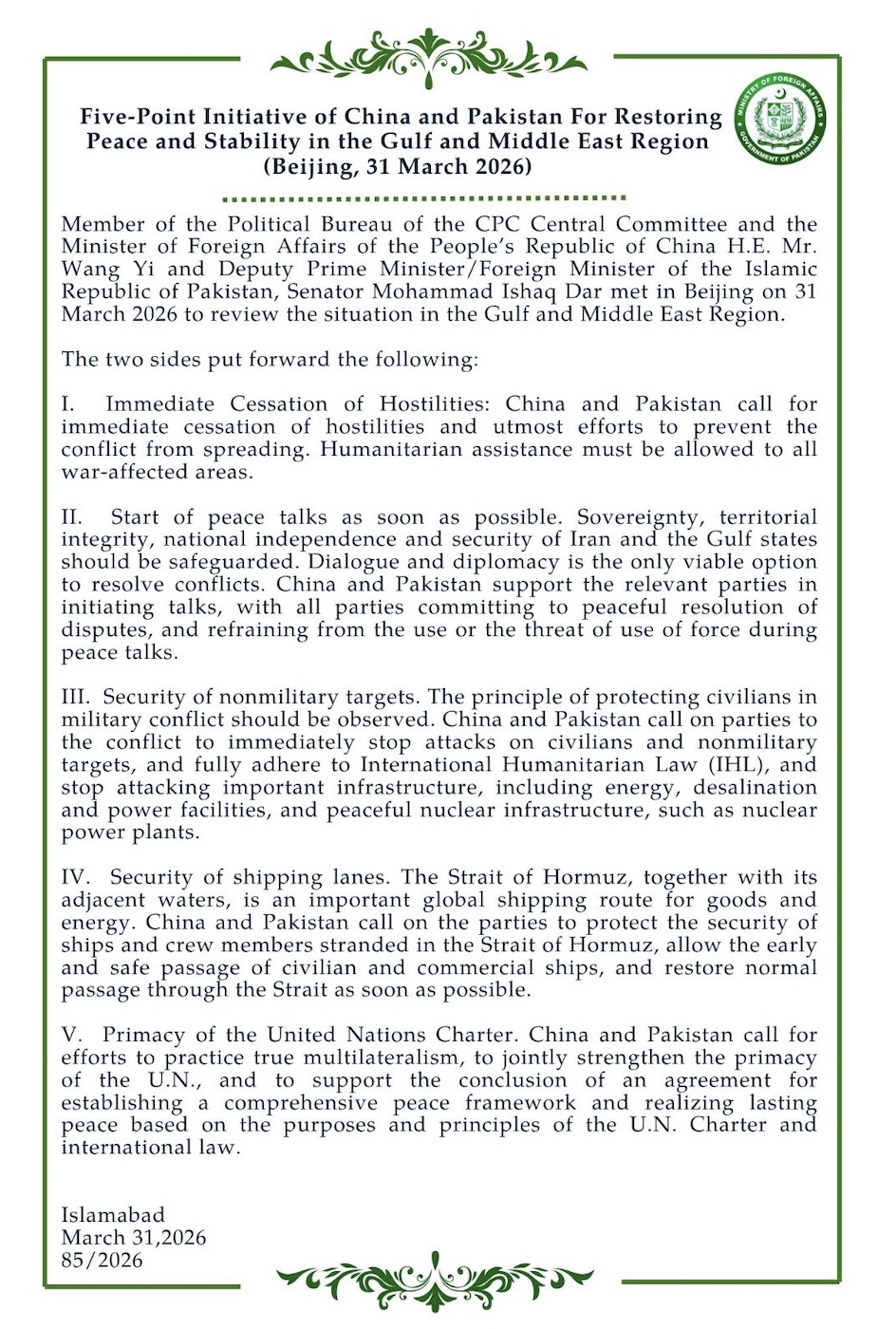
Peace initiative
Freeman noted that the Chinese-Pakistani proposal may offer Washington a way to step back from what he described as a disastrous conflict.
CFor her part, Cobban stressed Pakistan’s strategic position, noting its border with Iran and its ties to China, while also underscoring the significance of participation by states often treated in Washington as close partners. Freeman pushed back on that framing, arguing that the other three majority-Muslim governments that had been consulted are independent actors rather than true U.S. allies and that their interests are increasingly diverging from Washington’s.
Gulf choices
A major thread in the conversation was the pressure the war has been placing on Gulf states. Freeman argued that the region’s governments face a stark strategic choice: continue depending on the United States and Israel, or seek a durable accommodation with Iran. He said the war has exposed the fragility of external security guarantees and made regional self-help more attractive.
Freeman also discussed the Saudi-Pakistan defense pact and the broader possibility of new regional security arrangements. He said these developments reflect the recognition growing among the Arab states of the Gulf/Khalij that reliance on the United States as an arms supplier and security guarantor is no longer sustainable.
Israel’s role
The pair returned repeatedly to Israel’s role in the conflict and to the impact that role may have on continuing U.S. support for Israel. Freeman argued that the war cannot be separated from Israeli pressure for escalation and said the Israeli government has long pursued policies that deepen conflict rather than resolve it. He said the Chinese-Pakistani initiative should be read as a demand for a major shift in Israeli behavior.
Cobban highlighted the effect of the conflict on Gaza, Lebanon, the West Bank, and southern Syria, while Freeman said the war has widened beyond any single front. He argued that if the United States eventually steps away, Israel will confront a major strategic problem of its own making.
Humanitarian stakes
The conversation also focused on the humanitarian risks of further escalation– including the vulnerability of Arab Gulf societies to attacks on water infrastructure. Freeman noted that desalination systems are essential to life in those countries and warned that damage to them would be catastrophic. He described the Gulf states as highly exposed because their populations and economies depend very heavily on technologies that can be disrupted by war.
He extended that warning beyond the Gulf, saying the conflict is already producing collateral damage in India, South Korea, the Philippines, and elsewhere through fuel shortages, supply shocks, and wider economic disruption. In his view, the war is not a local crisis but a global destabilizer.
Nuclear danger
One of Freeman’s strongest warnings concerned nuclear proliferation. He said the war is creating incentives for Iran and other states to move toward nuclear capability, and he argued that the global nuclear non-proliferation regime may be one of the conflict’s biggest casualties. He suggested that Saudi Arabia, Egypt, Turkey, South Korea, and Japan could all reconsider their options if the current trajectory continues.
Cobban and Freeman treated that possibility as evidence that current policy is making the world less stable, not more secure. Freeman said the war is undermining the very structures that were supposed to prevent wider conflict.
Closing critique
The conversation ended with a sharp critique of U.S. and Israeli policy. Freeman dismissed Trump’s “Board of Peace” concept, saying he viewed it as fundamentally illegitimate. He argued that real stability will require accountability, pressure on Israel to change course, and a serious effort to reduce U.S. military involvement in the region.
Cobban closed by suggesting that meaningful change is still possible if governments and publics push for a genuine peace process. Freeman agreed that the region is undergoing a profound shift, and said the consequences of the war will continue to reverberate far beyond the battlefield.