
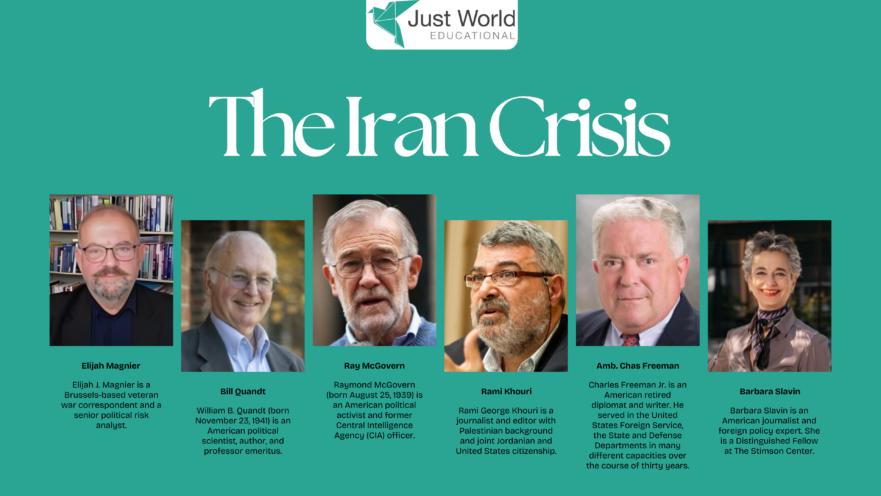
In late February 2026, Just World Educational launched a timely new series of expert conversations titled The Iran Crisis. The project forms Part 2 of the ongoing Gaza & the World initiative, which explores how the war in Gaza intersects with wider regional and global developments. Hosted by Just World Educational president Helena Cobban, the series brought together leading analysts, diplomats, journalists, and former officials to examine the origins, dynamics, and possible consequences of the rapidly unfolding confrontation involving Iran, Israel, and the United States. Across seven episodes, the conversations explored the strategic, political, economic, and legal dimensions of the crisis while highlighting its potential impact on the Middle East and the wider international system. Click here to access the project’s Resource Page on our website where you can find all multimedia records of the project.
The series opened with the episode titled “Elijah Magnier on ‘The Countdown between Tehran & Washington’,” featuring veteran strategic analyst Elijah Magnier. In conversation with Helena Cobban, Magnier warned that any U.S. attack on Iran could trigger a regional and global crisis with severe consequences. He explained that Iran’s ballistic missile capabilities give it the ability to inflict significant damage on U.S. bases and Israeli targets, which undermines the assumption that Washington could conduct limited strikes without facing serious retaliation. The discussion also explored the vulnerability of global energy supplies passing through the Strait of Hormuz and the potential economic shock that a major conflict could produce. Click here to watch the full recording, or here to access the full blog post summarizing the conversation on our website.
The second episode, titled “Bill Quandt on Trump’s Crazy Decision Making, Gulf Arab Politics, and More,” featured veteran policy analyst and former White House official Bill Quandt. Quandt examined the policymaking environment in Washington and described a highly personalized and unpredictable decision-making process under President Donald Trump. Drawing on decades of experience studying U.S. foreign policy in the Middle East, he analysed the influence of Israeli leadership, the internal debates within the U.S. national security establishment, and the possible paths toward either escalation or diplomacy with Iran. The conversation also placed the crisis within the longer history of U.S.–Iran relations and examined the strategic calculations of Gulf states that could be deeply affected by any regional war. Click here to watch the full recording, or here to access the full blog post summarizing the conversation on our website.
Episode three, titled “Ray McGovern on Why Trump is Unlikely to Initiate War and the Russian Dimension,” featured former CIA analyst and peace activist Ray McGovern. McGovern argued that several strategic and political factors make a full-scale war with Iran unlikely. He pointed to ongoing diplomatic contacts between Washington and Tehran, the role of Russia and China in encouraging negotiations, and the growing reluctance of the U.S. public to support another Middle East war. The conversation also addressed the gap between public perceptions of Iran’s nuclear program and the findings of the U.S. intelligence community, which concluded years ago that Iran halted work on nuclear weapons. McGovern suggested that diplomacy could offer a realistic alternative to confrontation if political leaders choose to pursue it. Click here to watch the full recording, or here to access the full blog post summarizing the conversation on our website.
The fourth episode, titled “Elijah Magnier on the Impact of the Iran War, Across West Asia and the World,” brought Elijah Magnier back for a deeper discussion of the evolving conflict. Magnier examined the differences between the strategic objectives of Israeli Prime Minister Benjamin Netanyahu and President Donald Trump. He argued that Israel seeks to weaken Iran permanently while the U.S. leadership often focuses on short-term political gains. The conversation also explored Iran’s resilience after heavy attacks, noting how its political and military structures continued to function despite major losses. Cobban and Magnier discussed how the war could reshape the security landscape of the Gulf region and expose the vulnerability of states that host U.S. military bases. Click here to watch the full recording, or here to access the full blog post summarizing the conversation on our website.
In episode five, titled “Rami G. Khouri on the Regional and Global Impact of the U.S.-Israeli War,” Helena Cobban spoke with veteran Arab journalist and analyst Rami G. Khouri. Their conversation examined the crisis within a longer historical context of Western intervention in West Asia. Khouri argued that Iran’s ability to withstand decades of sanctions and military pressure reflects a broader pattern of resistance to external domination. The discussion also addressed the regional expansion of the conflict, including strikes on energy infrastructure and the disruption of shipping routes. Cobban and Khouri emphasized the erosion of international legal constraints and the growing global economic risks created by the war. Click here to watch the full recording, or here to access the full blog post summarizing the conversation on our website.
Episode six, titled “Amb. Chas Freeman Defines Iran’s War Objectives & Prospects, & U.S. Politics,” featured former U.S. ambassador Chas W. Freeman, Jr. In conversation with Cobban, Freeman analyzed Iran’s war strategy and argued that Tehran entered the conflict with a coherent long-term approach. He outlined Iran’s objectives of exhausting U.S. and Israeli air defenses, imposing costs on Gulf states that host U.S. bases, and maintaining pressure through missile and drone strikes. Freeman also warned that disruption in the Strait of Hormuz could trigger a severe global energy crisis. The discussion further examined the broader geopolitical consequences of the war, including widening divisions between Western countries and the Global South. Click here to watch the full recording, or here to access the full blog post summarizing the conversation on our website.
The seventh and final episode, titled “Barbara Slavin on Iran’s Durability, Israeli-U.S. War Goals, and More,” featured longtime Iran expert Barbara Slavin. Slavin described the war as a risky strategic gamble driven by President Trump’s decision to align with Israeli demands for military action against Iran. She argued that while Iran has suffered severe damage, there is little evidence that the Islamic Republic is close to collapse. Instead, she warned that the conflict could lead to massive destruction while failing to achieve its stated political goals. The conversation also examined the domestic political pressures in the United States that could influence the future course of the war, as well as the broader international repercussions for U.S. credibility and global stability. Click here to watch the full recording, or here to access the full blog post summarizing the conversation on our website.
Taken together, the seven conversations in The Iran Crisis series provide a detailed and multifaceted examination of one of the most dangerous geopolitical confrontations of the present moment. By bringing together experts with decades of experience in diplomacy, intelligence, journalism, and policy analysis, the project offers audiences a deeper understanding of the forces shaping the conflict and the potential paths ahead. Readers are encouraged to explore the full series and engage with the insights shared by the speakers. Click here to access the project’s Resource Page on our website where you can find all multimedia records of the project.