
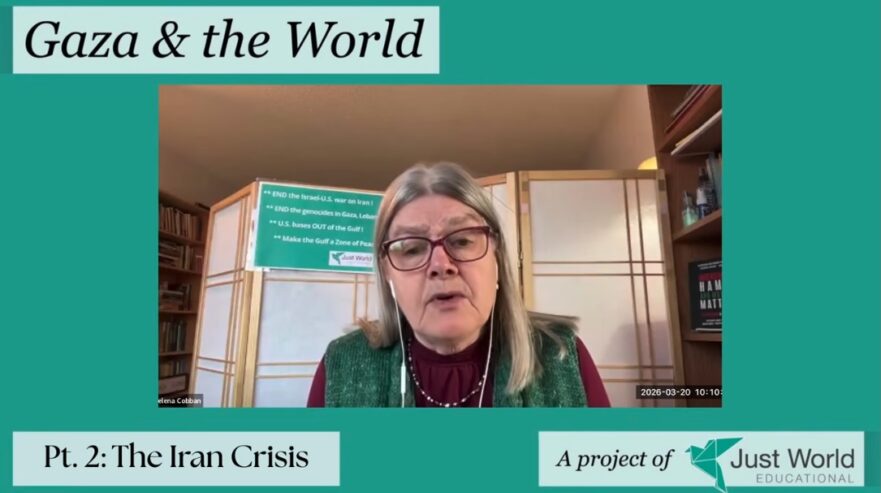
“It’s important to note the paralysis of the United Nations” was a central warning in an online talk that JWE president Helena Cobban gave on March 20, in which she observed that the current big crisis across West Asia highlights the continuing failure of most key global institutions. She also spoke to the specific responsibilities of U.S. citizens to do all they (we) can to find an end to the current conflict on a just and sustainable basis.
Cobban was speaking during the eighth episode of Just World Ed’s current “Iran Crisis” series, which is part of our continuing project on “Gaza and the World.”
You can watch the full video of Cobban’s 27-minute talk here. Find the audio on Apple Podcasts or Spotify; and a full transcript is here.
Cobban opened by describing the situation in Gaza, Lebanon, and Iran as a deeply connected chain of conflicts rather than separate crises. She noted that Israel’s military operations in Gaza have continued despite the “ceasefire” concluded among the parties in October 2025, and that Israel has restricted humanitarian aid shipments into Gaza to far below what was agreed in that accord. The 2-million-plus residents of Gaza are, she noted, still suffering under devastating hardships. She extended that same set of observations to Lebanon, where Israel has completely violated its commitments under the November 2024 ceasefire and has since February 28 expanded destruction across South Lebanon and into large parts of the capital, Beirut. She portrayed the damage inflicted by Israel as systematic and deliberate, arguing that the pattern of Israeli attacks in Lebanon mirrors tactics previously used in Gaza.
She then shifted her attention to Iran, where she noted that Israel’s strikes have targeted both governance structures and critical infrastructure, highlighting Israel’s attacks on energy facilities and on key institutional figures across security, police, political, and military spheres. The Israelis’ aim, she said, is not simply battlefield pressure but a broader attempt to sow “chaos, havoc, devastation and destruction” inside a large and resilient state. She emphasized that Iran’s size, geography, and military capacity make it very different from Gaza, but argued that the scale of disruption is still severe and potentially destabilizing for the wider region and the world.
A major theme of Cobban’s talk was the relationship between the United States and Israel. She argued that Israeli military operations in the region are deeply reliant coordination with the U.S. military, especially through CENTCOM, and she said Washington cannot credibly distance itself from the campaign. She said that when former President Donald Trump expressed surprise or discomfort with some Israeli actions, those comments did not change the underlying reality of close operational cooperation. She said the U.S. cannot claim ignorance if Israeli forces are able to move through regional airspace and target infrastructure only by enjoying close American coordination at all levels.
She also criticized Trump directly, saying he has been “jerked around” by Israeli leaders and has failed to exercise control over a relationship she sees as deeply unbalanced. She argued that the question is not simply whether Trump was misled, but whether U.S. institutions are functioning at all if they cannot clearly account for military operations conducted within airspace that is totally controlled by the U.S. military.
Cobban also addressed the economic dimension of the crisis. She pointed to the strategic vulnerability of the Strait of Hormuz and the significance of attacks on energy infrastructure in the Gulf. She noted that oil markets have already reacted sharply, with benchmark crude prices rising and the possibility of even steeper increases if the conflict continues. Disruptions to shipping lanes and energy markets could push the global economy into even deeper instability, hitting hard-pressed populations far beyond the immediate war zone. She noted that the effects are already being felt in Africa, Asia, South America, and elsewhere.
Cobban returned repeatedly to the United Nations, which she said has failed to respond meaningfully to Israeli and U.S. actions while finding time to criticize Iranian retaliation. She described Security Council behavior as lopsided and politically compromised, and she questioned why major powers with veto authority have allowed what she sees as harmful resolutions to pass. She acknowledged that some states, including Spain and China, have taken more constructive positions on parts of the crisis. But she said the overall UN system has become paralyzed at the moment when it is very sorely needed.
Her response was a call for U.S. citizens to act. She argued that Americans cannot stand aside merely as passive “global observers” because their government is directly implicated. U.S. voters have a responsibility to act, she said, to press for a different policy including the removal of U.S. military bases from the Gulf region. She characterized those bases as remnants of imperial control stretching back centuries and said they embody a long history of domination by outside powers over the region’s peoples and resources.
Cobban concluded with a forceful critique of Israel itself, saying the state has behaved like a “rogue elephant” and has lost legitimacy in her view. While stopping short of endorsing the most extreme language, she said the scale of destruction across West Asia has become intolerable and that the world must ask who will protect the global economy and vulnerable populations from the consequences. She closed by urging viewers to follow Just World Educational’s online platforms and by noting that Vijay Prashad is expected to join a future session.