
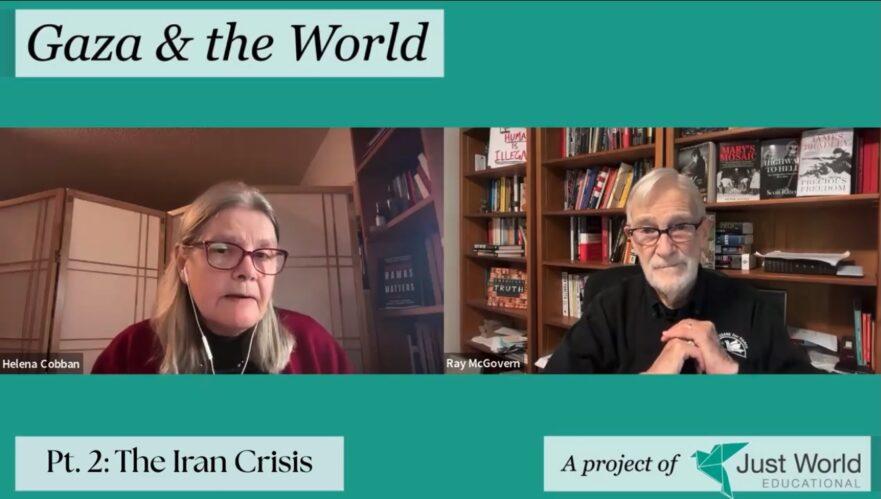
In an online conversation released by Just World Ed today veteran peace activist (and former CIA specialist) Ray McGovern provided a lively explanation of why he judges Trump is far, far more likely to do a deal with Iran rather than proceed with plans to attack it.
This convo, conducted by JWE president Helena Cobban,was the third episode in JWE’s continuing “Iran Crisis” series. You can view the whole 48-minute conversation on YouTube, here. Or you can listen to the audio version on Apple Podcasts, Spotify, or Buzzsprout.
Drawing on his decades of experience as a senior Soviet/Russia analyst and co‑founder of Veteran Intelligence Professionals for Sanity, McGovern laid out strategic, political, and diplomatic reasons why, in his view, escalation to full‑scale war remained a “fool’s errand.”
He stressed that emerging U.S.–Iran diplomacy, backed by active Russian and Chinese support, had already opened an off‑ramp from war. He highlighted the Geneva talks held February 26 by U.S. envoy Steve Witkoff and Iranian Foreign Minister Abbas Araghchi—no longer just “proximity talks” managed by Oman, but including a crucial face-to-face session—as a “big deal” that shifted the dynamic from confrontation to problem‑solving and paved the way for the technical discussions planned at the IAEA’s Vienna headquarters on March 2.
He predicted that Trump would claim victory by announcing an Iranian pledge never to develop nuclear weapons, reinforced by enhanced monitoring and disposition of highly enriched uranium to third countries– even though, as Cobban noted, Tehran had proclaimed and followed that policy for many years already.
A key theme of the discussion was the profound gap between U.S. public perceptions and the factual record on Iran’s nuclear program. McGovern recalled the post‑Iraq “honest estimate” that the U.S. intelligence community reached in 2005 that Iran had halted all work on a nuclear weapons at the end of 2003 and had not resumed it, a judgment held with “high confidence” across 14 agencies.
“What you don’t know, Trump can exploit,” he noted, adding that repeated rhetoric about “preventing Iran from getting a nuclear weapon” ignored both that estimate and the Supreme Leader’s 2003 religious edict against such weapons.
McGovern argued that military, electoral, and alliance factors all pushed Trump away from war. He pointed to reports that the U.S. military had depleted key missile stocks in Ukraine and might “run out of missiles” in any large Iran confrontation, as well as to strong public opposition to a new Middle East war and the political cost of “transfer cases” (body bags) returning to Dover Air Force Base in any substantial numbers before the fall elections. This, he suggested, had forced senior commanders to level with Trump about the true risks of a campaign that would likely trigger Iranian retaliation, closure of the Straits of Hormuz, and a global economic shock.
A “killer quote” from McGovern captured his core warning: “Somebody’s got to tell Trump… this is a fool’s errand. This is really terrible. You’ll go down in infamy, and besides that, you’ll lose Congress in the fall. Don’t do it.” He added a stark strategic irony for Israel: “If this thing went forward, and Israel was destroyed, you would get a Palestine from the river to the sea… Israel would be obliterated, pardon the word.”
The conversation also examined the possibility of what Cobban called a “diplomacy of entrapment,” including Israeli provocations and the risk of false‑flag incidents designed to drag Washington into war. McGovern judged a false‑flag scenario to be a “50–50 proposition” and underscored how much parts of the Israeli leadership and public still sought a “last chance” strike on Iran, despite the experience in June in which significant numbers of Iranian missiles penetrated Israel’s high‑tech defenses. Both speakers worried about whether Washington and Tehran could communicate quickly and credibly enough to prevent such incidents from spiraling out of control.
McGioern underlined the shifting geopolitical balance: “The Chinese have sent a very sophisticated intelligence ship,” he said, “and a very, very sophisticated radar system… Teamed up with Russian defenses, that should be enough to say, ‘Mr. Trump… it’s going to come to a no‑good end if you pursue this thing.’”
He described intensive Russian and Chinese consultations with senior Iranian national security officials in recent weeks, and suggested that Vladimir Putin likely used secure channels to tell Trump that this time– unlike last June– an attack on Iran would be treated as a “primary matter” requiring active Russian and Chinese support for Tehran.
Cobban closed by stressing the historic significance if the Islamic Republic of Iran managed to “stare down Donald Trump, and the Israelis, and the whole might of the Western world” and force them to step back—an outcome she said would carry “massive geopolitical consequences” that Just World Educational plans to explore in future programs. She also invited viewers to follow the rest of the organization’s “Gaza and the World” Iran series—featuring Trita Parsi, Amb. Chas Freeman, Barbara Slavin, and others—and to support Just World Educational’s broader work, including its earlier, pioneering Spring 2022 efforts on Ukraine and its 2024 book Understanding Hamas and Why That Matters.