
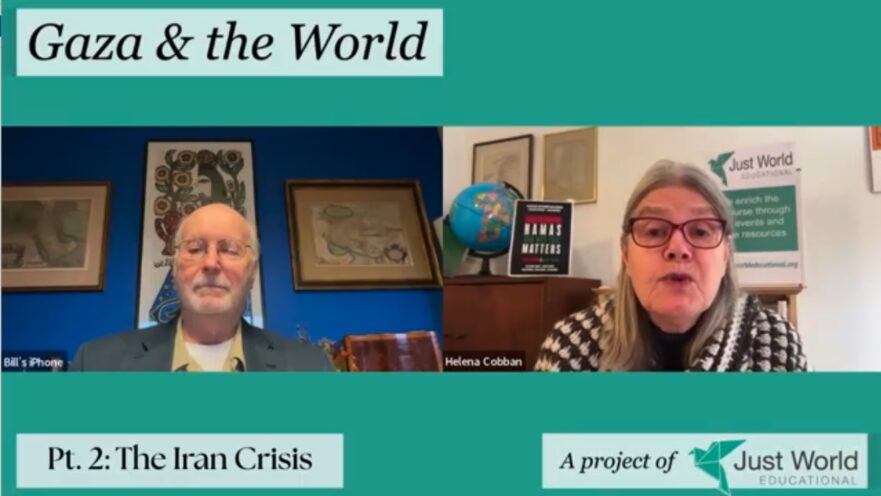
Just World Ed today released an in-depth conversation that examined the rapidly evolving Iran crisis that featured veteran policy analyst and former White House official Bill Quandt in dialogue with JWE president Helena Cobban. Quandt described the current policymaking process as a “shit show,” dominated by a television personality–style president who often disregards facts, rewards personal loyalty, and sidelines experts who might challenge him.
This was the second episode in JWE’s continuing “Iran Crisis” series. You can view the whole 33-minute conversation on YouTube, here. Or you can listen to the audio version on Apple Podcasts, Spotify, or Buzzsprout.
In this convo, Quandt drew on decades of experience studying U.S. national security decision-making and West Asia to offer a sobering assessment of President Donald Trump’s highly personalized and improvisational foreign policy style. He contrasted Trump’s approach with that of most post–World War II presidents, who, he noted, generally took foreign affairs seriously and surrounded themselves with well-informed advisors, even when their policies led to grave errors such as the Vietnam War. he argued that Trump, by contrast, brought very little substantive knowledge of international affairs to the Oval Office and had failed to compensate for this by appointing any strong, independent-minded national security aides.
Within this environment, he did see some institutional pockets of restraint, particularly in the Defense Department and intelligence community, which had to plan for real-world consequences such as casualties and regional escalation. Cobban highlighted the contrast between Secretary of Defense Pete Hegseth, whom she characterized as a staunch Trump loyalist, and Joint Chiefs of Staff Chairman Brigadier General Dan Caine, who had reportedly warned the president that an attack on Iran would be far from a “shoo-in” and could entail significant American losses.
Quandt and Cobban paid substantial attention to Israel’s role, particularly Prime Minister Benjamin Netanyahu’s efforts to draw Washington into a deeper confrontation with Tehran. Quandt recalled that during the “12‑day war” of the previous year, Israeli leaders had welcomed U.S. participation in strikes against Iranian nuclear infrastructure that lay beyond Israel’s own capabilities, seeing this as a pathway toward regime change in Tehran. He contrasted that maximalist Israeli objective with what he viewed as a more performative U.S. agenda, focused on quick, decisive actions with minimal American casualties and highly visible declarations of victory.
The pair then explored the layered concept of “regime change” in Iran, differentiating between outright regime replacement by a more pro-Western government, regime toppling that risked plunging the country into chaos, and various forms of regime co-optation through sanctions relief and economic deals. They noted that Iranian officials appeared to be testing the latter path, signaling potential readiness to limit uranium enrichment to low levels, allow intrusive inspections, and enter into major oil and gas arrangements with the United States, while retaining a civilian nuclear research capability.
Quandt argued that, if consolidated, these Iranian offers could amount to major concessions and form the basis for a renewed nuclear agreement stronger than the Obama-era Joint Comprehensive Plan of Action (JCPOA), with tighter inspections and a longer time horizon. He suggested that Trump could present such a deal domestically as a personal triumph—what Cobban jokingly dubbed a “Trump Comprehensive Plan of Action,” or “TCPOA”—and could potentially still win support for it across party lines and from key U.S. allies eager to avoid another Middle East war. But he also stressed that the president could just as easily choose escalation, quipping that Trump “might as well flip a coin,” given the internal cross-pressures from Israel, hardline advisors, and his own instincts.
The dialogue situated the crisis within a longer, often paradoxical history of U.S.–Iran relations. Quandt recalled moments of tactical cooperation, including Iran’s quiet support for U.S. efforts to contain Saddam Hussein after the 1990 invasion of Kuwait, and the fact that toppling Saddam in 2003 indirectly boosted Iran’s regional influence. Cobban underscored that many Iraqi opposition figures the United States had relied on prior to the 2003 invasion, such as Ahmad Chalabi, operated from (or had visited) Iranian territory and that in an earlier era Saddam Hussein had waged a lengthy and fierce war agaibst the Islamic Republic, with considerable support from Washington.
Turning to the Gulf, Quandt outlined the shifting calculations of key Arab monarchies. He noted that Saudi Arabia had recently moved from acute alarm over Iranian power toward a more cautious détente, improving bilateral ties, while the United Arab Emirates appeared more hesitant to adjust its stance. Qatar, with limited defensive capacity but outsized diplomatic ambitions, sought to mediate and avoid open conflict even as it hosted the largest U.S. military base in the region and maintained strong rhetorical and financial ties to Hamas, rooted in Muslim Brotherhood affinities. Both speakers pointed to recent attacks on Saudi oil infrastructure by Yemen’s Ansarullah/Houthi forces in 2019 and symbolic Iranian strikes near U.S. facilities in Qatar as reminders of the Gulf states’ extreme vulnerability to any escalation.
Quandt warned that if Iran is “pushed to the wall,” it possesses multiple avenues to retaliate, including disrupting tanker traffic through the Strait of Hormuz and targeting exposed oil and gas infrastructure in Saudi Arabia, the UAE, and Qatar. Such actions, he emphasized, could double global energy prices for a prolonged period, with immediate and painful effects for households worldwide and serious political consequences inside the United States. He observed that the American public has become increasingly weary of Middle East wars, from Iraq to Gaza, and suggested that a major Iran conflict would likely e deeply unpopular and politically costly for Trump as he sought to maintain Republican control in the midterm elections.
The discussion closed with Cobban noting that, even as they were speaking, Iranian negotiators were scheduled to be negotiating with Trump enovoys Steve Witkoff and Jared Kushner. Quandt noted that Iranian diplomats were generally sophisticated, multilingual professionals and that a realistic, mutually beneficial agreement was within reach if both sides chose to seize the opportunity. For Trump, he suggested, the moment represented a high‑stakes test of whether he would choose a risky war that could spiral out of control—or a headline-grabbing deal that might finally reduce the specter of a catastrophic U.S.–Iran confrontation.
This episode formed part of Just World Educational’s ongoing “Gaza and the World” project, which explores how the Gaza crisis intersected with broader regional and global dynamics. Copbban announced that upcoming conversations in the Iran series would feature former CIA analyst Ray McGovern, policy analyst Trita Parsi, and former U.S. Ambassador Chas Freeman, with additional guests to be announced, and encouraged interested audiences to visit www.justworldeducational.org for further details and opportunities to support its work.