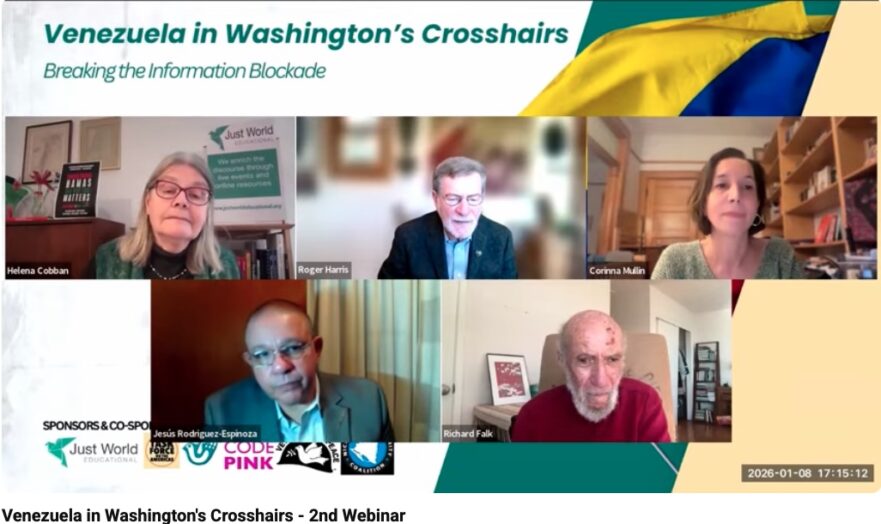
This week, Just World Educational and our partners from the Task Force on the Americas had an impactful launch of our joint project “Venezuela in Washington’s Crosshairs: Breaking the Information Blockade.”
The highlight came yesterday (January 8), when one of our speakers, leading Venezuelan journalist Jesús Rodríguo-Espinoza joined us live from his office in Caracas. He provided a spine-chilling account of how it felt last Friday night when the U.S. military undertook the super-violent operation to kidnap Venezuela’s President and First Lady– along with some super-smart analysis of the political forces at work in Venezuela and its region.
Rodríguo-Espinoza is the editor of the Orinoco Tribune and a former Venezuelan diplomat. Also with him on the Thursday panel was the veteran global rights specialist Professor Richard Falk, and the NYC-based anti-imperialism scholar Dr. Corinna Mullin.
Two days earlier, JWE and TFA had presented the first webinar in this very timely new series. It featured the Venezuelan-Canadian sociologist María Páez Victor, Leonardo Flores of the Venezuela Solidarity Network, and the international-law scholar Prof. Marjorie Cohn, who addressed the topic of “Why the U.S. is Attacking Venezuela.”
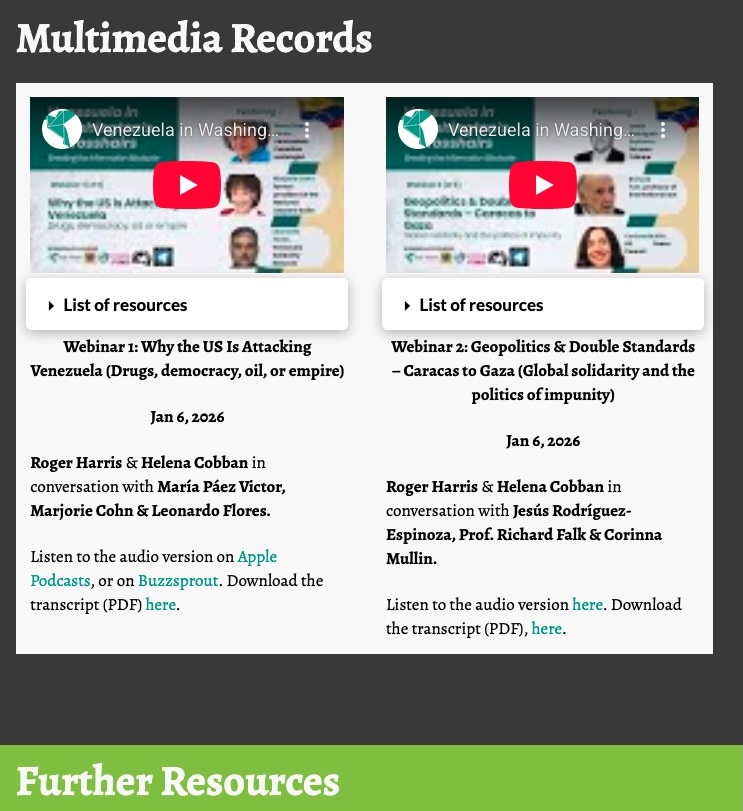
As part of this project, Just World Ed is now presenting on its website a new Learning Hub that presents the multimedia records of all the webinars in the project– the video, audio versions, and transcripts– along with a still-growing library of related resources.
This project is being jointly steered by Roger Harris the TFA board, and JWE president Helena Cobban. They are currently planning one more webinar, for Tuesday, January 13, at 1 pm PST / 4 pm EST. It will feature Ajamu Baraka of the Black Alliance for Peace, international rights lawyer Dan Kovalik, and Michelle Ellner of CodePink. Their topic is “Exploring the ‘Donroe’ Doctrine.”
People who registered for the earlier webinars are automatically registered for this one. Anyone else wanting to register can do so by clicking here, or by using the QR code.
Highlights of the first two webinars
We have already prepared full transcripts of the two discussions so far, and we hope that interested scholars and activists find these records informative and useful. Download the PDFs here (Webinar 1) and here (Webinar 2.) Please, if you use them, give due attribution to the respective speakers as well as to JWE and TFA as project organizers. We’re offering these records with a standard Creative Commons license.
If you don’t have time to read the whole texts, here are summaries:
Webinar 2, Geopolitics & Double Standards– Caracas to Gaza
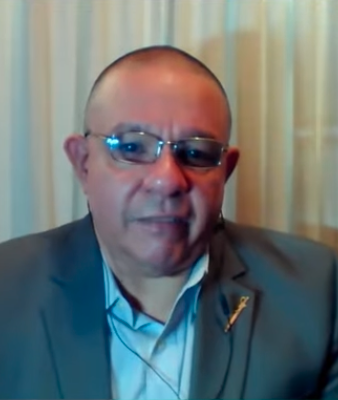
Jesús Rodríguez‑Espinoza reported live from Caracas that Chavismo, the collectivist anti-imperialist legacy of former President Hugo Chavez, remains alive and strong at the grassroots throughout inVenezuela. “Donald Trump did not achieve regime change in Venezuela. Chavismo is still in control of the country in a very monolithic way, and that’s extremely important,” he said.
He warned, however, that Venezuela faces likely further attacks under an openly revived Monroe Doctrine “on steroids.”
Mr. Rodríguez-Espinoza expertly framed U.S. strategy as operating on three levels: reasserting hemispheric control; seizing Venezuela’s oil and strategic minerals; and “decapitating” the Venezuelan leadership as an example directed toward Cuba, Nicaragua and other independent projects.
He stressed that, “Despite us feeling disgusted and outraged and even still shocked… We are ready to defend the country until our last drop of blood and we will win.”
Prof. Richard Falk situated the Venezuela crisis in the context of Pres. Trump increasingly applying a model of “separate spheres of influence,” as had been seen before during the U.S.-Soviet Cold War. He noted that this approach sidelines the UN, normalizes economic imperialism and resource theft, and mirrors Western complicity in Israel’s genocidal assault on Gaza.
He characterized this as, “an attempt to appropriate the wealth of weaker countries… a revival of economic imperialism, and the death of the UN milestone of permanent sovereignty over natural resources.”
For her part, Corinna Mullin noted that the unilateral sanctions Washington had long imposed against Venezuela have functioned as economic warfare and “collective punishment,” collapsing GDP, blocking 99% of state revenue, killing tens of thousands, and deliberately driving mass emigration.
“When this economic warfare failed to collapse Venezuela’s revolution, [Washington] escalated to blatant imperialist gangsterism,” she argued.
She described the events of January 3 as, “a brazen act of imperialist assault and international piracy, a grave violation of international law.”
All the speakers emphasized the deep connections between the issues of Venezuela and of Palestine, noting the role of Zionism as a settler-colonial project and Israel’s long support for repressive policies and movements in Venezuela and elsewhere in Latin America.
They explored in some depth the issue of whether existing international institutions are strong and effective enough to adapt to the new, U.S.-led insistence on unilateral action and the use of force. Mr. Rodríguez-Espinosa was the most emphatic on this point, arguing that they have proven them impotent and will need to be replaced.
The speakers also explored the role the Western corporate media play in propagandizing for colonialism and war, and the need to pair legal/diplomatic work with disruptive mass, labor and South–South resistance.
Such a rich discussion!
Webinar 1, Why the US is Attacking Venezuela

Maria Paéz Victor launched her presentation by describing the scale and terror of the U.S. raid on Caracas on January 3 that included a massive cyber‑offensive and the killing of dozens of guards and civilians, in addition to the kidnapping of President Nicolás Maduro and First Lady Cilia Flores.
She emphasized Venezuelan institutional continuity under Acting President Delcy Rodríguez and the resilience and political consciousness of the Chavista popular organizations, giving several moving examples of this.
She underlined that, “Venezuela is now the legitimate country and the illegitimate one is the United States.”
Leonardo Flores argued that Washington’s “narco‑terrorism” allegations have all along been fabricated, noting Venezuela does not produce fentanyl or cocaine; it handles only a small share of global cocaine transit, and has actually reduced trafficking.
“If there is a government that is actively involved in the drug trade, it’s not the government of Venezuela, it’s the government of the United States,” he said.
In reality, he said, Venezuela is being targeted for its oil, its mineral wealth, and its anti‑imperialist foreign policy, regional integration efforts, and solidarity with Palestine.
He also provided some very informative detail about the harshness of the economic sanctions that Washington. had unilaterally imposed on Venezuela over the course of many years (and under all recent U.S. presidents,) noting that in UN terminology these sanctions are clearly described as “Unilateral Coercive Measures” (UCMs.)
He also noted that the country’s Chavistas had worked hard and to good effect to build grassroots economic resilience: “The miracle is that Venezuela did not cave in. With a 99% drop in revenue, there was no famine, and now the country is growing again.”
Prof. Marjorie Cohn then gave a very clear analysis, from the international-law perspective, of the gross illegality of the actions the United States has taken against Venezuela for many years now, culminating in the attack and leadership-level kidnappings of January 3, along with other harsh actions including tanker seizures, the imposition of harsh unilateral sanctions, and threats of occupation.
She underlined that these actions all violate the UN Charter, including the self‑determination norm it proclaims clearly in Article 2(4), as well as U.S. constitutional and statutory constraints. She cited the characterization the Nuremberg Tribunal had used of the gravity of initiating a war of aggression, as the U.S. government did against Venezuela on January 3: “To initiate a war of aggression is not only an international crime; it is the supreme international crime, differing only from other war crimes in that it contains within itself the accumulated evil of the whole,” she said.
She also likened the U.S. operation in venezuelato illegal regime-change precedents such as those in Panama or Iraq.
In the closing discussion, panelists stressed the need to
- build international solidarity,
- pressure U.S. and Canadian officials,
- defend Delcy Rodríguez from smear campaigns, and
- situate Venezuela within Washington’s wider hemispheric and global offensive that also targets Cuba, Mexico, Colombia, Brazil, Haiti and the sovereignty of many nations in the Global South.
Yes, another very rich discussion. Just World Ed is proud to have helped lead these two webinars!