
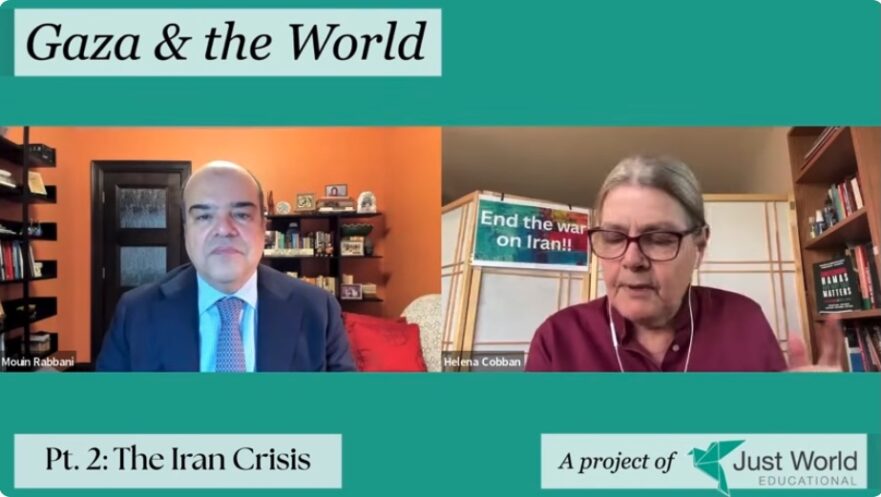
“Future historians may well point to this war as the moment when US imperial decline became unmistakable and irreversible.”
This was one of the most important assessments that veteran Palestinian analyst Mouin Rabbani shared with JWE president during the conversation they held April 17, in the 13th episode of JWE’s ongoing project on “The Iran Crisis.”
You can see this whole conversation on Youtube, here. You can listen to it on Apple Podcasts or Spotify, or read the transcript here.
In the conversation, Rabbani argued that the unprovoked war of choice that the United States and Israel launched against Iran on February– and crucially, also, Iran’s ability to withstand that assault– marked a major turning point in West Asian geopolitics as well as, potentially, in the global balance of power. He noted that the recent sequence of events involving the U.S., Iran, Lebanon, and Israel marked another key turning point, in that it demonstrated clearly that Pres. Trump had the power to stop Israel’s assault on Lebanon in its tracks, and was willing to use it. He said the immediate catalyst for trump’s decision was the positioning around the stalled U.S.-Iran negotiations in Islamabad, where Washington had initially addressed only issues immediately related to Iran the Iranians insisted that any meaningful negotiations needed to be predicated on a clear aceasefire in Lebanon.
That linkage, he said, became decisive after Israel’s devastating air campaign in Beirut, which he described as an attempt to provoke an Iranian response and collapse the emerging ceasefire framework. But on April 16, Pres. Trump called very publicly on Israel to abide by7 a ceasefire in Lebanon, which just hours later, it did.
Rabbani observed that that the outcome exposed the flimsiness of the proposition that U.S. decisionmaking had been shaped, or even misled, by Israeli pressure. He said the key breakthrough came only when the United States directly told Israel to stop its attacks, and he underscored that what mattered was not rhetoric but enforcement. That episode, he said, showed that a single U.S. phone call and Trump’s public intervention were enough to halt the escalation, but only after the conflict had already revealed how much of the American war agenda had earlier been driven by Israeli priorities.
A major theme of the discussion was the contrast between stated war aims and battlefield reality. Rabbani said the war had been launched with sweeping objectives: forcing unconditional surrender, pursuing regime change, ending Iran’s nuclear and ballistic missile programs, and reducing Iran to a weakened regional appendage. Later, he said, additional aims were added, including disarming Hezbollah and reshaping southern Lebanon into an Israeli security zone. But he argued that reality quickly overtook all those goals. Iran remained intact and coherent and undertook retaliation actions that Washington had not planned for; and the expected rapid collapse of the governance system in Iran never occurred.
He framed the result as a “Washington Suez moment,” suggesting a parallel with the 1956 crisis in which Britain’s imperial overreach met hard limits. But he and Cobban said that this episode was more consequential than Suez . Rabbani made the point that the wars against Iran and Lebanon were not merely political failures; they were also military failures. In his view, the campaign damaged the image of both U.S. and Israeli power far beyond the region.
He said future historians may view the war as the moment when U.S. imperial decline became unmistakable and irreversible, while Israel’s long-term project of regional hegemony also ran aground.
The conversation also explored the wider regional fallout. Rabbani said the Gulf states, especially the smaller monarchies dependent on U.S. protection and regional stability, now face serious strategic anxiety after discovering that the war threatened their own infrastructure and safety. He argued that their reliance on Washington has been badly shaken, and that they may now need to explore alternative arrangements involving Iran and other regional powers such as Pakistan, Egypt, Turkey, and China. He said the Abraham Accords have not delivered the security benefits their supporters promised and may instead have integrated Arab states more tightly into a failing U.S.-Israeli war architecture.
On Gaza, Rabbani said the ceasefire in Lebanon has not meaningfully altered the situation there, because Gaza was not explicitly included in the current ceasefire arrangements. He argued that Israeli behavior shows that anything not specifically named in an agreement is treated as irrelevant. That, he said, leaves Gaza and the West Bank exposed to renewed escalation. He warned that war has become a permanent condition for Israel, and that the conflict could easily be redirected back into Gaza under the cover of new political or security schemes.
The discussion concluded with a broader assessment of world opinion. Rabbani said Israel’s image has deteriorated sharply across the international community and the West alike. He noted that support once taken for granted in U.S. political life is now more contested, with candidates increasingly distancing themselves from AIPAC and wider sectors of public opinion blaming Israel for dragging the U.S. into another Middle East war. That shift, he suggested, could eventually reshape not only policy but the strategic relationship between Washington and Tel Aviv.