
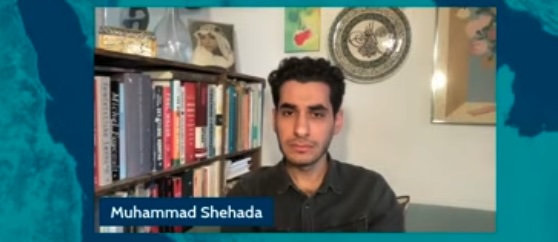
On April 13, the Carnegie Endowment for International Peace presented an online round-table on “The Board of Peace, Gaza, and the Future of Multilateralism.” Gaza-born analyst Muhammad Shehada‘s contribution was a razor-sharp, ten-minute critique of the harsh and damaging effects that Trump’s “Board of Peace” has had on the two-million-plus Gaza Palestinians who have (thus far) survived Israel’s still-ongoing genocide in Gaza.
Shehada is a Visiting Fellow with the European Council on Foreign Relations. You can see the whole 61-minute discussion here. Shehada’s contribution starts at 18:15. You can download the transcript of his presentation here. What follows is an (AI-assisted) summary of it.
… Shehada noted that the Trump-backed Gaza plan had largely failed in practice and that the reality on the ground did not resemble a genuine ceasefire. He said the only part of the October ceasefire agreement that had been fully implemented by late February was the release of all Israeli captives held in Gaza, while almost everything else— aid delivery, protection from attacks, reconstruction, and a path to governance— had remained stalled or only partially fulfilled.
He said that implementation of the humanitarian side of the October ceasefire agreement had never met the promised levels of 600 trucks-per-day that the agreement stipulated, and that much of what had been allowed in was private-sector goods sold at profit rather than the promised and much-needed humanitarian relief. He also described the corrupt “coordination fee” system in which Israeli officials charge large sums to permit trucks into Gaza, further distorting aid delivery.
He described the effects of the October agreement as never having constituted a real ceasefire, but rather a mechanism to reduce visible violence and prevent famine without ending Israel’s ongoing, broader destruction.
He was sharply critical of the political architecture around the plan. He said that even Arab officials involved in the negotiations had not believed the deal would produce a true ceasefire. He quoted one [un-named] Arab leader who when asked about this, reportedly said, “There’s no framework. There’s no plan. It’s only a spectacle. It’s basically a political stunt, a PR stunt, nothing more.”
Shehada argued that the Center for Civilian Military Coordination [CCMC] that the Americans established in southern Israel to coordinate implementation of the ceasefire had been unable to do any meaningful ceasefire-monitoring because it lacked any authority to do so. It could not itself order Israel to stop bombing or to lift the restrictions on aid deliveries, but had to route all such decisions back through the White House. he noted that, “The middleman between the White House and CMCC, the very person that’s in charge of implementing the ceasefire, is a guy called Aryeh Lightstone.”
He added, “I literally have no words to describe that guy, but the words that I got from Israeli colleagues that met him or European diplomats that met him face to face is that they said, quote, ‘He hates Palestinians with passion. He’s more right-wing than Netanyahu. He hates Palestinians with passion’.”
He noted that Lightstone’s right-hand person is someone called Adam Hoffman, whom he described as a 25-year-old graduate from Princeton who had only two possible “qualifications” for his role: “He used to write articles bashing pro-Palestinian demonstrations at the university. He’s very right-wing, very openly pro-Israel. And the second accomplishment is that he worked at DOGE, Elon Musk’s initiative to destroy the American government. And then he landed a job being Aryeh Lightstone’s right-hand guy that is in charge of designing what Gaza should look like on the day after!”
He also noted the insidious roles played in the BOP’s planning process for Gaza by an outfit called the Gotham Group, previously known mainly for having developed Trump’s “Alligator Alcatraz” detention center in Florida– and by a bitcoin entrepreneur called Liran Tancman, who was also a “graduate” of the Israeli military’s notorious “Unit 8200” surveillance unit.
Shehada warned that, under the BOP’s plan, Gaza would function as a test case for a new model of control, privatization, and techno-authoritarianism that combined billionaire-driven dealmaking, corporate profiteering, and artificial intelligence surveillance into a system that treated Palestinians as objects to be managed rather than people with rights.
He also warned that this model could spread far beyond Palestine: “Basically, you have Gaza no longer being just a unique extraordinary case of human savagery. It is basically a canary in a coal mine. What starts there does not end there. It is coming to your doorsteps very soon.”
At the end, he said he had read the [Israeli-origined] proposal that BOP negotiator Nikolay Mladenov handed to the Hamas delegation and other Palestinian leaders in Cairo,three weeks ago. He noted that, “It literally explicitly makes every single progress in Gaza, even if it’s a tiny, tiny fractional thing about temporary housing, if it’s about allowing tents into Gaza: all of it is conditional on Hamas surrendering, handing over everything– with no talk of Israeli withdrawal. And [Mladenov] told them explicitly, if you do not accept this proposal, war is going to be resumed again.”