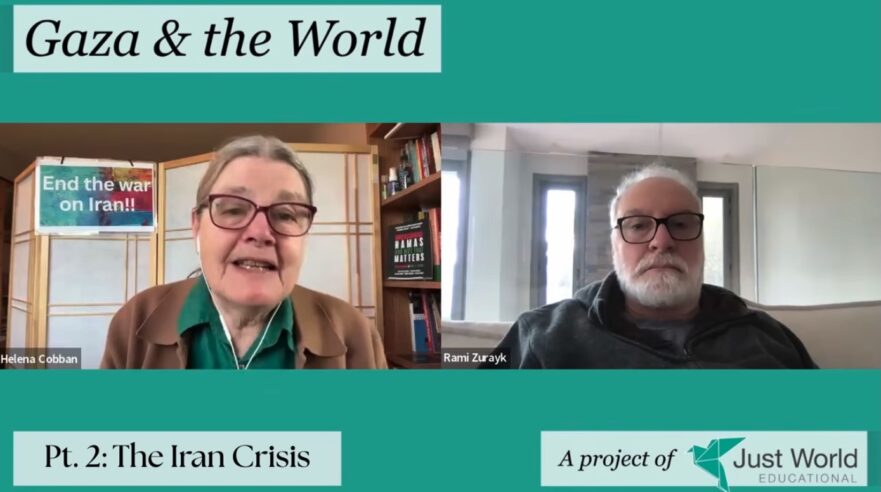
In April 12, JWE president Helena Cobban conducted a timely conversation with with Prof. Rami Zurayk on the impact on Lebanon of the violence that Israel has unleashed against the country for many months now. (Israel escalated that violence very notably on April 8– the very day on which it looked as if Washington was finally ready to sit down and negotiate a serious ceasefire with Iran.)
This was the twelfth episode in JWE’s ongoing project on the the Iran Crisis and its extensive implications worldwide. Find all the multimedia records of this project at this page on our website.
Rami Zurayk, who spoke with Cobban from a small town near Beirut, is a researcher on ecological affairs and a social activist who has deep family roots in South Lebanon. In 2011, Just World Books published his book War Diary: Lebanon 2006, a short, engaging account of what he’d experienced during the invasion of Lebanon that Israel undertook in 2006.
You can see Cobban’s full 52-minute conversation with Zurayk on Youtube, here. Listen to the audio on Apple Podcasts or Spotify, or read the transcript here.
Early on in the April 12 convo, Zurayk described the destruction Israel had inflicted on Beirut in the April 8 attack as unusually severe, noting that the death toll on that single day was more than twice that of the 2020 Beirut port explosion. He stressed that this was in now way “surgical” warfare, or limited only to allegedly “military targets,, but involved the complete, deliberate leveling of entire buildings on top of the people inside them. He noted that Israel was also striking key parts of Lebanon’s civil support system, including pharmacies and the humanitarian infrastructure that serves displaced civilians.
A major theme of the conversation was ecocide. Zurayk said he has been documenting environmental damage in South Lebanon since the early phase of the war, including Israel’s use of white phosphorus and glyphosates, its burning of fields, and destruction of oak thickets and other native ecosystems.
He placed this in a historical and ideological frame, arguing that traditional Zionist rhetoric about “greening the desert” reflected an eco-colonial mindset that treats native ecologies as obstacles to be erased. He linked this to settler colonialism more generally: the destruction of land, trees, and agricultural systems is also a way to destroy the social bases of resistance. He drew a parallel with the anti-Nazi maquis resistance movement in France, noting that both cases involve trying to eliminate the natural terrain that shelters resistance movements.
He addressed the social and humanitarian response to the crisis, describing the work of DALLA, a women-led organization he is involved with, which provides meals, kitchens, dignity kits, diapers, and other forms of support for displaced families, especially women and children. He said the group started building relationships and infrastructure before the current escalation and has continued adapting to the war by following displaced people rather than remaining tied to fixed locations.
Cobban and Zurayk discussed Lebanon’s very complex internal politics and the current prospects for negotiations with Israel. Zurayk said he and many people in the south are deeply shocked by the Lebanese government’s apparent willingness to move toward these negotiations at a time of massive suffering, including the scale of the continuing destruction in Gaza. He framed this as a dangerous attempt to pull Lebanon away from Iran and toward a deal that would amount to surrender. He stressed that the fighters of the resistance remain strong in the south, but noted that the government has come under intense pressure from the US, Israel, and other regional powers. to negotiate with Israel.
The conversation touched a little on Lebanon’s internal sectarian landscape. Zurayk explained that Lebanon’s “confessional” system locks people into inherited identities and creates a zero-sum political structure, where different “tribes” see each other as rivals. He said that Hezbollah’s strength rose after the movement succeeded in forcing an Israeli withdrawal from Lebanon in 2000, and again in 2006, but that many forces in Lebanese media and politics have spent years preparing the ground for internal division. He said that today the core support for the resistance remains the Shia community from the south and Bekaa, though there are also Christians, Sunnis, and Druze in smaller parties who support it.
The issue of the Palestinian refugees in Lebanon was another focus. Zurayk said the Palestinian presence in the country had been steadily eroded since 1982, with many camps destroyed, displaced, or weakened over time by migration and political marginalization. He stressed that Palestinians are not directly central to the current battle, both because their numbers have declined and because their political dynamics are complicated by continuing divisions between Hamas-aligned and Fatah-aligned factions in the camps.
Toward the end, the discussion widened to the regional level, especially the stalling of the Iran-U.S. negotiations that had held a short opening session in Islamabad, Pakistan, just a few hours earlier. Zurayk argued that Lebanon is only one piece of a much larger geopolitical struggle. He said Iran has historically supported liberation movements when others did not, and that resistance movements go where they can for help. Still, he made clear that his deepest concern at the moment is Lebanon’s possible drift into a direct peace agreement with Israel, which he sees as anathema.
The interview closed on a note that mixed realism and resolve. Zurayk said the point of sharing such conversations is to avoid flattening the situation into a simple, one-sided narrative. He insisted there are real nuances in Lebanese politics, but also some fundamental positions — especially opposition to Zionism — that remain strong and nonnegotiable for him and for many other Lebanese.