
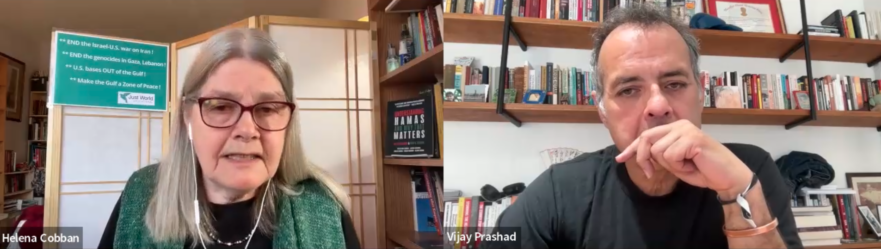
“There is no way, there is no scenario, no supercomputer can devise a scenario where Israel and the United States can win this war politically. It’s just it is actually impossible,” Indian historian and analyst Vijay Prashad told JWE president Helena Cobban in a wide‑ranging March 24 conversation, which formed the ninth episode of JWE’s continuing project on the Iran Crisis.
You can listen to the full conversation on Apple Podcasts or Spotify, or read the transcript here. (Video, coming soon.)
Speaking on Day 25 of the U.S.–Israeli war on Iran, Prashad said Washington has blundered into an unwinnable confrontation that it misread from the outset, and now faces “paralysis” in the Gulf as Iran establishes “escalation dominance” both militarily and politically. Cobban framed the war as the culmination of years of Israeli “testing, testing, testing” the limits of international law in Gaza and Lebanon, with successive U.S. administrations—President Joe Biden’s and now President Donald Trump’s—allowing those limits to be smashed and then extending the same practices to Iran.
Prashad stressed that the current conflict is, at its core, “an unprovoked war of aggression” launched by the United States and Israel against a state that had been negotiating in good faith through Omani mediators. He argued that Trump’s March 21 threat (which he stepped back from two days later) to bomb Iran’s power grid constituted an openly signaled intent to commit a war crime, echoing Israel’s practice in Gaza of announcing the cutoff of food, electricity, or other essentials and then carrying out those threats. Under the Nuremberg precedent, Prashad and Cobban noted, aggression is “the war crime of all war crimes,” since it enables all the atrocities that follow.
Cobban traced the evolution of current international war‑crimes law from European conventions concluded in the 19th century to the UN Charter and Genocide Convention. But she stressed that “every great civilization in history has had very clear constraints on what is lawful and what is not lawful in the conduct of war.” Both speakers accused the United States of long‑standing contempt for those norms. Prashad cited in particular the leveling of North Korea’s infrastructure in the early 1950s and the devastation of Vietnam’s agriculture with Agent Orange, describing those acts as early templates for Washington’s tactics today.
Much of the discussion focused on the asymmetric ethics and capabilities on each side. Prashad recounted interviews with Iranian veterans of the 1980–88 Iran–Iraq war who had endured Iraqi mustard‑gas attacks using precursors supplied by Western states. But he noted they rejected any desire to retaliate with chemical weapons as “dishonorable.” He linked that battlefield experience to Ayatollah Ali Khamenei’s fatwas against weapons of mass destruction and Iran’s insistence—repeated by its leaders in the weeks before Trump’s ultimatum—that it does not seek a nuclear bomb, despite possessing enriched uranium for energy and medical uses.
By contrast, Prashad said, Washington and its allies have normalized collective punishment. He cited the sinking of an unarmed Iranian ceremonial naval vessel in Sri Lankan waters during Indian Ocean exercises, an attack he called a crime against both Sri Lankan sovereignty and the Iranian sailors who died, and one that Western media largely misrepresented as the loss of a generic “naval frigate.” He also described the U.S. oil blockade on Cuba as a potentially genocidal measure, relaying a recent visit to a Havana neuropathy hospital where brain surgeries and life‑sustaining treatments were routinely disrupted by power fluctuations.
Turning to the regional balance of power, Prashad argued that Iran has so far held back key elements of its deterrent while still forcing Trump to retreat from his all‑caps threats. He pointed to an undeployed fleet of over 2,000 fast motorboats hidden in coastal caves that could wreak havoc on one‑hull U.S. warships in the Khalij (Gulf), as well as Iran‑aligned militias in Iraq, Bahrain, and Yemen that are “still standing down” pending a political decision to act. Any further U.S.–Israeli escalation, he warned, would likely mean only more civilian deaths and global revulsion, whereas Iran still possesses options that could shift the battlefield without comparable political cost.
Cobban and Prashad set this military picture against a broader geopolitical canvas in which Iran is both a key node in China’s Belt and Road Initiative and a long‑standing “good steward” of the Strait of Hormuz, allowing free transit of tankers while opposing the presence of U.S. bases that, in Prashad’s words, are “targets, not shields” for their host countries. Cobban argued that the apparent U.S. setback in the Gulf exposes the fragility of Washington’s decades‑long assumption that the western Indian Ocean and the Khalij would remain an uncontested “American lake.” An American defeat there, she suggested, would inevitably reverberate across West Asia and undercut Israel’s ability to sustain its campaigns in Gaza, Lebanon, and southern Syria, given its deep dependence on U.S. military, financial, and diplomatic backing.
The conversation repeatedly returned to the human costs and political futility of Israel’s ongoing operations in Gaza and Lebanon. Prashad argued that Israel’s determination to “lay waste” to Palestinian and Lebanese society has destroyed any realistic prospect of cultivating a Lebanese ally willing to “cut a deal with Israel,” and instead has convinced many Lebanese that they are now co‑victims of a single regional genocidal project. He invoked accounts from a forthcoming book on Palestinian prisoners from Gaza, describing detainees suffering horrific conditions who nonetheless drew strength from news that “the resistance is still striking,” seeing their own suffering as part of a wider struggle for dignity.
Both speakers concluded that neither the United States nor Israel has a viable endgame that avoids either mass slaughter on an unimaginable scale or an eventual reckoning with the peoples they seek to dominate. “Unless the Israelis and the United States are willing to kill about 80 million Iranians, you’re going to have to live with people,” Prashad said, extending that logic to millions of Palestinians and their supporters in Lebanon and elsewhere. Cobban closed by pressing him on whether an effective U.S. defeat in the Khalij would make it impossible for Israel to continue its campaigns in the Levant—a question Prashad called deeply hypothetical, but one that underscored their shared view that the current, U.S.-dominated regional order is cracking under the weight of its own violence and impunity.