
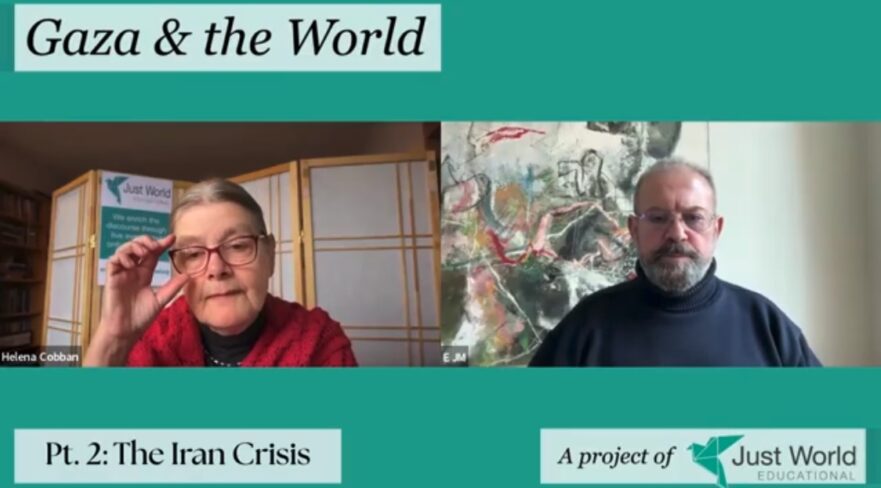
In the latest episode of our “Iran Crisis” series, strategic analyst Elijah Magnier argued that Washington and Tel Aviv launched the conflict with sharply divergent goals and dangerously thin planning. He assessed that while Israeli PM Benjamin Netanyahu has a clear long-term strategy of destabilizing Iran to the greatest degree possible, U.S. Pres. Trump is driven by short-term spectacle. “So the difference is Benjamin Netanyahu’s plan B is to see Iran completely destroyed or divided…. Donald Trump’s plan B doesn’t exist. He just wants the Nobel Prize as a plan B, or he wants a quick victory so he can claim and capitalize on it,” he said.
Magnier was speaking with JWE president Helena Cobban in the morning (ET) of Monday, March 2. You can see the whole of their 41-minute convo on our YouTube channel, here, or listen to the audio on Apple Podcasts, Spotify, or Buzzsprout. Or download the transcript here.
Magnier framed the conduct and direction of this war of choice war in the leadership styles of the two men. Netanyahu, he noted, brings to it 16 years of experience and a consistent desire to shatter Iran’s missile program, economy, and infrastructure to secure Israel’s regional supremacy as well as his own bid for re-election in October 2026. Trump, by contrast, seeks headline victories he can endlessly repeat, such as the killing of Qasem Soleimani or the seizure of Venezuelan and Syrian oil, with little regard for strategic coherence or regional stability. For Magnier, this mismatch has produced a war whose declared aim—regime change in Tehran—is far removed from any realistic path to a stable outcome.
The conversation highlighted how domestic politics in both the United States and Israel shape the conflict. Cobban pointed to polling just before the war showing only 27 percent of Americans supported an attack on Iran, compared with 90 percent before the 2001 invasion of Afghanistan and roughly 78 percent before the 2003 invasion of Iraq. She noted that Trump’s base is itself skeptical, and that rising energy prices and a high cost of living are already sharpening political pressure at home. Magnier added that the American public “don’t like to be the most hated people on earth after the Israelis” and see little benefit in a foreign policy that brings home dead soldiers and higher fuel prices.
Against this backdrop, Magnier argued that Iran entered the war better prepared than many in Washington or Tel Aviv expected. He explained that the Iranian constitution explicitly provides for continuity of leadership and command in the event of the Supreme Leader’s assassination, and that thousands of generals and deputies are trained to step into top roles. Even after the February 28 killing of Ayatollah Ali Khamenei and senior military figures, Iran’s governance and military structures “not only survived, [they are] doing remarkably well by fighting on so many fronts,” he said, listing operations stretching from Qatar, Bahrain, and the Straits of Hormuz to Israel, Jordan, and even Cyprus.
This resilience has shaped Iran’s negotiating posture, Magnier stressed. He said that Tehran refuses to appear as the weaker party suing for peace, especially after enduring more than 2,000 bomb attacks on its territory in just a few days. Iranian leaders, he said, insist they will only halt operations “on my terms,” imposing heavy costs on Europe and the United States through surging liquefied natural gas and oil prices. With no significant domestic opposition calling for a ceasefire—indeed, even regime critics have closed ranks against foreign attack—he sees no constituency inside Iran pushing for a quick deal.
Regionally, the war is exposing the vulnerability of the Gulf monarchies and the limits of U.S. protection. Magnier noted that the use of Gulf airspace and bases to strike Iran has made these states legitimate targets in Tehran’s eyes, as seen in attacks linked to U.S. assets in Kuwait and the United Arab Emirates. Rather than providing any protection for their host countries, U.S. bases have “turned out to be negative, not positive for the countries of the Gulf,” he said, inviting missile fire without delivering credible defense. This experience, Magnier argued, will force a long-term reckoning over the security architecture of the Gulf and may ultimately push Arab rulers back toward accommodation with Iran once the war ends.
The conversation also examined the impact on the so‑called Axis of Resistance. Magnier downplayed the notion that this Axis had ever had a unified joint command, describing it instead as a loose “deterrence narrative” in which groups like Hezbollah and Hamas retain operational independence while benefiting from Iranian support under Article 154 of Iran’s constitution, which mandates aid to oppressed peoples. Hezbollah’s potential escalation against Israel, he said, is driven not by a desire to fight on Iran’s behalf but by its own need to impose new rules of engagement after years of Israeli ceasefire violations and cross‑border killings in Lebanon.
Meanwhile, in Gaza, Magnier saw little sign that Israel’s capacity to impose its will has diminished. He said Israel continues to control the flow of aid trucks, the movement of people through Rafah, and the pace and location of reconstruction, all while expanding the share of Gazan territory it effectively occupies. The new war with Iran, he warned, risks further diverting international attention from what he and Cobban both described as an ongoing genocide in the enclave.
Looking ahead, Magnier suggested that Iran does not need an outright, spectacular victory; it simply must avoid defeat. “First, Iran needs not to lose for it to win,” he said, arguing that the mere survival and effective functioning of Iran’s state structures under such intense assault will, over days and weeks, amount to a major political and geopolitical gain.