
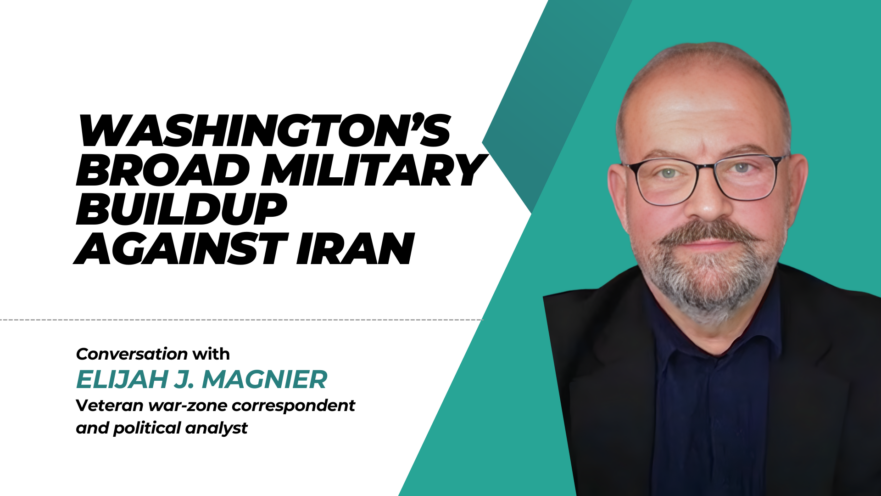
Just World Ed President Helena Cobban had a very timely conversation on February 2, 2026 with European strategic analyst Elijah J. Magnier, on the topic of “Washington’s Broad Military Buildup Against Iran.” The conversation drew on some of Magnier’s recent writings on U.S. and Israeli strategy toward Iran, including his February 1 analysis of why Washington emphasizes naval power while the real war architecture lies elsewhere.
The full video of the convo is at YouTube. Click here to access the transcript, and here to access the audio version of the conversation (Also available on Apple Podcasts & Spotify).

Magnier argued that the current U.S.–Israel confrontation with Iran was not centered on nuclear weapons, but rather on destroying or degrading Iran’s missile deterrent and its regional role. He emphasized that Iran did not possess nuclear weapons and that the small amount of 60-percent enriched uranium still in its stockpile functions mainly as leverage for a possible return to a JCPOA-type agreement. He stressed that scientific knowledge could not be destroyed through bombing, and that Israeli efforts to dismantle Iran’s missile capabilities would, in practice, require regime change.
The discussion also addressed the military limits facing Washington. Magnier described U.S. aircraft carriers as largely theatrical and insufficient for a sustained, multi-front campaign against Iran. He explained that any major attack would depend on numerous regional bases, all of which Iran had threatened to strike quickly in response. He warned that such an escalation could lead to a wider regional war involving allied forces in Iraq, Yemen, and Lebanon, especially after Ayatollah Khamenei’s warning that the entire region could be set aflame.
Magnier noted that Iran’s economy had been badly damaged by Western sanctions, yet Tehran continued to refuse negotiations over its missile program or its ideological commitment to support oppressed peoples, including Palestinians in Gaza. He added that mediation by Turkey, Egypt, Qatar, and Oman had opened channels for nuclear-only talks, but deep mistrust and the ongoing Gaza war meant that core strategic positions remained unchanged.
Please watch the full conversation and share it with others!