

On November 6, the influential Chinese web platform Guancha published an analysis by JWE President Helena Cobban of the role that shifting attitudes toward Israel played in the the Democratic Party’s victories in the U.S. mid-term elections. We’re happy to see it has already received 74,000 views! For those of you unable to read the Chinese, here is the English-language version of the text.
The shift in U.S. society toward breaking with Israel and recognizing Palestinian rights
by Helena Cobban, President of Just World Educational.
The Palestine-Israel Issue in U.S. politics
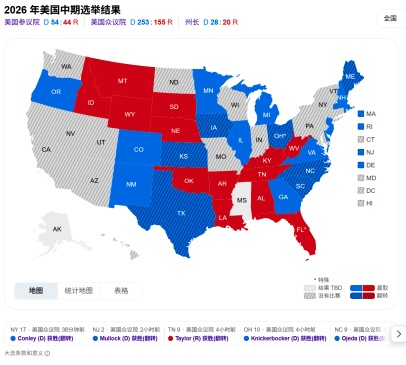
In the midterm elections of November 3, U.S. voters delivered strong criticisms of Pres. Trump’s policies on a range of issues including the steep, continuing increases in prices of groceries and gas, sharp cuts in access to healthcare, and the growing gap between regular Americans and small group of billionaires and trillionaires who surround Mr. Trump. But one notable new factor in U.S. politics that the elections revealed was the willingness of large numbers of Americans for the first time to break with, and openly criticize, the pro-Israel bias that had dominated Washington for more than six decades.
There have always been some Americans who have called for ending Washington’s starkly pro-Israel bias, and for delivering some measure of justice to Palestinians. But for many decades their voices were tightly suppressed. Then, after Israel on October 7, 2023 unleashed a chain of widely publicized atrocities on the Palestinians in Gaza (with great support from Washington) Americans’ support for Palestinian rights started to escalate sharply. And this year, the role that Israel played in openly pushing President Trump to launch a war against Iran that was quite illegal and that turned out to cause further sharp increases in consumer prices even further dented Americans’ support for Israel.
To understand the impact of Americans’ new willingness to break with Israel it is helpful to go back and see how Israel’s long-powerful influence machine had embedded itself in American society and politics in the first place, and how it maintained its position there for so long.
The history and influence of the U.S. Israel lobby
People of Jewish faith or Jewish heritage have always been a small minority in this country. Today, they number around 7.5 million, or 2.4% of the population. But it is good to remember two things concerning the influence of this population: (1) Very far from all Jewish people are active supporters of the Zionist settler-colonial project that gave birth to, and still strongly supports, Israel. Today, probably only a minority of Jewish Americans are pro-Zionist, while large numbers are non-Zionist, or even actively anti-Zionist. And (2) Numerically, by far the largest support for Israel in this country today is among Evangelical Christians, who are a lot more numerous than Jewish Americans. Many of them strongly support Israel, based on their reading of stories in the Bible about the “end times.”
The background to these developments is that in the years after the 1945 defeat of fascism, Americans of all religions (or none) were rightly horrified to learn of the atrocities that Hitler and the Nazis had inflicted on Jewish people in Europe. They wanted to help the Jewish people who had managed to survive the Nazi death camps; and they considered two main ways for doing this. One was to bring as many Jewish survivors as possible here to the U.S. The other was to provide aid to the Zionist project to ship the death-camp survivors to Palestine to strengthen the Zionist settler-colonial project there. (Also notable: many surviving Jewish Europeans were happy to stay in Europe. But here in the U.S., this whole national project had been built over centuries as a settler-colonial project, so offering something like this same template to Europe’s surviving Jews– whether here or in Palestine– came naturally to many Americans.)
In the years after 1945, many Americans, including both Zionists and active anti-Semites, wanted to send as many Jewish people to Israel as possible. Others argued against that, mainly on the grounds that it could disrupt relations with Britain, which still exercised colonial power over Palestine, or with the Arab countries that were starting to win their independence in West Asia in those years.
Changes in U.S. foreign policy to Israel
In 1947, Britain’s global power was shrinking rapidly. In August that year, India and Pakistan won independence from London. That same year, the British government went to the (still-new) United Nations and, saying it could no longer control Palestine, it simply handed over the whole “Palestine file” to the UN. In November 1947 the UN General Assembly adopted a resolution that partitioned historic Palestine, with a majority of the land allotted to the leaders of the Zionist colonial project and just a small amount to what was supposed to be a state for the Indigenous Arabs who constituted the vast majority of Palestine’s people.
The key vote at the UN that secured the Partition Plan was the one cast by Washington. In May of 1948, as Britain’s last colonial forces left Palestine, the well-prepared Zionist militias seized as much land there as they could– much more than UN’s plan had allotted them. They expelled as many of the Indigenous Palestinian residents from their homes as they could, seizing their properties to be the basis of the State of Israel that they then formed. Those expulsions birthed the crisis of mass Palestinian displacement and dispossession that continues to this day. Ever since then, Washington’s support has been an essential pillar for the State of Israel.
In 1956, that support came under stress. In October that year, the Israeli government conspired with the British and French governments on a plan to overthrow Egypt’s nationalist president, Gamal Abdel-Nasser. Under that plan, Israel would start to fight with the forces that Nasser had in Egypt’s Sinai Peninsula, and then Britain and France would send in forces ostensibly to “separate” the combatants, but they would do so along the vital Suez Canal in order to assert control over it, and then use those forces to actively attack Cairo and overthrow Nasser’s government.
The three conspiring powers launched the plan—which was strongly condemned by China and the USSR. In Washington President. Eisenhower was furious. His concept of how “Western” powers could best control the peoples and resources of West Asia was different from the directly colonial concept of London, Paris (and Tel Aviv.) He told the three conspiring powers to speedily end their aggression and used Washington’s large financial power to force them to comply.
Within the U.S., supporters of Israel were extremely upset that Eisenhower had done that. A group of them decided to build a new organization within that would be powerful enough to ensure that no U.S. president would ever again put similar pressure on Israel. Thus was born the American Israel Public Affairs Committee, “AIPAC”, an organization that, along with its allies, soon came to dominate much of U.S. public life and to exercise tight control– often through intermediaries– over all key areas of Washington’s policymaking for West Asia.
My experience of the Israel lobby in the U.S.
I moved to the U.S. in 1982, after having grown up in England and worked for seven years as a journalist in West Asia. I was immediately struck by the depth of support the Zionist project had in the popular culture here, and the degree of control that AIPAC and its sister-organizations exercised over national decision making. In popular culture, productions like a book (and later, movie) called “Exodus” painted an idealistic view of the journeys that Jewish people from Europe made to go to and join the Zionist settler-colonial project in Palestine. Those Zionists were engaged, many Americans believed, in “making the desert bloom”– a trope that assumed that before the Zionists arrived nearly all of Palestine was desert, which was certainly not the case. Israelis were portrayed as heroic, idealistic– and also as staunch and effective allies in Washington’s “Cold War” contest against the Soviet Union and China. Meantime, generally far from the public spotlight, AIPAC’s operatives were working deep in the political system, steering national policy in directions the government of Israel wanted and also harshly punishing anyone in public life who questioned that alignment.
In the early 1980s, AIPAC scored two major political victories that established its image among aspiring political leaders that it was an organization that they should not even try to oppose. In 1982, AIPAC activists in Illinois successfully ousted eleven-term U.S. Congressman Paul Findley, a Republican who had recently started to argue for opening communications to the PLO. Two years later, AIPAC toppled an even more powerful legislator from Illinois: the three-term Senator Charles H. Percy, who had served with distinction as chairman of the Senate Foreign Relations Committee. For the next 40 years AIPAC was able to hold in its thrall just about all the leading political figures in both the Democratic Party and the Republican Party. (In 2009, I conducted an interview with Tom Dine, who headed AIPAC from 1980 through 1993. He reminisced fondly about the close ties he had built with President Reagan’s Secretary of State George Shultz, back in the 1980s.)
For 60 years after AIPAC’s founding in the mid-1950s, the organization and its allies held powerful sway over not just political leaders but also the public discourse, where they stifled nearly all public consideration of essential historical facts such as Israel’s long-time possession of nuclear weapons, or a key incident in 1967 in which Israel’s Air Force had attacked a US Navy ship called the “Liberty”, killing 34 crew members and injuring 171.
Rising opposition to the Israel lobby
However, from the mid-2010s on, a new cohort of younger, more leftwing Democratic Party legislators started to be elected to the U.S. Congress who were ready to challenge Israel’s sway over U.S. politics. These legislators, who came to be called “the Squad,” included Ro Khanna and Pramila Jayapal from California, Rashida Tlaib from Michigan, Ilhan Omar from Minnesota, Alexandria Occasio-Cortez from New York, and Mark Pocan from Wisconsin. Notably, of all these Squad members, only Pocan had traditionally “White” American heritage. Rep. Tlaib is a proud Palestinian American whose parents had immigrated here from the West Bank.
Palestine was one of a number of issues that Squad members were eager to support. But in late 2023, after Israel started its atrocities against Gaza’s population, working to end these atrocities and the significant support that President Biden continued to give them became a much larger part of their concern. Meantime, all across the country, Palestinian Americans and a broad range of other U.S. citizens became deeply energized by the brutality of Israel’s actions. Students on college campuses organized sit-ins to protest Israel’s atrocities, and scores of city centers saw repeated, large, vocal public demonstrations with the same slogans.
A large proportion of those protesters identified much more with the Democratic Party than the Republican Party. But President Joe Biden (a Democrat) and all the other top leaders in the Democratic Party had been working so closely with Israel for so long, and had internalized so much of the Zionist propaganda glorifying Israel that they blocked out any consideration of the demands that Washington cut back the support it was giving to the atrocities. In July 2024, Joe Biden (very belatedly) bowed out of the presidential race. But Kamala Harris, who speedily replaced him as candidate, just continued his stance of providing “ironclad” support for Israel.
In response, in the lead-up to the presidential election of November 2024, grassroots supporters of Palestine supported a new trend called the “Uncommitted” movement, which urged people to vote for neither the Democratic Party nor the Republican Party at the polls.
As we know, Vice President Harris lost that election to Donald Trump. Several independent analyses concluded that the Biden-Harris team’s unswerving support for Israel and its atrocities had been a major driver of that loss, though the internal post-mortem that party leaders themselves conducted omitted any consideration of that factor.
The strong rise of opposition to Israel within the Democratic Party
Throughout 2025, several important things happened. President Trump, pushed on by the many wealthy pro-Zionist figures who were his close allies and financial backers, launched harsh crackdowns on the student protesters and on the universities where in 2024 they had staged their sit-ins. (He did this by accusing the protesters and the universities of engaging in “anti-Semitism,” which is a patently false charge since opposing the acts of the State of Israel is very different from engaging in hatred against all Jewish people.) Meantime, many organizers of the pro-Palestinian protests of 2024 sought a new way to work with the allies that they knew they had within the Democratic Party, among the Squad members and others, and thus to start to shift the party’s policies from the inside.
This new approach won a first key victory in June 2025. That was when the Democratic Party in New York City held its primary election for those seeking to represent the party in the city’s mayoral election, due that November. In the primary, an engaging young leftwing candidate called Zohran Mamdani beat out veteran Democratic Party insider Andrew Cuomo. (After Cuomo lost in the primary, he rebranded himself as an “independent” so he could run in the final election in November, and Mamdani beat him then, too.)
Mamdani is a proudly Muslim American of Indian heritage, and an outspoken supporter of Palestinian rights. For him to win in New York City, long considered the “capital city” of Jewish life in America, radically shifted the balance within the Democratic Party. After the decades in which Zionist power and Zionist discourse-control had been paramount inside the party, the joint efforts of Mamdani and his supporters, and all the former street activists who had re-engaged with the Democratic Party, had finally made the party a place in which support for Palestinian rights could be openly voiced and openly pursued. In the Democratic Party primaries held this year, prior to the nationwide congressional elections, the effect has been very evident. In many of these primaries– including three in congressional districts in Mamdani’s New York City– insurgent candidates who are left-wing, Squad-backed, and vocal supporters of Palestinian rights beat out older, more traditional, and clearly pro-Israel candidates. It even reached the point where candidates who for many years gratefully accepted funding and support from AIPAC started eagerly announcing that they hadn’t taken any money from AIPAC, at all. (On October 21, AIPAC itself announced it would be financing no more political candidates.)
The rise of mass opposition to Israel in U.S. society
This year, the war of aggression against Iran that President Trump launched on February 28 has joined Israel’s still-ongoing atrocities in Gaza in pushing increasing numbers of Americans to seek to end this country’s long-held support of Israel. It has been crystal clear in the U.S. that Trump launched the war, which he did in an open alliance with Israel’s military, largely in response to the strong urging of Israeli PM Netanyahu.
Perhaps President Trump believed that the harsh blows the U.S. and Israeli forces delivered against Iran would lead to a speedy Iranian surrender? If so, the resilience and smarts Iran has exhibited in this war have proved him quite wrong. So here we are eight months later with Iran’s governmental system and most of its key military capabilities still intact, and its forces now exercising a great deal of control over the Strait of Hormuz and thus over a world economy deeply dependent on transit through the strait. Meanwhile, Iran’s military has used its sophisticated military to destroy or disable large amounts of vital and expensive U.S. military matériel right across the Arabian Peninsula, and Iran’s allies in Yemen have not only fended off attacks from Saudi Arabia but also delivered damaging strikes to vital Saudi oil pipelines.
This war was never popular with U.S. voters, at all. As it has dragged on, its role in driving inflation became ever clearer; and large numbers of Americans recognized the crucial role that Israel’s government had played in pushing for, and sustaining, the war. A poll conducted in mid-May found that 45% of Americans judged the U.S. relationship with Israel harmed U.S. interests more than it helped them, with only 20% saying the relationship was still helpful. Among Democrats, a group whose ties with Israel had traditionally been much stronger, the ratio of “harmful” to “helpful” was much broader: 67% to 5%.)
Effects of the November 3 elections
At the November midterm elections, voters across the country delivered a stinging rebuke not just to Trump and his Republican Party, but also to the proposition that the U.S. should always be 100% pro-Israel. A Democratic Party that had among its congressional candidates the strongest bloc of pro-Palestine and Israel-critical politicians ever won a strong majority in the House of Representatives and flipped enough seats in the 100-strong Senate to win at least 54 seats there. The anti-Israel wave even– though more tentatively– reached into the Republican Party as well. On November 4, Vice President Vance openly acknowledged that one of the top reasons many voters had switched their votes from his party to the Democrats was because they wanted a change in U.S. policy toward Israel.
These mid-term elections will not immediately change any policies. President Trump still wields executive power and he has long shown himself ready to defy the Congress on issues that the country’s Constitution had clearly allotted to Congress, including– crucially– the right to declare war on other nations. Also, the newly elected Congress will not be seated until January 3, and Trump may launch some disruptions to this process along the way.
But still, we have now seen a marked shift inside this country toward a willingness to end the control that Israel has for so long exercised over U.S. policy both within Palestine and across the rest of West Asia. I find this shift very exciting. It offers some hope that Pres. Trump will find himself obliged to bring the war on Iran to a speedy end, and also that the long-oppressed Palestinian people might soon see not just an end to the horrific atrocities in Gaza, but also the restoration of the national rights that have for so long been denied them.