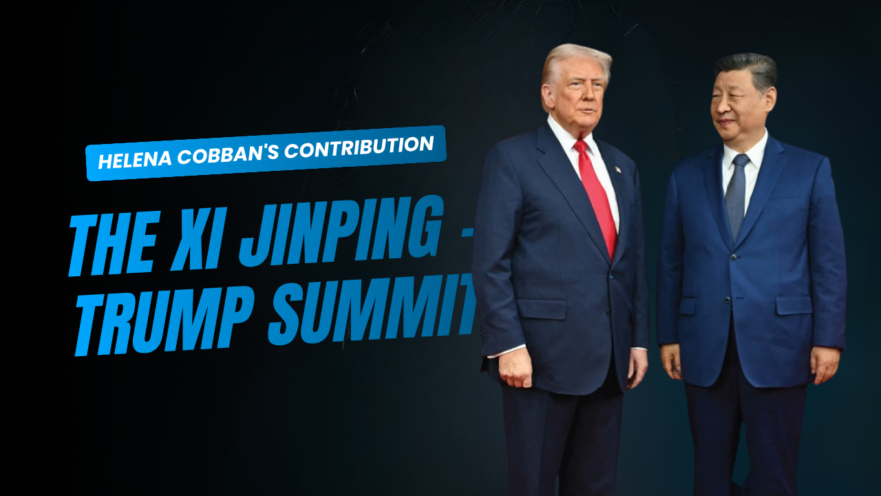
As media reports pointed to a possible late-September summit between Presidents Xi Jinping and Donald Trump, an international panel of scholars, analysts, and commentators gathered for a webinar, “The Xi Jinping – Trump Summit,” to examine what the meeting might mean for US-China relations and for the wider world. Among the contributors was Helena Cobban, President of Just World Educational, whose remarks touched upon history and connected the webinar directly to some of the world’s most pressing conflicts, including the war on Iran and the Israeli genocide on Gaza.

The webinar was organized by the No Cold War campaign and supported by the Chongyang Institute for Financial Studies at Renmin University of China. Chaired by John Ross, a Senior Fellow at Chongyang and a member of the No Cold War International Collective, the event brought together speakers from China and from Western and Global South countries alike. As Ross explained in his opening remarks, the meeting was intended to give those both inside and outside China who oppose escalating tensions—whether “hot” or “cold” wars—a chance to compare analyses of the international situation ahead of the anticipated summit.
Framing the discussion, Ross noted that the world is passing through what President Xi has called “changes unseen in a century,” pointing to the rise of the Global South, strains within the US-China-Russia relationship, stagnation in Europe, and recent US actions against Venezuela, Cuba, Iran, and Gaza. The panel’s opening speaker, Wang Wen, Dean of the Chongyang Institute, argued that the US-China relationship could, for the first time in history, escape the so-called “Thucydides Trap” through what he called “constructive strategic stability.” He described an emerging multipolar order built on parallel, non-aligned relationships among China, the US, and Russia, arguing that US global hegemony is giving way to a more regional role.

Biljana Vankovska, Professor Emerita at Saints Cyril and Methodius University in Skopje, spoke from what she called the perspective of a “non-global power” in the Balkans. She gave a mixed assessment of progress since the two presidents’ May meeting, welcoming Trump’s restraint on Taiwan arms sales and improving US public opinion of China, while pointing to an “implementation gap,” the collapse of a joint G20 finance ministers’ communiqué, and US threats of secondary sanctions against countries cooperating with Iran. She called the summit a “stress test” for constructive strategic stability and asked what the new paradigm means for smaller states and for crises in Gaza, Lebanon, Iran, Venezuela, and Cuba.
Liu Zhiqin, Senior Research Fellow at the Chongyang Institute, argued that much of today’s geopolitical tension stems from Second World War crimes that were never fully accounted for, warning in particular about Japanese remilitarization and what he described as US ambivalence toward it. He pointed to China’s visa-free travel policy as evidence of confidence, warned against rhetoric from US politicians that he likened to the 1930s, and urged the US to focus on its own domestic problems rather than confrontation with China.
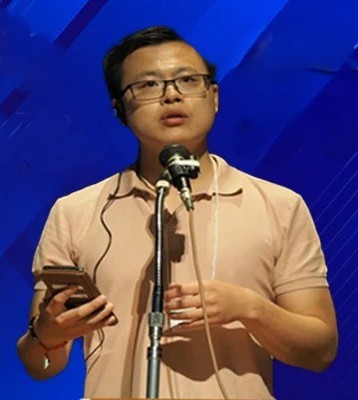
Anlin Wang, co-chair of the International Committee of the Democratic Socialists of America, described the organization’s growth and its members’ opposition to escalating US-China tensions. He linked rising US militarism to worsening conditions for the American working class, cited polling showing a decline in the number of Americans who view China as an enemy, and stressed the importance of people-to-people ties and US-China cooperation on climate change.
Yi Yingnan, Research Fellow and Director of the Department of Industry Research at the Chongyang Institute, addressed the summit from an economic and financial perspective. He argued that its main value lies in reducing policy uncertainty for business and markets rather than in specific agreements, said US-China competition is a long-term reality that should be kept within clear, predictable boundaries, and noted that domestic US concerns over housing, healthcare, and education are increasingly shaping foreign policy debates.

Vijay Prashad, Executive Director of the Tricontinental Institute for Social Research, framed Xi Jinping’s visit as a choice between two futures: one of escalating confrontation, the other of coexistence. He set out four realities he argued must guide the relationship — that China cannot be contained, that economic separation would be costly to both countries, that shared problems such as climate change and artificial intelligence require joint action, and that war between two nuclear-armed powers must be avoided, with Taiwan a particular flashpoint. He said countries of the Global South have a direct stake in avoiding a new Cold War.
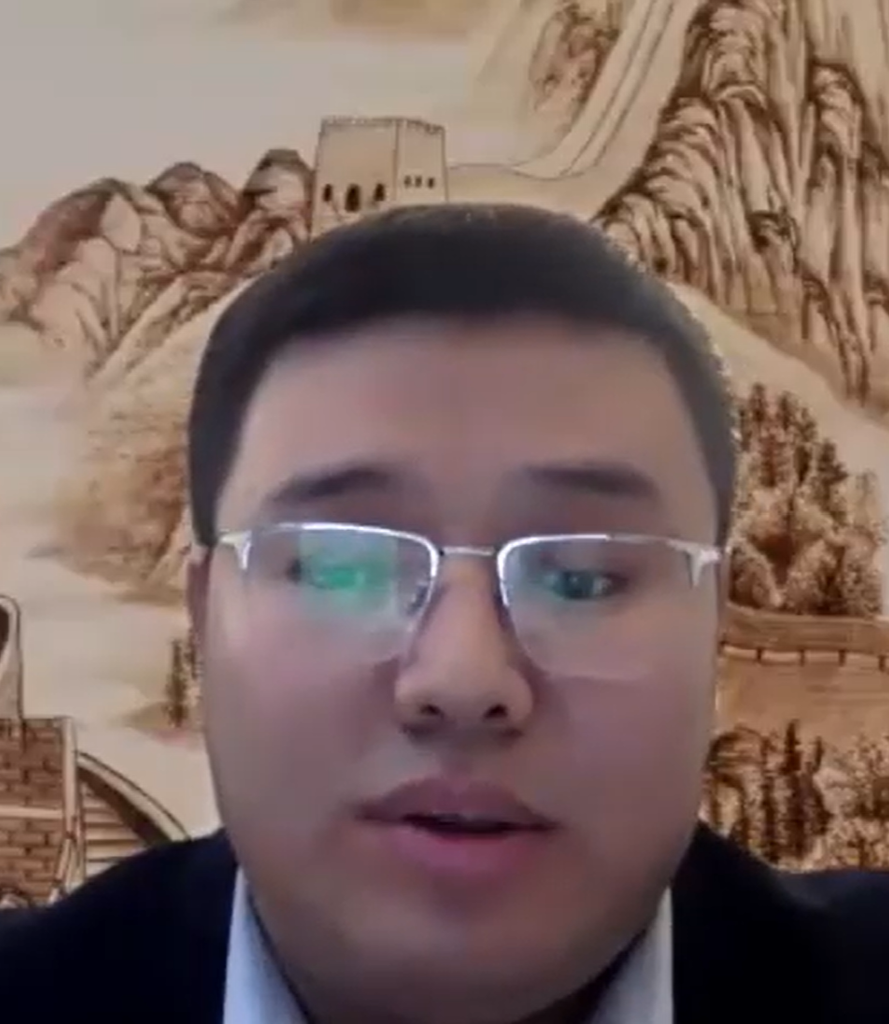
Guo Zhidong, Associate Research Fellow at the Chongyang Institute, outlined the likely agenda for the summit, including tariffs and trade, AI governance, Taiwan, the use of “national security” as a pretext for restrictions on China, and the wars in Ukraine and Iran. Turning to the US midterm elections, he argued that neither major party has resolved the core problems facing ordinary Americans, and said win-win cooperation remains the only viable path for US-China relations.
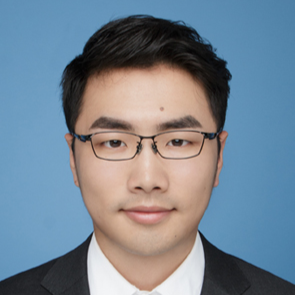
Long Chen, Assistant Research Fellow at the Chongyang Institute and a researcher born in the 1990s, argued that the mere stability of US-China relations since Trump’s state visit to Beijing in May is itself an achievement, given the scale of the two economies, which together account for more than 40 percent of global GDP. He said younger generations in both countries share similar concerns about climate change, artificial intelligence, and living standards, and want dialogue rather than confrontation.

Wu Qicong, Assistant Research Fellow at the Chongyang Institute, focused on the summit’s implications for Asia, arguing that a stable China-US relationship functions as a public good for the wider region. He cited an IMF estimate on the investment costs of trade policy uncertainty, pointed to the Regional Comprehensive Economic Partnership as a model of economic integration across differing political systems, and called for clearer rules, stronger crisis communication, and initiatives that let Southeast Asian partners help shape the agenda.
Helena Cobban’s Contribution
Speaking as the final contributor of the session, Helena Cobban began by engaging directly with Wang Wen’s opening analysis, before setting out her own reading of the historical moment. She argued that the summit is taking place at a genuinely historic juncture, coming after roughly six centuries during which a handful of small Western European states and their “offspring”—the United States, Israel, Australia, and New Zealand—established and consolidated hegemony over world affairs. In her view, that era of Western hegemony is now ending, a development she described as cause for optimism given the disastrous costs that era imposed on the peoples of the Global South, including China’s “century of humiliation.” She pointed to the resistance of the peoples of Iran, Palestine, Yemen, and Lebanon in recent years as having hastened the decline of Western hegemony, while noting that this decline had already been underway before 2023.
Responding to Wang Wen’s description of an emerging multipolar system built on parallel bilateral relations, Cobban offered a refinement of the terminology. She said she prefers the term “multinodal” to “multipolar,” arguing that the points of connection in the emerging order function less like discrete poles and more like interconnected nodes, with authority distributed more widely than among just three major powers. She also described the system as “multivalent,” stressing that competition among states is playing out not only militarily but across economic, technical, and financial domains.
Turning to the domestic American context, Cobban observed that the summit comes at a moment when President Trump faces significant political headwinds at home, with his approval rating at roughly 32 percent and midterm elections approaching in early November. She suggested that such a climate of uncertainty can create a temptation to blame outsiders and stoke Sinophobia and xenophobia—a temptation Trump has already acted on in trade policy, without success. However, she argued that this temptation toward confrontation is now tempered by the visible costs Americans have borne from what she described as the illegal and unprovoked US-Israeli attacks on Iran, including economic disruption reflected in higher fuel prices and military casualties she suggested are higher than officially reported.
Cobban also cited longitudinal polling from the Pew Research Center, noting that unfavorable American attitudes toward China rose fairly steadily between 2006 and 2023, but that public sentiment has since begun to improve—particularly among younger Americans. She argued this shift creates an opening to make the case that China is not an adversary but a necessary partner, especially on shared global challenges such as climate change and the risks posed by artificial intelligence, the latter a concern she noted President Xi has also raised. On climate, she pointed to the effects both countries are experiencing, from the collapse of a glacier in Tibet and extreme weather across China to the anticipated impact of an approaching El Niño in the United States.
Cobban closed her remarks on a personal and generational note, expressing appreciation for the number of younger researchers and analysts taking part in the discussion. Reflecting on her own experience as a young journalist covering the civil war in Lebanon and the start of the Iran-Iraq war in the 1970s and 1980s, as well as her later work on the costs of the US-Soviet Cold War, she argued that those who have witnessed the costs of both hot and cold war understand, in a direct way, why they must be avoided. She concluded by calling on all generations present—hers, the panel’s, and that of her grandchildren—to work to defuse tensions and find ways to cooperate globally, particularly between the United States and China.
Cobban’s contribution has been published on the Just World Educational YouTube channel. You can read the transcript here, and the full webinar, featuring all of the panel’s speakers, is available on the No Cold War YouTube channel.