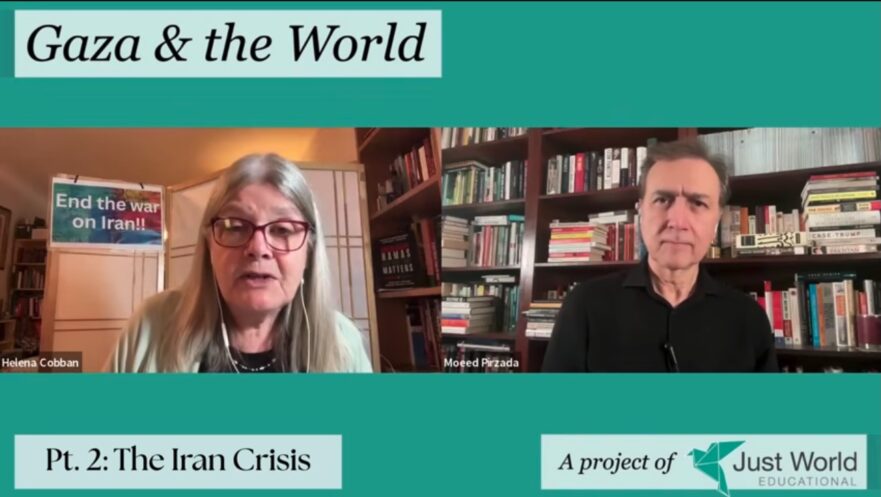
“We are expecting any new attack from both Israel and United States anytime within the next 24 hours.” This was the somber warning voiced on the evening of April 23 (Washington DC time) by Dr. Moeed Pirzada, a prominent Pakistani journalist and analyst who has been following the fate of the Pakistan-brokered ceasefire efforts very closely.
Pirzada is the founder/editor of Global Village Space and is currently based in Washington DC. He was in a wide-ranging conversation with Just World Ed president Helena Cobban in the 15th episode of the project on the Iran Crisis that JWE launched back on February 25.
You can see the whole conversation on Youtube, here. The audio is on Apple Podcasts and Spotify. Or you can download the complete transcript here. Here is a summary of the main points they discussed:
The Ceasefire That Wasn’t
Pirzada broke down the deep confusion surrounding the so-called ceasefire. Trump, he said, sent contradictory signals, insisting he was in no rush for a deal while simultaneously maintaining a naval blockade of Iran, which both sides interpreted very differently. Iran did not consider the blockade a ceasefire at all. Pirzada also noted that Trump had publicly rejected a peace proposal that would have acknowledged Iranian sovereignty over the Strait of Hormuz.
Military Buildup and the Threat of Renewed Hostilities
Pirzada noted that the USS George H.W. Bush completed a longer-than-usual journey and took up position in the Persian Gulf, while the USS Gerald Ford returned to the Red Sea. Israeli Defense Minister Israel Katz signalled readiness to resume hostilities at any moment. Pirzada specifically mentioned the possibility of surgical strikes targeting IRGC leadership as a scenario designed to give Trump political cover for a new round of negotiations.
Iran’s Strait of Hormuz Strategy
Iran seized two oil tankers registered in Greece and Switzerland and imposed a system of coordination requirements and fees on vessels passing through the Strait. Pirzada explained that Iran was not technically blocking the Strait but asserting administrative control over it.
Pakistan’s Complicated Role
Pirzada argued that Islamabad functioned less as a genuine mediator and more as a facilitator that gives Trump diplomatic cover each time he needs to walk back an escalatory threat. Pakistan’s dependence on U.S.-aligned financial institutions severely limits its room to maneuver, he said.
At the same time, the recent deployment of roughly 13,000 Pakistani troops and an Air Force squadron to King Abdulaziz Air Base in Saudi Arabia placed Pakistan in the awkward position of mediating a conflict while being aligned with one of its combatants.
China’s Strategic Patience
Pirzada described China as deliberately staying on the sidelines. Despite Pakistan’s efforts to bring Beijing into the negotiation process, China issued only minimal public statements and declined to participate formally. Pirzada interpreted this as part of a longer-term Chinese strategy to build economic alternatives to the dollar-dominated financial system, while avoiding entanglement in a crisis that could strengthen Washington’s hand.
The Petrodollar and the Dollar’s Grip
Pirzada explained how the dollar clearing system and secondary sanctions had left Iran with tens of billions of dollars in frozen payments from countries including Iraq, India, and China. He discussed the desire among many nations to reduce dollar dependence while acknowledging that unseating the dollar remained enormously difficult given how deeply entrenched the system was.