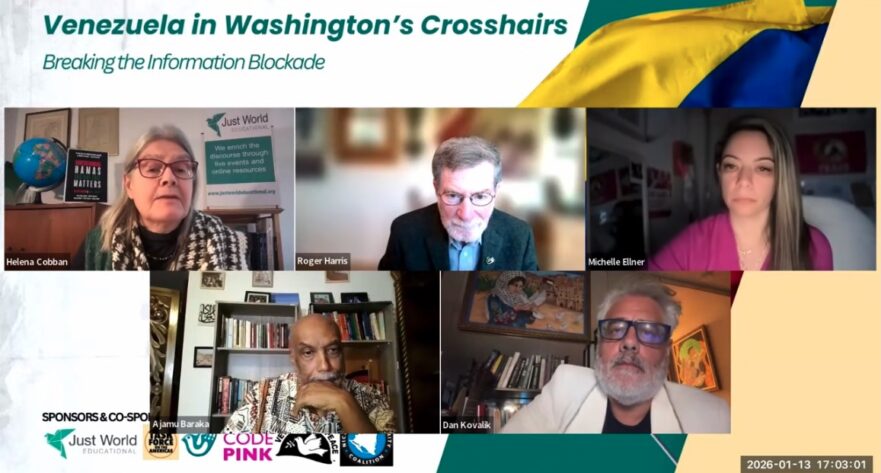
On January 13, Michelle Ellner of CodePink, international rights lawyer and author Dan Kovalik, and Ajamu Baraka of Black Voices for Peace wrapped up our timely series of three webinars on Venezuela with a forceful, very informative, and wide-ranging discussion.
The co-moderators Roger Harris of the Task Force on the Americas and JWE president Helena Cobban gave each speaker 15 minutes to make a main presentation, then conducted a more interactive portion that included some of the questions posted from a “live” webinar audience that numbered in the hundreds.
You can watch the whole of this 90-minute conversation here on YouTube. The multimedia records of this conversation (audio, transcribed, and video) can also now all be found, along with the records of the two earlier webinars, at this Online Learning Hub on the JWE website.
Michelle Ellner led off the session by describing the intense jolt of surprise and fear she had felt when she first learned of the violent operation Pres. Trump initiated in the early morning of January 3, to snatch and abduct Venezuela’s President Nicoláas Maduro and First Lady Cilia Flores from their home in Caracas. “I couldn’t believe that one country was capable of just… going to my country, invading or bombing and kidnapping a sitting president,” she said.
She then gave a good description of the trajectory of the 1823 “Monroe Doctrine”, under which Washington claimed “exclusive jurisdiction” over the affairs of the whole hemisphere. (The formal title of our webinar was “Exploring the ‘Donroe’ Doctrine.”)
Ellner gave a strong critique of Trump’s claims that Venezuela was a “narco-state.” She noted that,
The opioid crisis has caused real pain to American families in this country. Families have lost loved ones due to the drugs, communities have been devastated. So when officials link Venezuela to drug cartels, they are, you know, basically tapping into that grief and anger… And it’s really powerful, because it’s weaponizing the fear and the trauma and the loss, to manufacture the consent that they need from the American people to coercion, to military action, without any proof.
She closed with a strong reminder that Venezuela’s people were determined to fight for their sovereignty, and urged listeners to support the then-current push by many U.S. senators to get the Senate to pass a resolution that would force Pres. Trump to get formal Senate approval for any further use of force against Venezuela. (That measure was later defeated, by one vote.)
Dan Kovalik was up next. He gave a quick survey of Venezuela’s history, from the time when it was effectively a U.S. dependency– “not a banana republic, but an oil republic”, through the Chavista Revolution of 1998. He described the many achievements of the Chavista era, in terms of infrastructure, social programs– and also democracy:
In the first year of Chavez’s presidency, 1999, he convened a constitutional assembly to rewrite the constitution. People from around Venezuela were able to contribute to the substance of the constitution. It was approved by referendum… It created an elaborate electoral structure that guaranteed reliability and accountability and verification for elections.
Remember that in 2012, former President Jimmy Carter would say that Venezuela had the best electoral system in the world. These are facts that go against the claim that somehow Chavez was a dictator and Maduro was a dictator. In fact, it’s just the opposite.
He surveyed the history of the increasingly severe, unilateral economic sanctions that Washington has inflicted on the country, starting in the Obama era and then more severely in Trump’s first presidency. He cited estimates that between 2017 and 2019, U.S. sanctions were responsible for 100,000 excess deaths in Venezuela. He also underlined the coercive intention of the U.S. sanctions: “There’s no greater interference in an election than another country like the United States putting a gun to the heads of the voters… and saying, if you vote the wrong way, we’re going to continue these sanctions that are killing you.”
(At one point later in the conversation, Ajamu Baraka made the important point that: “One cannot be anti‑war unless you also are anti‑sanctions… Sanctions are a form of warfare.”)
Kovalik noted the many links between Trump’s forceful bulldozing of laws and norms in the international arena with the analogous actions he has taken in the domestic arena, concluding with this:
When you can just murder fishermen in the Caribbean on the mere allegation that they’re drug traffickers, then there’s nothing to prevent that force from murdering Americans and detaining Americans without due process. And that’s exactly what we’re seeing. So the need to resist is important, not just for Latin America and the Caribbean, but for the United States, for the people of the United States.
For his part, Ajamu Baraka located Trump’s assault against Venezuela within the lengthy record of U.S. aggressivity abroad and at home, but he assessed that the era of U.S. global hegemony is coming to an end (or anyway, becoming notably curtailed.) “What we have with the targeting of Venezuela is part of their desperate strategy, that they recognize that their ability to try to maintain and even expand global hegemony is limited,” he said.
He assessed that Trump’s primary goal was to “shore up its base” in the Western Hemisphere. But he added that there was a secondary objective:
To push out the Chinese, if possible, and to focus their full weight of their repressive apparatus on the Cubans and eventually again on Nicaragua. They declared, again, national and class war… What we are seeing in my friends is the consolidation of global fascism. Global fascism.
He noted that one clear aspect of this was Washington’s intensified push, under Trump, to sideline and render completely irrelevant all the institutions of the United Nations, making an explicitly and powerful connection between the UN Security Council’s adoption on November 17 of Trump’s entire– and very coercive– “peace plan” for Gaza and the UN’s complete impotence over Venezuela.
During the interactive portion of the conversation, the speakers discussed a broad range of issues, including:
- The history and record of the colectivos inside Venezuela,
- The role (or the potential, or already foregone role) that various international bodies like the UN, the OAS, or CELAC might play ion bolstering Venezuela’s sovereignty,
- The (unsurprising) fact that within the Chavista coalition there are several differences of opinion, though these get resolved through internal debate, and
- The potential role that BRICS institutions like the BRICS Bank might be able to play to help shore up Venezuela’s economy.
At the end of the webinar, Ajamu Baraka issued an impassioned appeal for listeners to support some key projects spearheaded by the Black Alliance for Peace, including one to demand that FIFA pull the upcoming World Cup games out of the USA, “because of its international criminality, because the U.S. is an unsafe place for fans and teams, because of its support for genocide in Gaza.”
He closed with this:
We leave here with the knowledge that organized, connected, and coordinated, we definitely can win. Thank you. Venceremos!